
Blade Application Guides / Application Guide / plastics recycling
Granulating Plastic Scrap and Regrind
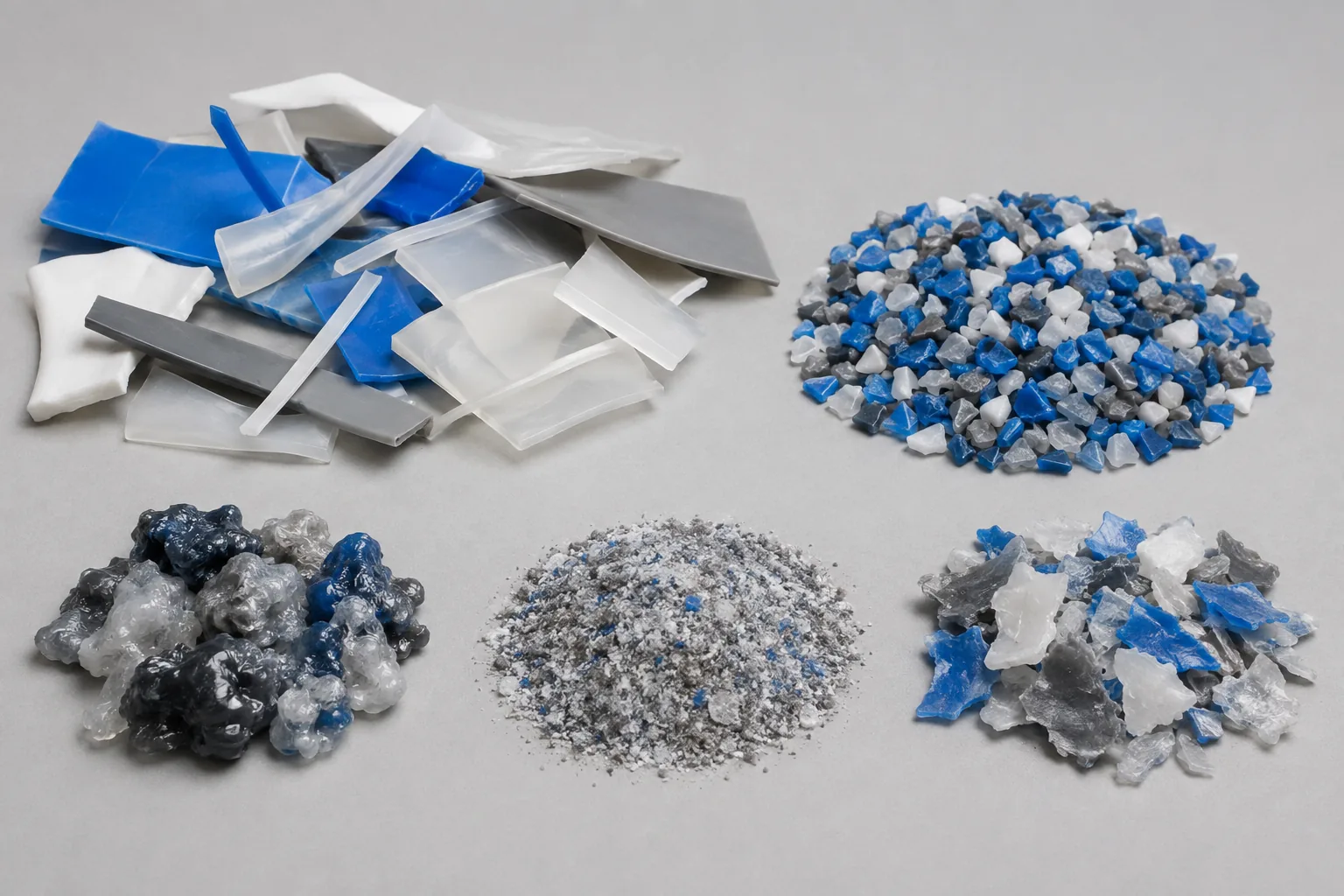
Plastic scrap and regrind can arrive as runners, molded parts, purgings or mixed already-reduced pieces. Record resin family only when known, then describe feed geometry, contamination and temperature condition without assuming one lot represents the next. A granulator knife review should separate feed variation, cutting-interface condition and screen recirculation before changing knife material or edge geometry.
Updated
Where This Cutting Application Appears
Injection-molding sprue recovery
Reduces runners and rejected parts into feedstock sized for the plant's controlled regrind stream.
Extrusion edge-trim granulation
Processes continuous trim or chopped web waste without wrapping it around the rotor.
Mixed rigid-scrap size reduction
Handles sorted molded parts whose wall thickness and impact response vary within a batch.
Granulation And Size Reduction process boundary
granulation and size reduction for plastic scrap and regrind feed is a linked sequence: the output condition and datum from each operation become the controlled input for the next. It should not be evaluated as one generic cut or accepted only by the final dimension.
Granulation And Size Reduction setup checkpoint
For plastic scrap and regrind feed, define the operation order, intermediate dimensions, registration transfer, material support, web or part handling and waste route for every stage of granulation and size reduction.
Granulation And Size Reduction acceptance checkpoint
Verify both intermediate and final results from granulation and size reduction, including dimensions, registration, edge or feature quality, material damage, waste separation and stable transfer between stages.
Define the Required Cut Result
- Consistent regrind through the selected screen
- Low heat and melted deposits
- Controlled fines and dust
- Predictable knife-gap maintenance
Problems to Diagnose Before Changing the Knife
Melted or glazed regrind
- Record chamber temperature and feed rate
- Inspect knife gap and edge recession
- Check screen blockage and rotor ventilation
Too many fines
- Separate brittle feed from ductile feed
- Review screen-hole size and residence time
- Inspect repeated impacts caused by dull edges
Oversize flakes
- Look for damaged or plugged screen areas
- Measure rotor-to-bed-knife gap
- Check whether bulky feed is bouncing above the cutting circle
Localized knife damage
- Audit metal and mineral contamination
- Map chips to rotor position
- Check fastener seating and knife support
Plastic regrind granulation: separate feed, cutting and screen causes
Use labeled input and output samples from the same interval so a changing scrap mix is not misdiagnosed as knife wear.
Output shifts when the runner, part or purge mix changes
Sort input by geometry and known resin family, then compare each sub-stream at the same feed setting. Record hard inclusions and unusually thick pieces before judging the knife.
Tails, fused edges or load rise appear at every feed condition
Inspect rotor and bed-knife seating, clearance by position, edge condition, screen blockage and discharge. A local seat or clearance problem may resemble general dulling.
Fines increase while oversize continues to recirculate
Classify a fixed-mass output sample, inspect the screen for damage or bypass and record residence or recirculation behavior before selecting a smaller opening.
Acceptance Criteria for a Controlled Trial
Agree how the trial will be judged before changing the knife or machine setting.
- Use a documented representative mix and record any excluded metal, glass, mineral or unknown inclusions.
- Classify a fixed-mass discharge sample into agreed oversize, target and fines bands.
- Record tails, fused pieces, temperature trend, recirculation and abnormal load events over a fixed interval.
- Photograph labeled rotor and bed-knife positions before and after the trial and note localized edge or seat marks.
Knife Forms That May Be Considered
| Possible knife form | When it may be considered | What must be confirmed |
|---|---|---|
| rotor granulator knives | Bolted moving knives provide the primary scissor action and must match the rotor pocket, rotation and resharpening allowance. Treat the rotor and bed knife as a matched interface; confirm seats, bolt pattern, projection, adjustment range and screen before choosing an edge geometry. | Confirm the final geometry and mounting from the granulator rotor, an unworn sample or an approved drawing before manufacture. |
| stationary bed knives | A rigid counter-edge establishes the working gap and supports clean shearing across the rotor width. | Confirm the final geometry and mounting from the granulator bed-knife seat, an unworn sample or an approved drawing before manufacture. |
| segmented rotor knives | Individual segments may suit rotors designed for replaceable sections or staggered cutting loads, but segment layout is equipment-specific. | Confirm the final geometry and mounting from the segmented granulator rotor, an unworn sample or an approved drawing before manufacture. |
Information to Send for Technical Review
You do not need to know the exact blade name. Send the available workpiece, machine, current-knife and cut-result information so the application can be reviewed against a drawing or sample.
- Scrap source, known resin families, runner/part/purge mix and allowable lot variation
- Largest feed dimensions, wall-thickness range, temperature condition and bulk presentation
- Metal, glass, mineral, dust or other contamination controls before granulation
- Required oversize, target and fines bands plus the downstream use or inspection method
- Granulator make or model, rotor arrangement, rotation and bed-knife adjustment method
- Rotor knife, bed knife, clamp, seat and screen drawings with used-part photographs
- Screen opening, rotor speed, feed rate, recirculation and temperature records
- Accepted and rejected output samples from the same documented feed condition
Related Recycling Knife and Service Pages
Questions About This Cutting Application
Why is the regrind warm or partly melted?
Long residence, restricted screening, excessive rubbing or an unsuitable knife gap can generate heat; log temperature and load before changing geometry.
Do smaller screen holes always make finer, cleaner regrind?
They reduce the exit size but may increase residence time, fines and heat if throughput is not adjusted.
What causes long strips instead of regular flakes?
Flexible feed can bridge, wrap or pass an excessive knife gap; identify the scrap form and where the strips first appear.
Can a chipped knife be resharpened and returned to service?
That depends on crack extent, remaining section, balance and the manufacturer's minimum dimensions; a photograph alone is not enough.
Which sample best supports a knife review?
Provide representative feed plus regrind from acceptable and faulty runs, with screen size, gap and operating condition recorded.
Public references and scope
These public sources provide material, cutting-method or safety context for this guide. Supplier pages describe their own materials or equipment; they do not establish a MEIRENTE blade specification or performance claim. Confirm the actual grade, machine setup and required cut with a drawing or sample.
Related product and service information
- Cutting Post-Consumer Plastic Film for Recycling - post-consumer plastic film · film shredding and granulation
- Washed PET Bottle Flake Cutting - washed PET bottle flakes · flake size reduction
- Waste Tire Rubber Size Reduction - waste tire rubber · shredding and granulation
Request a Custom Cutting-Knife Review
Send the workpiece details, machine or holder information, current knife photos or sample, required quantity and examples of the present cut problem. Final dimensions, material, edge geometry and tolerances are confirmed from the approved requirements.