
Blade Application Guides / Application Guide / rubber recycling
Waste Tire Rubber Size Reduction
Waste tire reduction is a staged, mixed-material process involving rubber, steel reinforcement and textile. The RFQ must identify whether the machine receives whole tires, tire sections or pre-shredded chips and whether bead or wire removal has already occurred. Knife selection and acceptance should match that specific stage and the required downstream fraction.
Updated
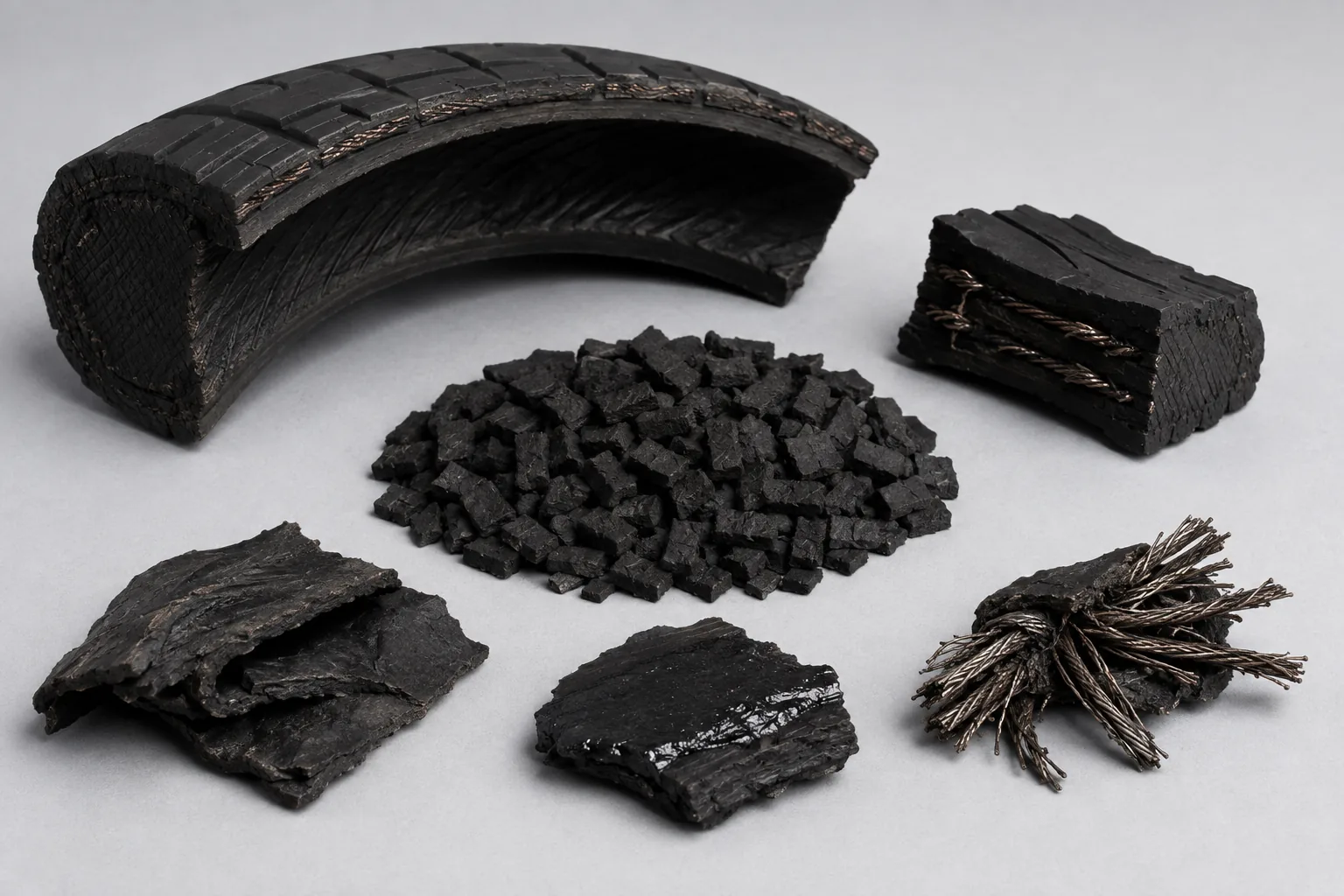
Where This Cutting Application Appears
Primary tire sectioning
Open or divide whole or debeaded tires into pieces that can enter a downstream shredder.
Secondary tire-chip reduction
Reduce pre-shredded rubber containing declared reinforcement to a smaller controlled feed.
Granulating metal-reduced rubber
Produce crumb-range material after steel-removal stages, subject to the customer's screen and separation system.
Shredding And Granulation process boundary
shredding and granulation for waste tire rubber is a linked sequence: the output condition and datum from each operation become the controlled input for the next. It should not be evaluated as one generic cut or accepted only by the final dimension.
Shredding And Granulation setup checkpoint
For waste tire rubber, define the operation order, intermediate dimensions, registration transfer, material support, web or part handling and waste route for every stage of shredding and granulation.
Shredding And Granulation acceptance checkpoint
Verify both intermediate and final results from shredding and granulation, including dimensions, registration, edge or feature quality, material damage, waste separation and stable transfer between stages.
Define the Required Cut Result
- Reliable cutting through elastic rubber without persistent fold-over
- Impact tolerance matched to declared steel or foreign material
- Controlled chip size with limited recirculation heat
- Even wear across matched rotor and stationary edges
Problems to Diagnose Before Changing the Knife
Rubber folds through the gap without separating
Review knife clearance, edge geometry, feed size, rubber temperature and whether pieces are adequately captured.
Edges chip at steel contact points
Confirm bead or cord content, upstream removal, impact location, rotor alignment and overload events.
Rubber smears or heats in the chamber
Check dullness, excessive recirculation, screen restriction, feed rate and cooling or ventilation.
One knife position wears faster
Inspect feed distribution, rotor runout, local clearance, trapped steel and seat condition.
Waste tire reduction: identify stage, reinforcement and liberation defects
Do not use one “tire shredder blade” specification across primary cutting, granulation and fine reduction.
Whole tires or large sections stall, bounce or cut unevenly
Confirm feed orientation, tire range, bead condition, cutter engagement, counterknife position and whether the machine is designed for this incoming stage.
Steel cords pull into long exposed wires or cause local edge damage
Map the wire event to tire construction and knife position. Inspect seats, clearance and local chipping before assuming general abrasive wear.
Rubber granulate carries excessive textile or steel
Compare the output with the next separation step, screen or classifier condition and the preceding reduction stage. Smaller particles alone may not improve liberation.
Acceptance Criteria for a Controlled Trial
Agree how the trial will be judged before changing the knife or machine setting.
- Define the tire types, size range, bead status and upstream cutting already completed.
- Measure the agreed chip or granule distribution with oversize and fines from a fixed sample.
- Record exposed steel length, textile carryover and misplaced material using the downstream inspection method.
- Track temperature, load events and labeled knife-edge damage over a fixed controlled interval.
Knife Forms That May Be Considered
| Possible knife form | When it may be considered | What must be confirmed |
|---|---|---|
| shredder knife | A robust shredder knife may suit primary tearing where large pieces and intermittent impacts are expected. Match hooked cutters, counterknives or granulator rotor/bed knives to the documented reduction stage; confirm the reinforcement path and machine drawing before selection. | Confirm shaft or rotor interface, hook/profile, cutting circle, fasteners, counter-knife relationship and declared metal content. |
| granulator rotor knife | A straighter rotor edge may suit secondary reduction after feed size and reinforcement are controlled. | Confirm rotor drawing, knife seat, cutting angle, bed-knife clearance, screen and maximum input piece. |
| stator knife | A stationary counter-edge completes the shear and determines working clearance. | Confirm length, section, datum, adjustment, support and matched rotating-tool geometry. |
Information to Send for Technical Review
You do not need to know the exact blade name. Send the available workpiece, machine, current-knife and cut-result information so the application can be reviewed against a drawing or sample.
- Tire types and size range, whole/section/chip feed condition and allowable mix
- Bead, steel-cord and textile construction plus removal or separation already completed
- Required output bands and limits for exposed wire, textile, oversize and fines
- Named downstream granulation, separation, cleaning or final-use requirement
- Machine make or model, reduction stage, shaft or rotor arrangement and rotation
- Cutter, counterknife, spacer, holder and screen drawings with used-part photographs
- Feed rate, speed, reversals, load and temperature observations
- Accepted and rejected tire-chip or granulate samples from the same feed definition
Related Recycling Knife and Service Pages
Questions About This Cutting Application
Why must the tire-processing stage be identified?
Whole tires and metal-reduced rubber impose very different impact, capture and size-control duties.
Can harder knife material prevent steel-impact chipping?
Not automatically. Higher hardness can reduce toughness; first address steel control, support and impact geometry.
What causes rubber to smear instead of shear?
Heat, dull edges, wide clearance and repeated circulation can soften and deform the rubber.
Does a smaller screen always improve crumb size?
It can increase residence time, heat and wear. Evaluate screen, feed rate and knife condition together.
What evidence helps diagnose localized damage?
Map each chip to rotor position and compare feed, trapped metal, seat contact, runout and clearance records.
Public references and scope
These public sources provide material, cutting-method or safety context for this guide. Supplier pages describe their own materials or equipment; they do not establish a MEIRENTE blade specification or performance claim. Confirm the actual grade, machine setup and required cut with a drawing or sample.
Related product and service information
- Wind Turbine Composite Scrap Bale Cutting Blades - wind turbine composite scrap · bale cutting
- Granulating Plastic Scrap and Regrind - plastic scrap and regrind feed · granulation and size reduction
- Cutting Post-Consumer Plastic Film for Recycling - post-consumer plastic film · film shredding and granulation
Request a Custom Cutting-Knife Review
Send the workpiece details, machine or holder information, current knife photos or sample, required quantity and examples of the present cut problem. Final dimensions, material, edge geometry and tolerances are confirmed from the approved requirements.