
Blade Application Guides / Application Guide / plastics recycling
Washed PET Bottle Flake Cutting
Washed PET bottle flakes may still vary in moisture, thickness, shape and residual label, closure or foreign-polymer content. The knife trial should preserve that feed information and judge the output by a measured flake distribution and downstream requirement. A nominal screen opening does not by itself prove an accepted PET flake cut.
Updated
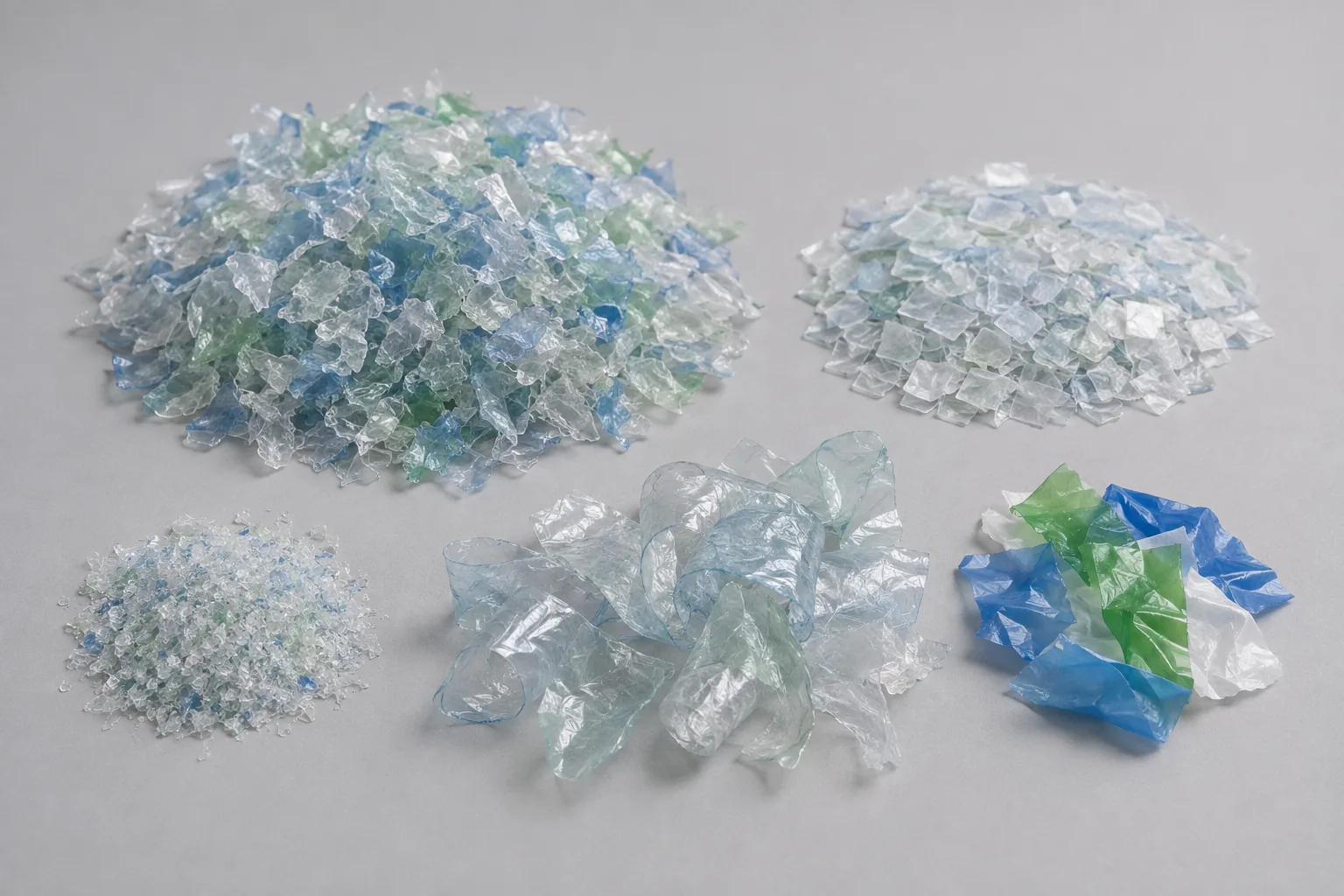
Where This Cutting Application Appears
Reducing oversized washed flakes
Return pieces above the customer's target range to a granulator before drying or further processing.
Conditioning mixed bottle-wall and neck flakes
Cut variable-thickness PET pieces while monitoring the effect of denser neck sections.
Processing flakes with residual labels
Handle declared paper or polymer label remnants without treating uncontrolled foreign material as normal feed.
Flake Size Reduction process boundary
flake size reduction for washed PET bottle flakes is planned around controlled feed-size reduction, with the required output range and downstream separation step defined before equipment selection; it is not a finished-dimension cut or an unspecified one-stage crushing operation.
Flake Size Reduction setup checkpoint
For washed PET bottle flakes, confirm incoming form and maximum size, contamination, target particle range, throughput, heat control and the screen or classification route.
Flake Size Reduction acceptance checkpoint
For washed PET bottle flakes, evaluate output-size distribution, oversize return, fines, contamination release, temperature, throughput stability and suitability for the next recovery stage.
Define the Required Cut Result
- Controlled flake-size distribution with limited fines
- Consistent shear through curled and variable-thickness pieces
- Stable clearance as abrasive residue wears the edges
- Low incidence of impact chips from managed contaminants
Problems to Diagnose Before Changing the Knife
Too many fines are generated
Review edge condition, rotor speed, repeated circulation, screen size, brittleness and feed moisture.
Oversized flakes remain in the output
Check screen damage, knife clearance, rotor/stator overlap, feed rate and whether curled pieces evade engagement.
Wear concentrates at one part of the bed knife
Inspect feed distribution, rotor alignment, local clearance, screen flow and contamination path.
Knife chips appear after sorting failures
Identify glass, metal or stones and correlate impact marks with separator and inspection records.
Washed PET flake: distinguish feed carryover, cutting defects and screen effects
Use traceable feed and discharge samples so fines or oversize are not attributed to the knife without evidence.
Fines or powder change with flake source or dryness
Record moisture, flake thickness and bottle-stream carryover for each lot. Compare the same knife setting with labeled feed samples before changing geometry.
Long flakes or tails remain after repeated passes
Inspect rotor and bed-knife clearance by position, edge condition, knife seating, feed loading and screen bypass or damage.
Output size is acceptable but downstream quality rejects the lot
Check residual labels, closures, foreign polymers and the downstream washing, sorting or extrusion acceptance method; cutting cannot correct an unsuitable feed composition.
Acceptance Criteria for a Controlled Trial
Agree how the trial will be judged before changing the knife or machine setting.
- Document moisture, residual label/closure carryover and the representative washed-flake lot.
- Measure oversize, target flake and fines fractions from a fixed-mass sample.
- Record tails, powder, temperature and recirculation without substituting screen size for inspection.
- Confirm that the labeled output sample is accepted by the named sorting, drying or extrusion step.
Knife Forms That May Be Considered
| Possible knife form | When it may be considered | What must be confirmed |
|---|---|---|
| rotor knife | A rotor knife can provide repeated shearing of irregular flakes against a fixed edge. Review rotor and bed knives as a matched pair and confirm mounting, adjustment and screen interface before discussing edge angle or material. | Confirm rotor body, seat, cutting circle, bolt pattern, rotation and maximum regrind limit from the machine drawing. |
| stator knife | A fixed knife establishes the counter-edge and working clearance for flake reduction. | Confirm length, section, datum, adjustment direction and matched rotor clearance across the full width. |
Information to Send for Technical Review
You do not need to know the exact blade name. Send the available workpiece, machine, current-knife and cut-result information so the application can be reviewed against a drawing or sample.
- Washed PET flake source, thickness and shape range, moisture and allowable lot variation
- Residual labels, closures, metals, glass and known foreign-polymer controls
- Incoming and required output size bands with fines and oversize limits
- Downstream sorting, drying, crystallizing or extrusion step and its sample method
- Granulator make or model, rotor arrangement, bed-knife position and clearance procedure
- Rotor knife, bed knife, holder, clamp and screen drawings with used samples
- Screen opening, rotor speed, feed rate, recirculation and temperature observations
- Paired accepted and rejected flake samples from traceable feed lots
Related Recycling Knife and Service Pages
Questions About This Cutting Application
Why can sharper knives still create excessive PET fines?
Rotor speed, recirculation, screen and brittle feed can dominate. Compare the full process settings with particle distribution.
Do washed flakes still cause abrasive wear?
They can retain fine mineral contamination. Describe washing and separation, and inspect the wear surface rather than assuming clean feed.
What makes curled flakes difficult to reduce?
They may flex or orient through a gap without being captured. Rotor engagement, clearance and screen circulation all matter.
Can output size be inferred from the knife dimensions?
No. Screen, rotor, feed rate and recirculation also shape the distribution; provide representative sieve or size data.
What indicates a clearance problem?
Long polished edges, uneven wear, oversized output or rising load may be clues, but clearance should be measured along the knife length.
Public references and scope
These public sources provide material, cutting-method or safety context for this guide. Supplier pages describe their own materials or equipment; they do not establish a MEIRENTE blade specification or performance claim. Confirm the actual grade, machine setup and required cut with a drawing or sample.
Related product and service information
- Waste Tire Rubber Size Reduction - waste tire rubber · shredding and granulation
- Granulating Plastic Scrap and Regrind - plastic scrap and regrind feed · granulation and size reduction
- Cutting Post-Consumer Plastic Film for Recycling - post-consumer plastic film · film shredding and granulation
Request a Custom Cutting-Knife Review
Send the workpiece details, machine or holder information, current knife photos or sample, required quantity and examples of the present cut problem. Final dimensions, material, edge geometry and tolerances are confirmed from the approved requirements.