
Blade Application Guides / Application Guide / frozen food processing
Frozen Meat Block Portioning
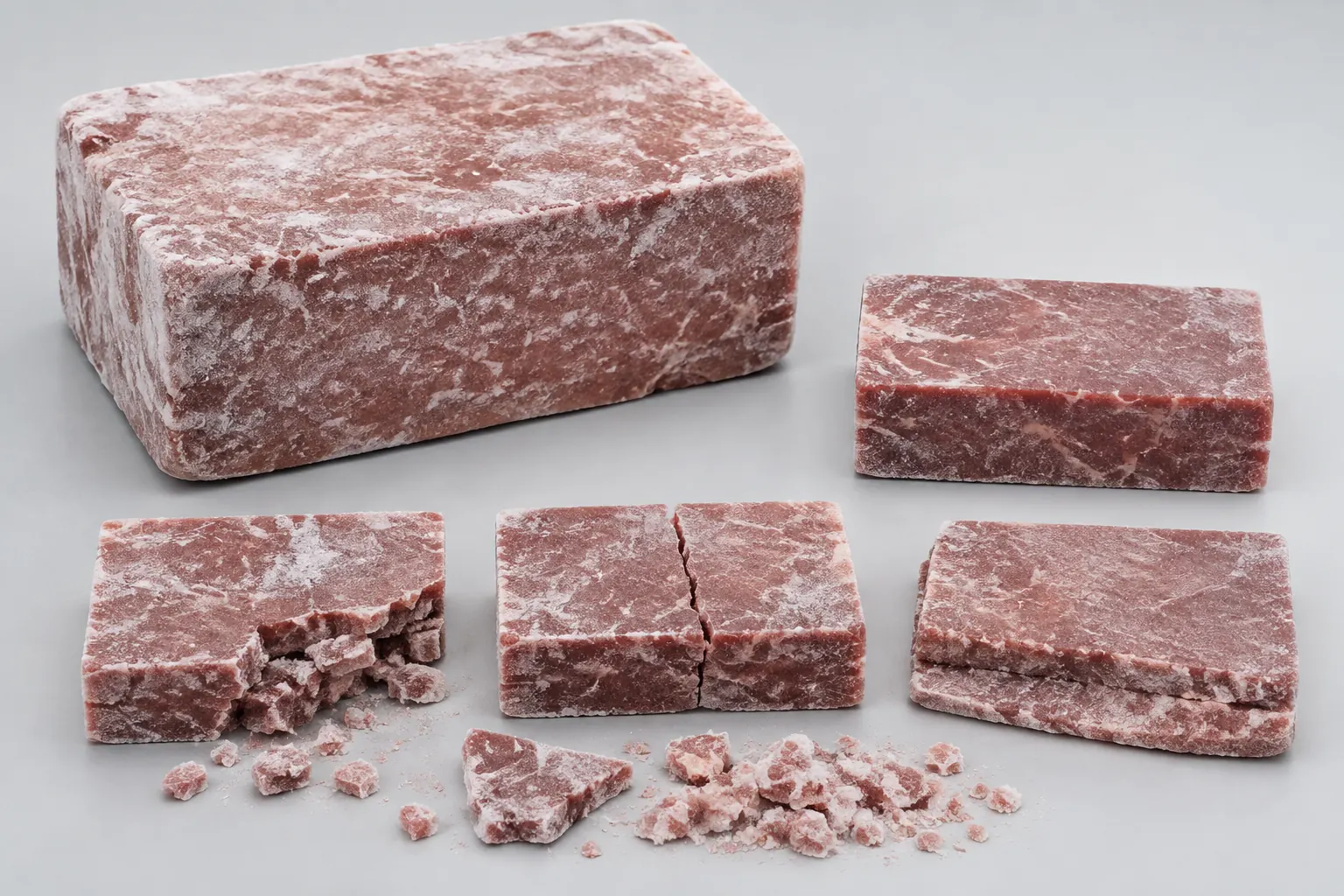
Frozen meat blocks combine high cutting resistance with temperature-dependent brittleness. Portioning decisions should account for block temperature, bone content, surface frost, support and the machine's cutting motion; forcing an unsuitable edge can fracture the portion or overload the holder.
Updated
Where This Cutting Application Appears
Dividing frozen boneless blocks
Create manageable portions for thawing, grinding or further processing while limiting uncontrolled fractures.
Sizing formed meat logs
Cut frozen or tempered logs into consistent sections before slicing or packaging.
Breaking down mixed-content blocks
Handle blocks that may contain fat layers, connective tissue or permitted bone, with the actual composition declared before knife selection.
Block Portioning process boundary
block portioning for frozen meat blocks is planned around division to a specified serving, mass, geometry or count target rather than uniform-thickness slicing alone; it is not broad slicing, strip production or multidirectional dicing without a portion specification.
Block Portioning setup checkpoint
For frozen meat blocks, confirm portion target, product temperature, orientation, presentation, indexing, restraint and yield allowance.
Block Portioning acceptance checkpoint
For frozen meat blocks, evaluate portion mass or geometry, cut-face quality, product loss, incomplete separation and repeatability for packing or serving.
Define the Required Cut Result
- Controlled fracture at the intended cutting plane
- Repeatable portion mass and thickness
- Limited fines, shards and broken corners
- No avoidable knife chipping or holder overload
Problems to Diagnose Before Changing the Knife
The block fractures ahead of the cut
Check core and surface temperature, internal voids, support span, cutting speed and whether the edge wedges the block apart.
Frozen product sticks to the knife
Review frost, surface melt, blade finish, dwell time, release motion and temperature changes during the run.
Knife edges chip after impact
Determine whether bone, clips or hard contaminants are present; inspect alignment, shock loading and previous regrinding.
Portion thickness varies
Check block location, stop position, product squareness, deflection under load and recovery between strokes.
Knife Forms That May Be Considered
| Possible knife form | When it may be considered | What must be confirmed |
|---|---|---|
| serrated straight knife | Progressive tooth engagement can reduce the initial load on some frozen blocks and help start through a hard surface. | Confirm tooth geometry, stroke, holder stiffness and the actual frozen product by trial; serration is not automatically suitable for bone-bearing blocks. |
| band knife | A continuous band may suit steady slicing where the machine guides and tensions the band around a supported block. | Confirm band width, thickness, length, tooth form, wheel interface and allowable product condition from the equipment documentation. |
| guillotine knife | A heavy straight knife can suit indexed block division when the machine supplies rigid support and adequate stroke. | Confirm bevel, section, mounting, counter-surface and maximum block condition from an approved machine drawing. |
Information to Send for Technical Review
You do not need to know the exact blade name. Send the available workpiece, machine, current-knife and cut-result information so the application can be reviewed against a drawing or sample.
- Meat type and whether the block contains bone or foreign clips
- Core and surface temperature at the moment of cutting
- Block dimensions, shape, mass range and internal layering
- Target portion dimensions or mass tolerance
- Cutting motion: guillotine, band, rotary or another system
- Holder, guide and counter-surface drawings
- Current knife damage pattern and regrinding history
- Photos of fractures, fines, sticking and the full cut face
Questions About This Cutting Application
Is colder frozen meat always easier to cut cleanly?
No. Lower temperature may increase brittleness and cutting load. Provide the actual temperature range and fracture behavior.
Why are block corners breaking away?
Unsupported corners, internal voids, wedging action or excessive brittleness can redirect the fracture. Show the block orientation and broken surface.
Should bone-in blocks use the same knife as boneless blocks?
Do not assume so. Bone changes impact and fracture conditions and must be declared during technical review.
Can a serrated edge reduce cutting force?
It may change how the cut starts, but tooth form, product temperature and machine motion determine the result. A representative trial may be necessary.
What should be measured on a damaged knife?
Record the location and spacing of chips, bending, polished wear and mounting marks, then relate them to the product and stroke direction.
Related product and service information
- Leafy Vegetable and Herb Cross-Cutting - leafy vegetables and herbs · cross-cutting and chopping
- Cheese Block and Log Slicing - cheese blocks and logs · slicing and portioning
- Processed Fruit Slicing and Dicing - processed fruit pieces · slicing and dicing
Request a Custom Cutting-Knife Review
Send the workpiece details, machine or holder information, current knife photos or sample, required quantity and examples of the present cut problem. Final dimensions, material, edge geometry and tolerances are confirmed from the approved requirements.