
Blade Application Guides / Application Guide / dairy processing
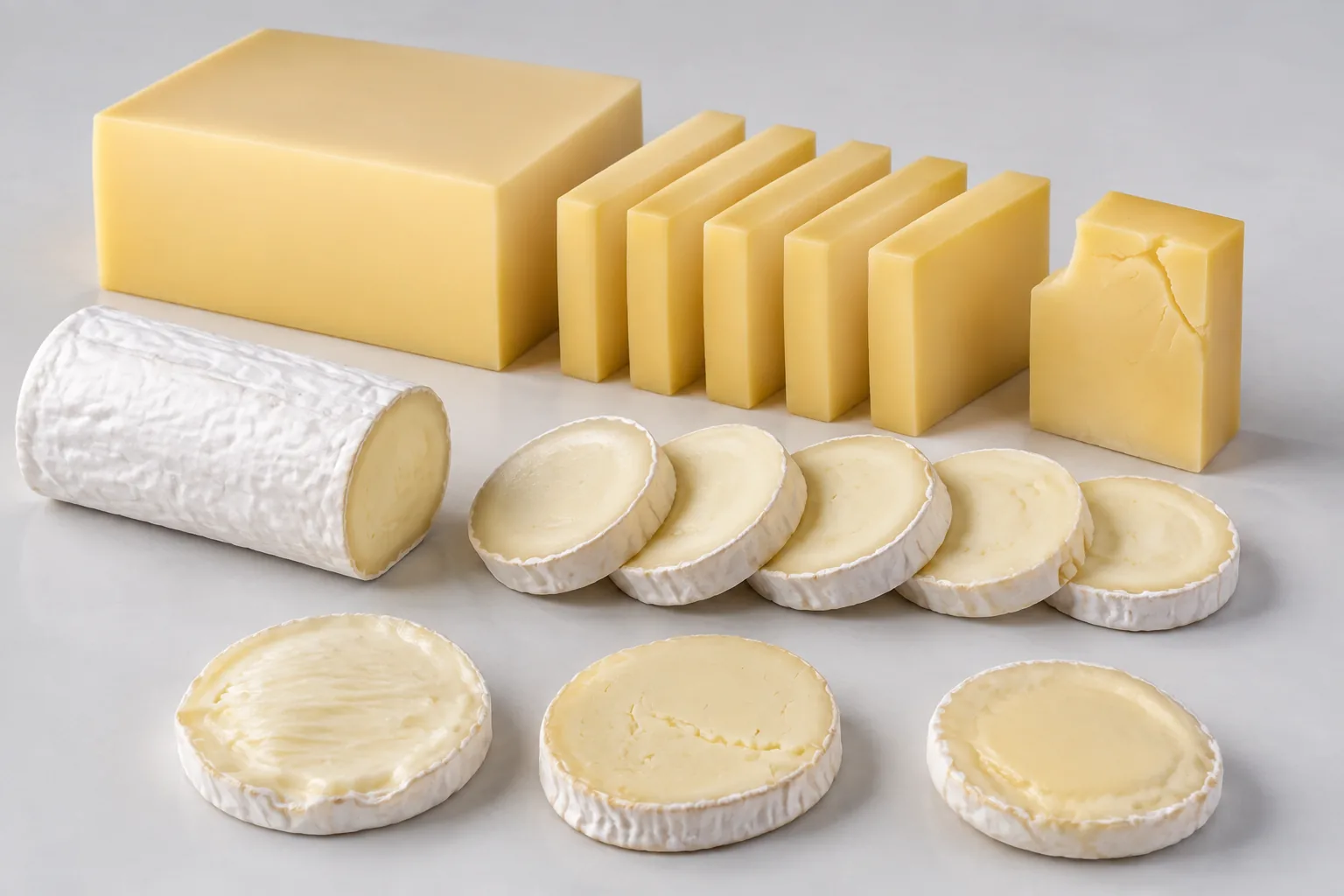
Cheese Block and Log Slicing
Cheese can range from firm and brittle to soft, elastic and adhesive, and its behavior changes with temperature and aging. Slicing a block or log therefore requires the edge finish, contact area, release path and product support to be evaluated together.
Updated
Where This Cutting Application Appears
Portioning firm cheese blocks
Divide matured blocks into retail or further-processing sizes while limiting cracks and broken corners.
Cutting soft cheese logs
Produce slices or sections without excessive compression, sticking or shape recovery after the cut.
Sizing processed cheese slabs
Make straight cross-cuts before wrapping, stacking or downstream dicing.
Slicing And Portioning process boundary
slicing and portioning for cheese blocks and logs is a linked sequence: the output condition and datum from each operation become the controlled input for the next. It should not be evaluated as one generic cut or accepted only by the final dimension.
Slicing And Portioning setup checkpoint
For cheese blocks and logs, define the operation order, intermediate dimensions, registration transfer, material support, web or part handling and waste route for every stage of slicing and portioning.
Slicing And Portioning acceptance checkpoint
Verify both intermediate and final results from slicing and portioning, including dimensions, registration, edge or feature quality, material damage, waste separation and stable transfer between stages.
Define the Required Cut Result
- Smooth cut faces without smear ridges
- Complete release from the knife after each cycle
- Repeatable thickness with limited product compression
- No uncontrolled cracking in firm or aged cheese
Problems to Diagnose Before Changing the Knife
Cheese accumulates on the blade face
Review product temperature, fat and moisture, surface finish, contact area, cleaning interval and release motion.
Soft cheese bulges before cutting
Check hold-down, support, edge thickness, approach angle and whether the feed stops fully before the stroke.
Firm cheese cracks beyond the cut line
Inspect cutting wedge, block temperature, internal openings, support span and corner condition.
Slices vary after leaving the station
Separate true cut-position error from elastic recovery; compare dimensions immediately after cutting and after settling.
Knife Forms That May Be Considered
| Possible knife form | When it may be considered | What must be confirmed |
|---|---|---|
| straight slicing knife | A smooth straight edge may suit blocks or logs when a slicing motion and controlled release are available. | Confirm blade section, bevel, surface finish, stroke and product temperature range with the holder drawing and cut samples. |
| wire-compatible cutoff knife | Some lines use a wire or a knife within a dedicated cutoff assembly to minimize contact on soft cheese. | Confirm the existing machine architecture; a wire-based station and a knife holder are not interchangeable without engineering approval. |
| serrated knife | A serrated profile may be evaluated for firm crusted products when progressive entry is beneficial. | Confirm whether tooth marks are acceptable and verify tooth geometry, sanitation and product release in trials. |
Information to Send for Technical Review
You do not need to know the exact blade name. Send the available workpiece, machine, current-knife and cut-result information so the application can be reviewed against a drawing or sample.
- Cheese type, composition and age at cutting
- Product temperature range and time outside controlled storage
- Block or log dimensions and natural variation
- Target portion size and when it is measured
- Surface rind, coating, inclusions or internal openings
- Machine motion, support and product-release method
- Current blade finish, edge style and cleaning schedule
- Samples or photos showing smear, cracking, sticking and recovery
Questions About This Cutting Application
Why does cheese stick even to a polished blade?
Adhesion also depends on temperature, moisture, fat, contact area and release motion. Surface finish alone may not solve the problem.
Should soft cheese be cut colder?
Cooling may improve shape retention, but it can change texture or create other process issues. Define the permitted product-temperature window.
What causes a slice to become thicker after cutting?
Elastic recovery can make the final dimension differ from the knife position. State when and how thickness is inspected.
Can a serrated knife be used on cheese?
It may be considered for particular firm products, but tooth marks, crumb generation and sanitation must be acceptable.
How do we specify the desired cut face?
Provide accepted and rejected samples under consistent lighting, and identify smear, drag lines, cracks and permitted surface texture.
Related product and service information
- Frozen Meat Block Portioning - frozen meat blocks · block portioning
- Leafy Vegetable and Herb Cross-Cutting - leafy vegetables and herbs · cross-cutting and chopping
- Processed Fruit Slicing and Dicing - processed fruit pieces · slicing and dicing
Request a Custom Cutting-Knife Review
Send the workpiece details, machine or holder information, current knife photos or sample, required quantity and examples of the present cut problem. Final dimensions, material, edge geometry and tolerances are confirmed from the approved requirements.