
Blade Application Guides / Application Guide / vegetable processing
Leafy Vegetable and Herb Cross-Cutting
Leafy vegetables and herbs are thin, wet and easily bruised, while stems can be much tougher than the leaves around them. Cross-cutting must keep the product mat evenly presented and complete separation quickly enough to avoid squeezing out moisture or dragging strands.
Updated
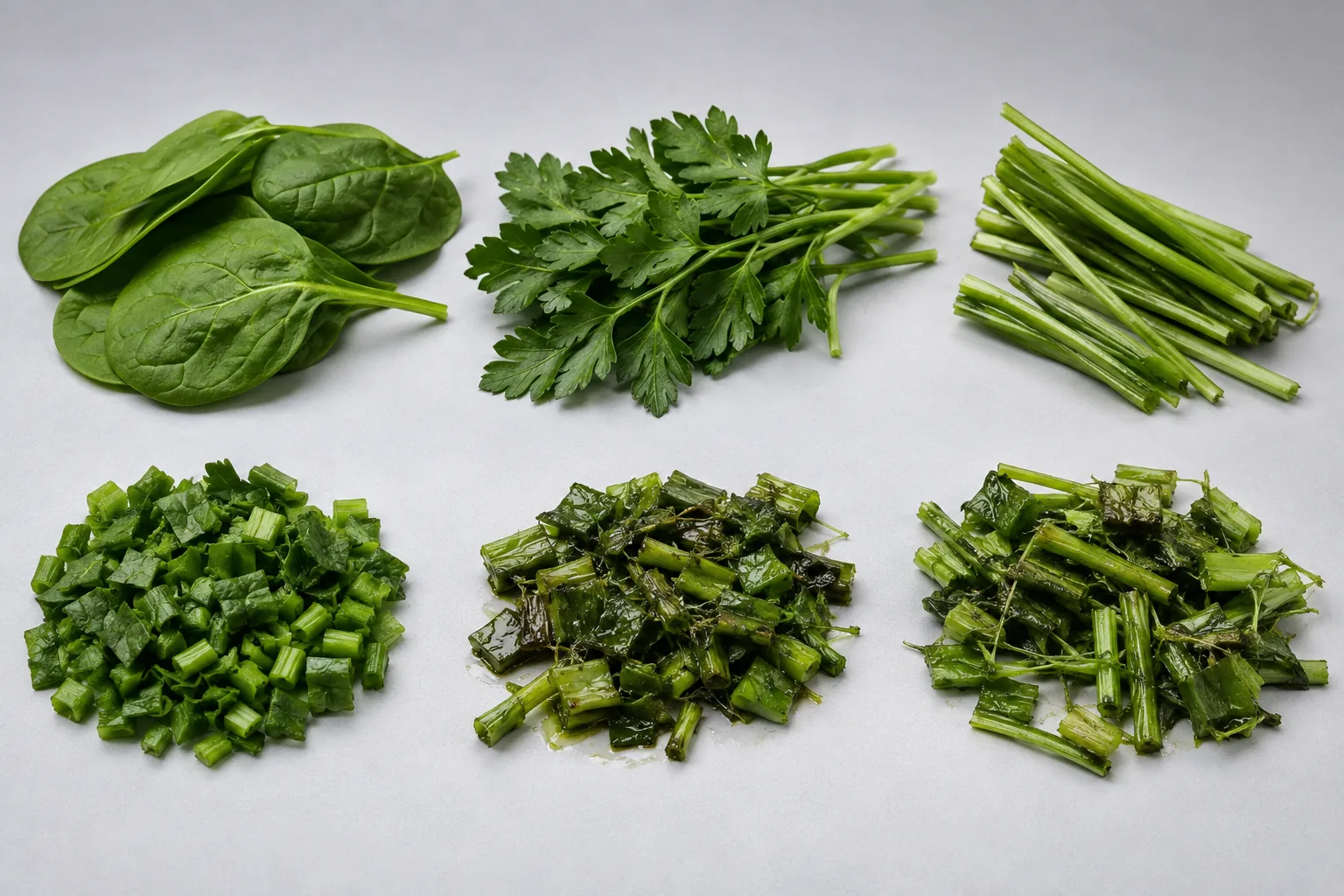
Where This Cutting Application Appears
Cutting salad greens to length
Cross-cut lettuce, cabbage leaves or mixed greens before washing, blending or packing.
Chopping culinary herbs
Produce short herb pieces while limiting darkened bruised edges and loss of aroma-bearing juices.
Processing mixed leaves and stems
Separate a variable product mat where tougher stems must be cut without crushing tender leaves.
Cross-Cutting And Chopping process boundary
cross-cutting and chopping for leafy vegetables and herbs is a linked sequence: the output condition and datum from each operation become the controlled input for the next. It should not be evaluated as one generic cut or accepted only by the final dimension.
Cross-Cutting And Chopping setup checkpoint
For leafy vegetables and herbs, define the operation order, intermediate dimensions, registration transfer, material support, web or part handling and waste route for every stage of cross-cutting and chopping.
Cross-Cutting And Chopping acceptance checkpoint
Verify both intermediate and final results from cross-cutting and chopping, including dimensions, registration, edge or feature quality, material damage, waste separation and stable transfer between stages.
Define the Required Cut Result
- Complete separation of leaves and stems
- Limited bruising, darkening and juice release
- Consistent cut length through a variable product mat
- Free discharge without strands wrapping or bridging
Problems to Diagnose Before Changing the Knife
Leaves show wet, dark cut edges
Check edge sharpness, compression, product temperature, dwell time and whether buildup is dragging across the cut.
Stems remain connected
Review cutting depth, counter-surface condition, edge continuity, mat thickness and the orientation of fibrous stems.
Cut length varies within a batch
Inspect feed belt slip, product loading, compression thickness and timing between feed and cutoff.
Fibers wrap around rotating parts
Locate the wrapping point, then review strand length, clearance, scraper condition and whether the cut is complete before discharge.
Knife Forms That May Be Considered
| Possible knife form | When it may be considered | What must be confirmed |
|---|---|---|
| rotary cutoff knife | A rotary cutoff can suit continuously fed greens when timing, product compression and the mating surface are controlled. | Confirm rotor diameter, blade mounting, rotation, cut frequency, counter-surface and washdown conditions from the line data. |
| straight chopping knife | An indexed straight knife can suit batch-fed herbs or leafy mats supported across the full cutting width. | Confirm stroke, cutting length, bevel, hold-down and bed condition with representative leafy and stem material. |
Information to Send for Technical Review
You do not need to know the exact blade name. Send the available workpiece, machine, current-knife and cut-result information so the application can be reviewed against a drawing or sample.
- Specific vegetables or herbs and typical product mix
- Leaf-to-stem ratio and maximum stem diameter
- Washed or dry condition and product temperature
- Mat thickness and loading variation at the cut
- Required cut-length range and acceptable bruising
- Feed method, line speed range and cutoff timing
- Counter-surface, hold-down and washdown arrangement
- Photos taken immediately after cutting and after the normal holding period
Questions About This Cutting Application
Why do freshly cut herb edges darken?
Mechanical bruising and juice release can accelerate visible darkening. Compare edge sharpness, compression and product condition, while also reviewing post-cut handling.
Can one setup cut both leaves and thick stems?
It may, but the required force and support differ. Provide the actual mix and the largest stems rather than testing leaves alone.
What causes strings between supposedly separate pieces?
Fibrous stems may bridge when penetration is incomplete or the backing surface is worn. Check depth across the full width.
Is a faster knife always better for leafy products?
No. Speed interacts with feed timing, product support and discharge. Use the equipment's operating range and inspect real cut samples.
How should bruising be assessed?
Agree on the observation time, lighting and acceptable edge appearance, because damage may become visible after the cutting station.
Related product and service information
- Processed Fruit Slicing and Dicing - processed fruit pieces · slicing and dicing
- Frozen Meat Block Portioning - frozen meat blocks · block portioning
- Cheese Block and Log Slicing - cheese blocks and logs · slicing and portioning
Request a Custom Cutting-Knife Review
Send the workpiece details, machine or holder information, current knife photos or sample, required quantity and examples of the present cut problem. Final dimensions, material, edge geometry and tolerances are confirmed from the approved requirements.