
Blade Application Guides / Application Guide / motor and transformer materials
Slitting Electrical Steel Lamination Strip
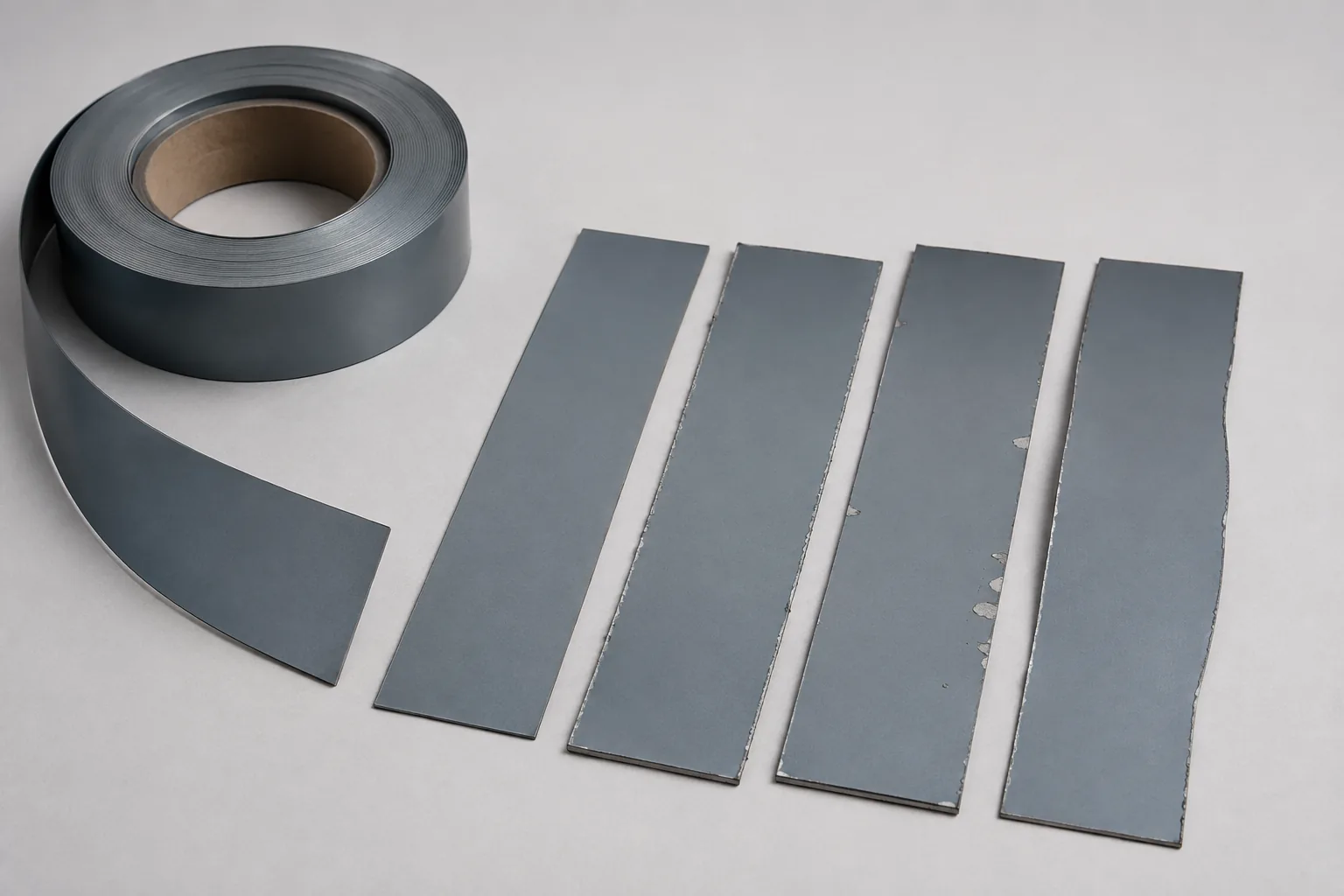
Electrical steel is supplied with an insulating surface coating and may be thin, hard and sensitive to residual stress. Slitting must preserve coating continuity near the edge and produce stable feed strip without creating a tall burr or curved strand that disrupts subsequent lamination stamping.
Updated
Where This Cutting Application Appears
Motor-lamination feed strip
Converts master coil into widths aligned with stator or rotor stamping layouts.
Transformer-lamination strip preparation
Slits grain-oriented or non-oriented stock after rolling direction and coating requirements are identified.
Prototype lamination coil conversion
Produces controlled small-lot widths for die trials while edge and flatness results are recorded.
Precision Coil Slitting process boundary
Precision coil slitting divides metal foil or strip longitudinally into tightly controlled daughter coils; its width, burr, tension and winding criteria are stricter than general web slitting.
Precision Coil Slitting setup checkpoint
Confirm daughter-coil widths, knife and spacer stack, overlap or clearance, strip tension, separator arrangement, rewind alignment and edge-trim handling.
Precision Coil Slitting acceptance checkpoint
Measure width and burr by coil position, then inspect edge wave, camber, telescoping, interleaving, surface marking and winding stability.
Define the Required Cut Result
- Low, consistent edge burr
- Insulating coating retained near the cut
- Straight strip for accurate die feeding
- Stable width across every strand
Problems to Diagnose Before Changing the Knife
Excessive lamination-edge burr
- Measure burr by strand and knife rotation
- Check clearance, overlap and edge wear
- Identify grade, hardness and coating thickness
Coating chipped beside the slit
- Inspect fracture direction and knife finish
- Check strip support and separator contact
- Compare damage before and after recoiling
Strip camber
- Review incoming coil stress and crown
- Verify stack symmetry and side load
- Check differential strand tension
Progressive width drift
- Monitor arbor and spacer temperature
- Measure bearing play and knife runout
- Verify edge-guide stability
Knife Forms That May Be Considered
| Possible knife form | When it may be considered | What must be confirmed |
|---|---|---|
| precision circular slitter knives | Closely controlled rotary pairs support thin lamination stock when runout, clearance and spacer accuracy are managed as a system. | Confirm the final geometry and mounting from the electrical-steel slitter arbor, an unworn sample or an approved drawing before manufacture. |
| carbide circular slitter knives | Carbide may be considered for wear-intensive grades if the slitter is rigid and edge-impact risk is controlled. | Confirm the final geometry and mounting from the rigid lamination-strip slitting head, an unworn sample or an approved drawing before manufacture. |
| thin-section rotary knives | Thin knives can enable closely spaced strands where arbor support prevents deflection and face contact. | Confirm the final geometry and mounting from the multistrand electrical-steel slitter, an unworn sample or an approved drawing before manufacture. |
Information to Send for Technical Review
You do not need to know the exact blade name. Send the available workpiece, machine, current-knife and cut-result information so the application can be reviewed against a drawing or sample.
- Slitter model, arbor diameter and center distance
- Electrical-steel grade and rolling direction
- Thickness, hardness range and coating type
- Master width, finished widths and strand layout
- Burr, coating and camber acceptance methods
- Speed, lubrication and recoiler tension
- Marked edge sections from each strand position
- Knife stack drawing, quantity and service history
Questions About This Cutting Application
Why is lamination-strip burr monitored closely?
Raised metal can affect stacking and downstream die behavior; the customer should define the measurement location and acceptance limit.
Can coating damage be judged only from the top face?
No. Inspect both faces and the fracture edge because damage may follow the exit side or separator contact.
Does grain orientation change the review?
Yes. Identify rolling direction and whether cuts run parallel or transverse when comparing edge behavior.
Why can one strand feed poorly even when its width is correct?
Camber, edge wave, coil build or localized burr can affect tracking independently of average width.
What records are most useful for repeat orders?
Retain grade, coating, knife positions, stack plan, clearance, overlap and strand-by-strand inspection results.
Related product and service information
- Slitting Stainless Steel Strip - stainless steel strip · coil slitting
- Copper Strip Coil Slitting - thicker-gauge copper strip coils · precision coil slitting
- Slitting Carbon Steel Coil - carbon steel coil · coil slitting
Request a Custom Cutting-Knife Review
Send the workpiece details, machine or holder information, current knife photos or sample, required quantity and examples of the present cut problem. Final dimensions, material, edge geometry and tolerances are confirmed from the approved requirements.