
Blade Application Guides / Application Guide / steel service centers
Slitting Carbon Steel Coil
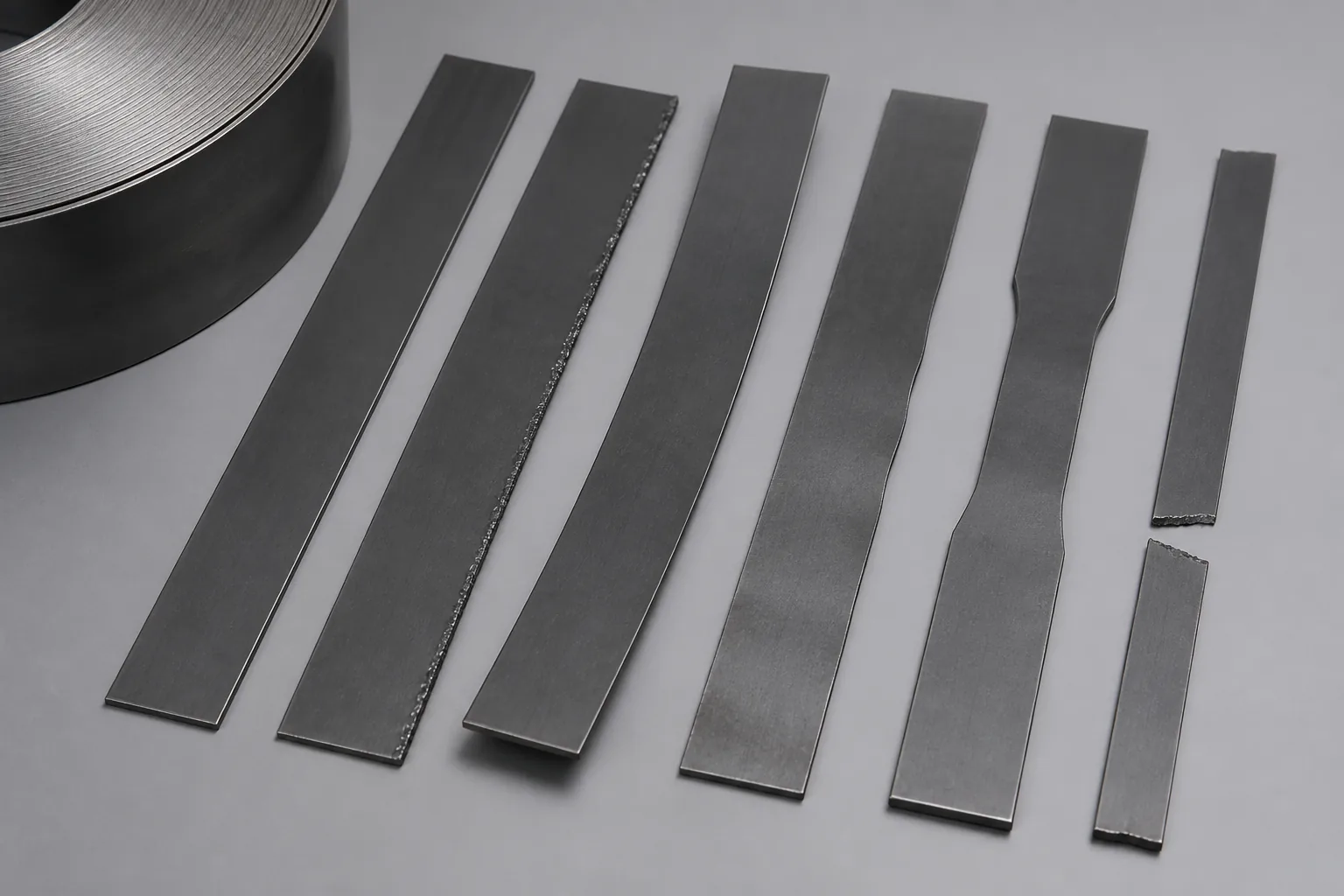
Carbon-steel coil can shift from soft drawing grades to high-strength stock while retaining the same nominal thickness. Slitter clearance, overlap, knife runout, spacer accuracy and strip tension must therefore be set from the actual mechanical condition and edge acceptance, not thickness alone.
Updated
Where This Cutting Application Appears
Service-center multicut slitting
Converts a master coil into several customer widths while managing strand tension and scrap edges.
Stamping-feed strip preparation
Produces narrow coils whose width, camber and edge condition must suit progressive-die feeding.
Grade and strength changeover
Re-establishes clearance and penetration when yield strength or coating changes at a familiar gauge.
Coil Slitting process boundary
coil slitting for carbon steel coil is planned around longitudinal width conversion of a moving roll, web, sheet or strip into controlled lanes or daughter rolls; it is not transverse length cutting, profile formation or removal of only a narrow damaged margin.
Coil Slitting setup checkpoint
For carbon steel coil, confirm unwind and rewind tension, lane widths, knife positions, edge guidance, core alignment, trim removal and discharge behavior.
Coil Slitting acceptance checkpoint
For carbon steel coil, evaluate lane width, edge condition, camber or wandering, debris, telescoping, interleaving and stable winding or downstream transfer.
Define the Required Cut Result
- Burr height within the agreed inspection method
- Stable strip width across the coil
- Low camber and edge wave
- Continuous scrap-edge handling
Problems to Diagnose Before Changing the Knife
Heavy or uneven burr
- Measure clearance by knife pair
- Inspect penetration and edge wear
- Compare burr around the arbor circumference
Strip camber
- Check knife side load and setup symmetry
- Review incoming coil shape and residual stress
- Compare tension between outside and center strands
Width variation
- Verify spacer stack and arbor temperature
- Measure knife runout and bearing play
- Check separator and recoiler alignment
Scrap edge breakage
- Review trim width and fracture pattern
- Inspect scrap-chopper timing if fitted
- Check edge tension and pit geometry
Knife Forms That May Be Considered
| Possible knife form | When it may be considered | What must be confirmed |
|---|---|---|
| paired circular slitter knives | Opposed rotary knives suit continuous coil slitting when diameter, thickness, bevel and overlap match the installed heads. | Confirm the final geometry and mounting from the coil-slitter arbor and tooling stack, an unworn sample or an approved drawing before manufacture. |
| thin-section precision slitter knives | Reduced knife thickness can support narrow multicut layouts if the arbor, spacers and lateral support control deflection. | Confirm the final geometry and mounting from the precision multicut slitter, an unworn sample or an approved drawing before manufacture. |
| heavy-section rotary shear knives | A stiffer section may be considered for thicker or higher-strength stock where holder space and penetration permit it. | Confirm the final geometry and mounting from the heavy-gauge slitting head, an unworn sample or an approved drawing before manufacture. |
Information to Send for Technical Review
You do not need to know the exact blade name. Send the available workpiece, machine, current-knife and cut-result information so the application can be reviewed against a drawing or sample.
- Slitter make, model, arbor diameter and center distance
- Steel grade, tensile range and coating
- Coil thickness and master width
- Finished widths, slit count and tolerance
- Speed, tension and recoiling arrangement
- Current clearance, overlap and spacer plan
- Burr, camber and edge-wave measurements with samples
- Knife dimensions, quantity and delivery schedule
Questions About This Cutting Application
Why does burr increase on only some strands?
Local knife wear, stack error, runout or strand tension can differ across the arbor; map each result to its knife pair.
Can clearance be selected from sheet thickness alone?
No. Strength, ductility, coating, edge target and machine rigidity also affect a workable setting.
What causes slit strip to curve sideways?
Asymmetric deformation, incoming residual stress, unequal side force or recoiling tension can produce camber.
Should knife overlap be increased when edges become dull?
Using extra overlap to compensate for wear can raise force and edge distortion; inspect and service the tooling first.
What data should accompany an edge sample?
Mark top and bottom, operator side, strand position, travel direction and the measured setup used for that coil.
Related product and service information
- Trimming Copper and Brass Strip - copper and brass strip · edge trimming and width control
- Slitting Stainless Steel Strip - stainless steel strip · coil slitting
- Trimming Aluminum Sheet Edges - aluminum sheet and strip · edge trimming
Request a Custom Cutting-Knife Review
Send the workpiece details, machine or holder information, current knife photos or sample, required quantity and examples of the present cut problem. Final dimensions, material, edge geometry and tolerances are confirmed from the approved requirements.