
Blade Application Guides / Application Guide / precision metal converting
Slitting Stainless Steel Strip
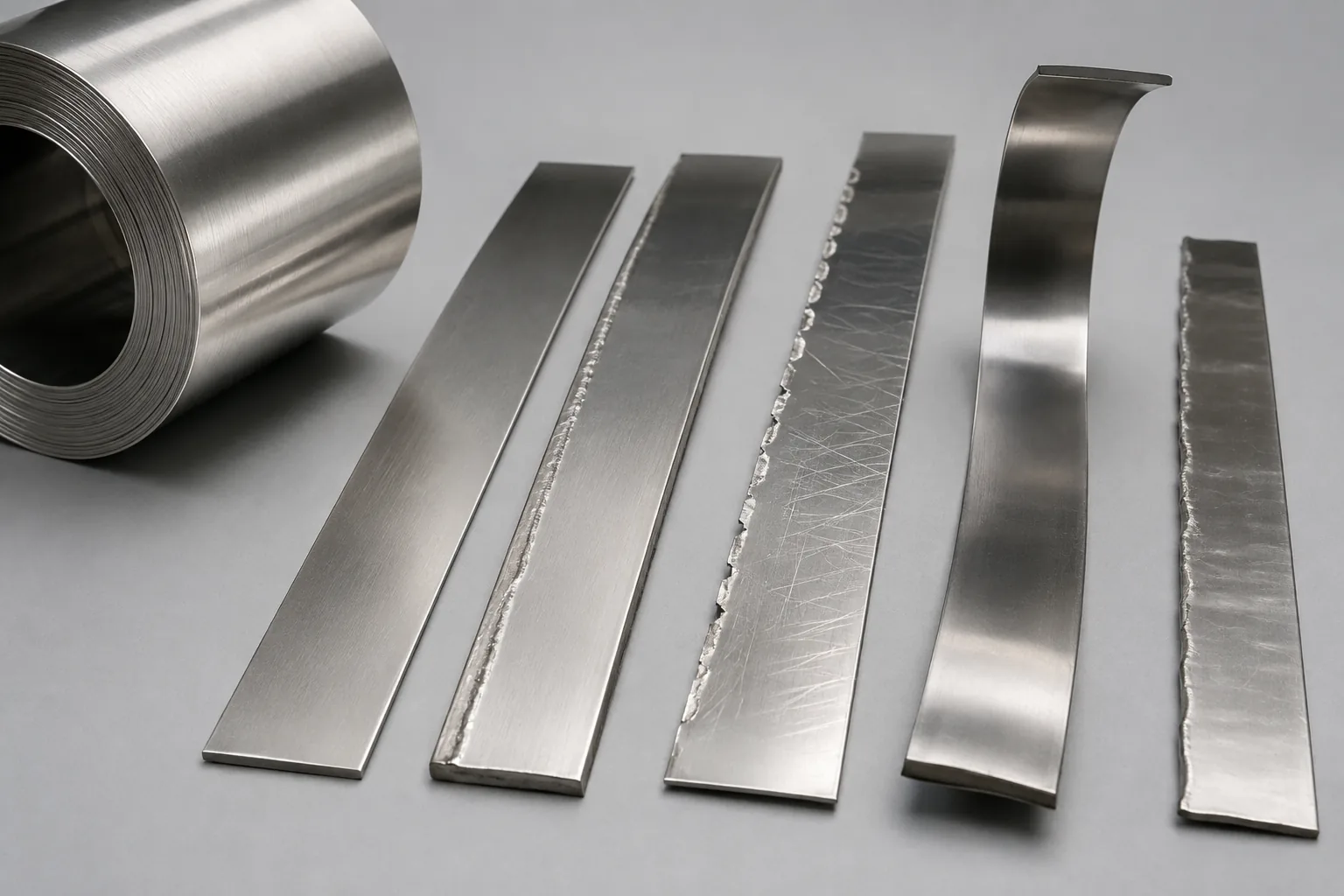
Stainless strip combines high work-hardening tendency with surfaces that may be polished, coated or protected by film. The cutting pair must fracture the section before prolonged rubbing generates rollover or pickup, while separators and handling protect the visible faces.
Updated
Where This Cutting Application Appears
Precision strip for formed components
Slits coil for clips, springs or deep-drawn parts where edge cracks can start during later forming.
Decorative-surface coil conversion
Maintains protected or polished faces while knives and separators control the edges.
Thin stainless multistrand slitting
Produces narrow widths that are sensitive to arbor deflection and differential recoiling tension.
Coil Slitting process boundary
coil slitting for stainless steel strip is planned around longitudinal width conversion of a moving roll, web, sheet or strip into controlled lanes or daughter rolls; it is not transverse length cutting, profile formation or removal of only a narrow damaged margin.
Coil Slitting setup checkpoint
For stainless steel strip, confirm unwind and rewind tension, lane widths, knife positions, edge guidance, core alignment, trim removal and discharge behavior.
Coil Slitting acceptance checkpoint
For stainless steel strip, evaluate lane width, edge condition, camber or wandering, debris, telescoping, interleaving and stable winding or downstream transfer.
Define the Required Cut Result
- Controlled fracture zone with low rollover
- No adhesive or metal pickup on knife faces
- Protected strip surface
- Straight, stable recoiled strands
Problems to Diagnose Before Changing the Knife
Rolled or smeared edge
- Identify alloy and temper
- Measure clearance and penetration
- Inspect polished lands for pickup
Knife-face galling
- Check transferred metal and lubricant condition
- Review side load and knife finish
- Record heat buildup over the run
Surface scratches
- Trace marks through guides and separators
- Inspect protective-film debris
- Check strip contact with spacer or knife faces
Strand camber
- Compare incoming crown and residual stress
- Verify stack symmetry and side clearance
- Review separator pressure and recoiler tension
Knife Forms That May Be Considered
| Possible knife form | When it may be considered | What must be confirmed |
|---|---|---|
| precision circular shear knives | Closely controlled thickness and face finish support paired rotary shearing where stainless edge and surface limits are tight. | Confirm the final geometry and mounting from the stainless-strip slitter arbor, an unworn sample or an approved drawing before manufacture. |
| dished slitter knives | A relieved face may reduce unwanted strip contact in equipment designed for dished tooling, subject to correct orientation and support. | Confirm the final geometry and mounting from the dished-knife slitting head, an unworn sample or an approved drawing before manufacture. |
| carbide rotary knives | Carbide may be reviewed for abrasive or long-run work only when impact, holder rigidity and regrinding capability are suitable. | Confirm the final geometry and mounting from the rigid stainless slitting station, an unworn sample or an approved drawing before manufacture. |
Information to Send for Technical Review
You do not need to know the exact blade name. Send the available workpiece, machine, current-knife and cut-result information so the application can be reviewed against a drawing or sample.
- Slitter model, arbor details and tooling stack
- Stainless grade, temper and tensile range
- Surface finish, coating and protective film
- Thickness, master width and finished strands
- Burr, rollover and camber acceptance
- Lubrication, speed and recoiler tension
- Marked edge samples and scratch photographs
- Current knife drawing, quantity and regrind history
Questions About This Cutting Application
Why does stainless build up on the knife face?
High contact pressure, heat, finish condition and lubricant failure can promote adhesive pickup; inspect both transferred metal and the underlying edge.
Does a harder knife automatically prevent galling?
Not by itself. Surface finish, side load, lubrication, toughness and operating heat remain important.
Why can a small burr matter during forming?
A burr or smeared fracture zone may act as a notch when strip is bent or drawn; define the downstream test with the buyer.
How should protected stainless be sampled?
Retain the film and mark every scratch relative to the guides, knives and separators so the source can be traced.
Can carbon-steel settings be reused for stainless?
Do not assume so; work hardening, strength and surface protection can require a different setup.
Related product and service information
- Copper Strip Coil Slitting - thicker-gauge copper strip coils · precision coil slitting
- Slitting Carbon Steel Coil - carbon steel coil · coil slitting
- Trimming Aluminum Sheet Edges - aluminum sheet and strip · edge trimming
Request a Custom Cutting-Knife Review
Send the workpiece details, machine or holder information, current knife photos or sample, required quantity and examples of the present cut problem. Final dimensions, material, edge geometry and tolerances are confirmed from the approved requirements.