
Blade Application Guides / Application Guide / electrical component and metal stamping supply
Copper Strip Coil Slitting
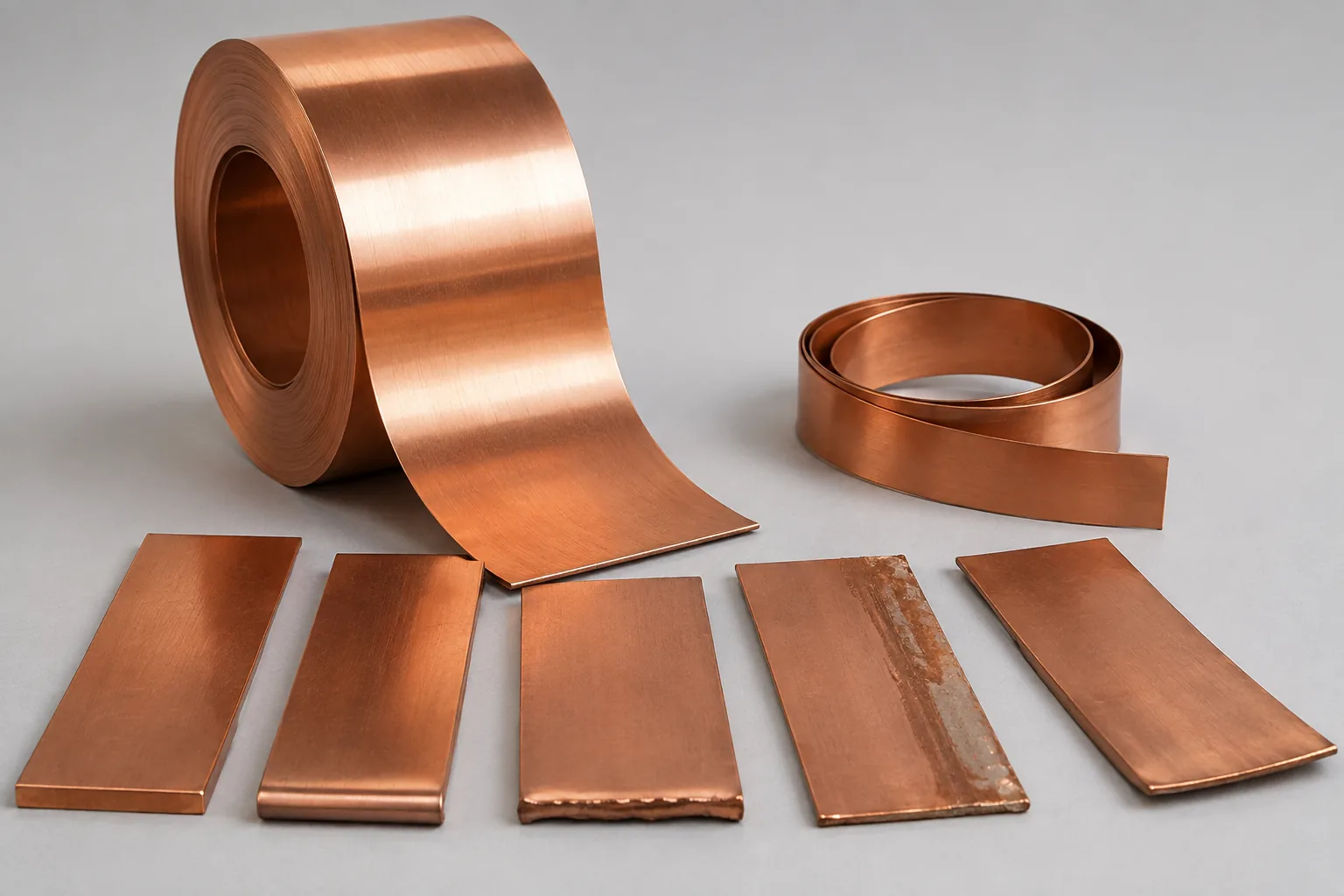
Copper strip for terminals, bus components and stamped parts is substantially thicker and stiffer than battery-current-collector foil, yet remains prone to adhesive pickup and plastic edge rollover. Slitter setup must balance fracture quality with strand tension so the finished coils remain flat, clean and windable.
Updated
Where This Cutting Application Appears
Terminal-stock width conversion
Slits copper coil into stamping widths while limiting burrs that could interfere with forming or plating.
Bus-component strip preparation
Produces wider, heavier strands that require stable tension and controlled coil build.
Connector-alloy changeover
Resets the cutting pair when temper, alloy or plated surface changes the strip's fracture and pickup response.
Precision Coil Slitting process boundary
Precision coil slitting divides metal foil or strip longitudinally into tightly controlled daughter coils; its width, burr, tension and winding criteria are stricter than general web slitting.
Precision Coil Slitting setup checkpoint
Confirm daughter-coil widths, knife and spacer stack, overlap or clearance, strip tension, separator arrangement, rewind alignment and edge-trim handling.
Precision Coil Slitting acceptance checkpoint
Measure width and burr by coil position, then inspect edge wave, camber, telescoping, interleaving, surface marking and winding stability.
Define the Required Cut Result
- Low rollover and attached burr
- Straight strip with controlled camber
- Clean faces without copper transfer
- Tight, level recoiled strands
Problems to Diagnose Before Changing the Knife
Rounded or rolled edge
- Verify clearance against thickness and temper
- Inspect penetration and knife sharpness
- Compare deformation on drive and operator sides
Copper pickup on tooling
- Inspect knife-face roughness and deposits
- Review lubrication and side pressure
- Record heat increase through the coil
Strand camber
- Check incoming residual stress
- Compare arbor loading across the stack
- Review separator and recoiler tension balance
Telescoped or loose coil
- Measure strand tension by width
- Inspect separator alignment
- Check core grip and recoiler taper setting
Knife Forms That May Be Considered
| Possible knife form | When it may be considered | What must be confirmed |
|---|---|---|
| precision circular slitter knives | Paired rotary knives provide continuous shear for copper strip when face finish, clearance and overlap are matched to the actual gauge and temper. | Confirm the final geometry and mounting from the copper-strip slitter arbor, an unworn sample or an approved drawing before manufacture. |
| dished rotary knives | Face relief can reduce strip rubbing in slitting heads built for dished tooling, particularly where surface pickup is a concern. | Confirm the final geometry and mounting from the dished-knife copper slitter, an unworn sample or an approved drawing before manufacture. |
| heavy-section circular knives | A more rigid knife section may suit heavier copper strip if arbor spacing, penetration and side-load capacity support it. | Confirm the final geometry and mounting from the heavy-strip slitting head, an unworn sample or an approved drawing before manufacture. |
Information to Send for Technical Review
You do not need to know the exact blade name. Send the available workpiece, machine, current-knife and cut-result information so the application can be reviewed against a drawing or sample.
- Slitter make, model and arbor arrangement
- Copper alloy, temper and any plated surface
- Minimum and maximum strip thickness
- Master width, finished widths and slit count
- Width, burr and camber acceptance
- Speed, lubricant and recoiling tension
- Marked rollover, pickup and coil-build samples
- Knife drawing, set quantity and delivery schedule
Questions About This Cutting Application
How is this different from battery copper-foil slitting?
The thicker strip carries higher cutting and recoiling loads; its rollover, camber and coil-build decisions should be reviewed as strip processing rather than foil conversion.
Why does copper smear instead of forming a clean fracture?
Ductility, excessive clearance, worn edges or sustained rubbing can enlarge the burnished and rolled zones.
Can pickup be removed without changing the setup?
Cleaning may restore the surface temporarily, but recurring deposits require review of finish, pressure, heat and lubrication.
Why does one narrow strand telescope?
Narrow coils respond strongly to small tension or separator differences; map the strand position and winding behavior.
What should a slit-edge sample include?
Send a full-width sequence with top face, line direction, strand number, alloy, temper and setup values identified.
Related product and service information
- Cutting Thin-Wall Metal Tube to Length - thin-wall metal tube · cut-to-length cutoff
- Slitting Electrical Steel Lamination Strip - electrical steel lamination strip · precision coil slitting
- Slitting Carbon Steel Coil - carbon steel coil · coil slitting
Request a Custom Cutting-Knife Review
Send the workpiece details, machine or holder information, current knife photos or sample, required quantity and examples of the present cut problem. Final dimensions, material, edge geometry and tolerances are confirmed from the approved requirements.