
Blade Application Guides / Application Guide / nonferrous metal processing
Trimming Copper and Brass Strip
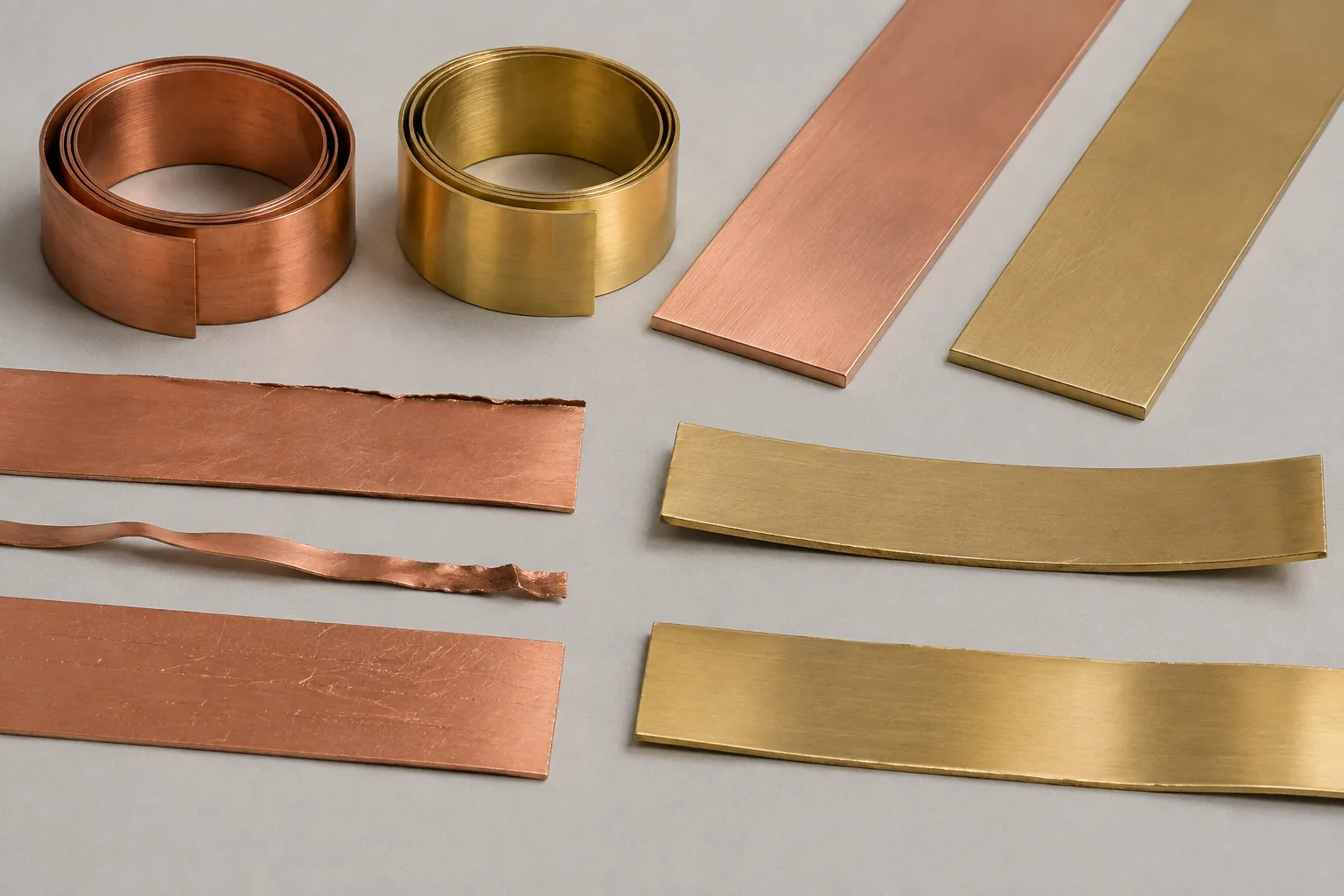
Edge trimming is often used to remove cracked, wavy or oxidized margins from copper-alloy strip before precision finishing. Because these alloys mark readily and retain residual stress from rolling, narrow trim width, guide position and recoiler pull can change both the edge and the strip path.
Updated
Where This Cutting Application Appears
Rolled-strip mill-edge removal
Cuts away irregular margins before final width inspection and recoiling.
Plating-feed edge preparation
Produces controlled copper or brass edges before surface treatment, with burr direction and cleanliness defined.
Decorative brass strip finishing
Maintains visible faces while trimming stock for architectural or consumer-component fabrication.
Edge Trimming And Width Control process boundary
edge trimming and width control for copper and brass strip is a linked sequence: the output condition and datum from each operation become the controlled input for the next. It should not be evaluated as one generic cut or accepted only by the final dimension.
Edge Trimming And Width Control setup checkpoint
For copper and brass strip, define the operation order, intermediate dimensions, registration transfer, material support, web or part handling and waste route for every stage of edge trimming and width control.
Edge Trimming And Width Control acceptance checkpoint
Verify both intermediate and final results from edge trimming and width control, including dimensions, registration, edge or feature quality, material damage, waste separation and stable transfer between stages.
Define the Required Cut Result
- Complete removal of unstable mill edge
- Specified burr direction and level
- Low strip camber after recoiling
- Unmarked copper or brass faces
Problems to Diagnose Before Changing the Knife
Residual cracked edge
- Compare trim allowance with defect depth
- Inspect cracks after flattening
- Check guide drift into the damaged margin
Narrow scrap ribbon breaks
- Review trim width and alloy temper
- Check scrap tension and discharge path
- Inspect intermittent burr hooks
Face scratches
- Trace contact at guides and separators
- Remove embedded chips from tooling faces
- Inspect oxide particles and lubricant cleanliness
Width or camber change
- Verify edge-guide datum
- Measure arbor runout and knife side load
- Compare recoiler tension between coils
Knife Forms That May Be Considered
| Possible knife form | When it may be considered | What must be confirmed |
|---|---|---|
| paired circular edge-trim knives | Rotary shear pairs suit continuous side trimming when narrow scrap is supported and discharged without pulling the strip. | Confirm the final geometry and mounting from the copper-alloy edge-trim head, an unworn sample or an approved drawing before manufacture. |
| dished trim knives | A relieved face may reduce unwanted contact with the retained edge where the installed holders are designed for this knife form. | Confirm the final geometry and mounting from the dished nonferrous trim station, an unworn sample or an approved drawing before manufacture. |
| straight shear knives | Indexed straight shearing may suit sheeted strip or short lengths with firm hold-down and controlled surface protection. | Confirm the final geometry and mounting from the copper or brass sheet shear, an unworn sample or an approved drawing before manufacture. |
Information to Send for Technical Review
You do not need to know the exact blade name. Send the available workpiece, machine, current-knife and cut-result information so the application can be reviewed against a drawing or sample.
- Edge-trim line manufacturer and model
- Copper or brass alloy and temper
- Thickness, incoming width and coil condition
- Trim allowance on each side and final tolerance
- Surface finish, oxide or plating status
- Guiding, scrap handling and recoiling tension
- Marked crack, burr, camber and scratch samples
- Knife dimensions, quantity and required delivery
Questions About This Cutting Application
How much edge should be removed?
Base the allowance on measured defect depth, guide capability and finished-width tolerance rather than a generic percentage.
Why does a narrow copper scrap ribbon keep breaking?
Ductility, work hardening, burr hooks, fluctuating trim width or poor scrap tension can interrupt the ribbon.
Can brass and copper use the same knife geometry?
Only after alloy, temper, gauge and edge target are compared; their fracture and pickup behavior can differ.
What causes scratches beside the trimmed edge?
Chips or transferred metal on knives, spacers, guides and separators can mark the retained face.
Should mill-edge cracks be checked before or after leveling?
Inspect both states when possible because waviness can hide crack length and leveling can open a marginal edge.
Related product and service information
- Slitting Electrical Steel Lamination Strip - electrical steel lamination strip · precision coil slitting
- Slitting Carbon Steel Coil - carbon steel coil · coil slitting
- Slitting Stainless Steel Strip - stainless steel strip · coil slitting
Request a Custom Cutting-Knife Review
Send the workpiece details, machine or holder information, current knife photos or sample, required quantity and examples of the present cut problem. Final dimensions, material, edge geometry and tolerances are confirmed from the approved requirements.