
Blade Application Guides / Application Guide / nonwoven converting
Slitting Spunbond Nonwoven Rolls
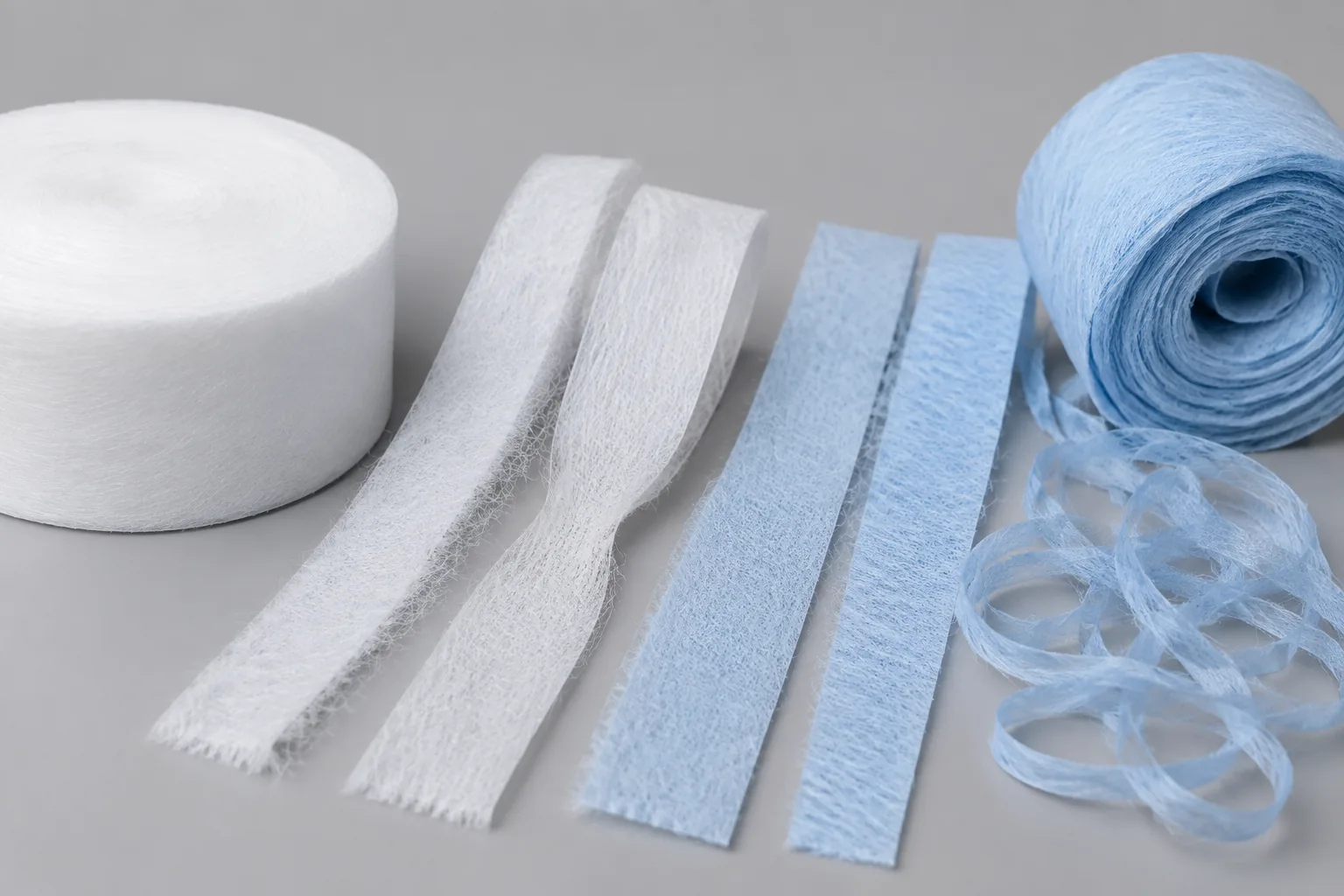
Spunbond web strength comes from bonded continuous filaments, yet low basis weight material can flutter or neck in under local cutting load. The slitting setup must balance web tension, support and edge engagement without stretching the web before width is established.
Updated
Where This Cutting Application Appears
Master-roll width conversion
Divides a spunbond master roll into narrower finished rolls for hygiene, medical, agricultural or packaging conversion.
Edge trim after web formation
Removes unstable deckle edges before winding so the finished roll has a controlled usable width.
Basis-weight changeover
Resets tension and cutting engagement when a lighter or heavier web changes neck-in, flutter and fiber release.
Longitudinal Roll Slitting process boundary
longitudinal roll slitting for spunbond nonwoven rolls is planned around longitudinal width conversion of a moving roll, web, sheet or strip into controlled lanes or daughter rolls; it is not transverse length cutting, profile formation or removal of only a narrow damaged margin.
Longitudinal Roll Slitting setup checkpoint
For spunbond nonwoven rolls, confirm unwind and rewind tension, lane widths, knife positions, edge guidance, core alignment, trim removal and discharge behavior.
Longitudinal Roll Slitting acceptance checkpoint
For spunbond nonwoven rolls, evaluate lane width, edge condition, camber or wandering, debris, telescoping, interleaving and stable winding or downstream transfer.
Define the Required Cut Result
- Clean separation of bonded filaments
- Stable finished width without web neck-in
- Low lint and no fiber wrapping at the holder
- Smooth winding edges across the roll length
Problems to Diagnose Before Changing the Knife
Fuzzy slit edge
- Check bond pattern and basis weight
- Inspect edge damage at the exact axial position
- Compare web support on both sides of the slit
Web neck-in
- Measure tension before and after the slitter
- Check whether the blade displaces the web laterally
- Compare width under tension and after winding
Fiber wrapping
- Inspect exposed shafts, spacers and holder gaps
- Check static control and extraction
- Record where loose filaments first accumulate
Slit-width variation
- Verify web guiding and holder locking
- Measure rotary runout or razor position
- Correlate variation with roll diameter and speed
Knife Forms That May Be Considered
| Possible knife form | When it may be considered | What must be confirmed |
|---|---|---|
| circular shear slitter | Provides supported scissor action on a moving web when overlap, side load and runout are controlled. | Confirm the mounting dimensions, cutting motion and edge details from the spunbond slitting equipment, an unworn sample or an approved drawing before manufacture. |
| razor slitter | May suit low-basis-weight, low-tension web with adequate backing or free-span geometry and safe fragment control. | Confirm the mounting dimensions, cutting motion and edge details from the spunbond slitting equipment, an unworn sample or an approved drawing before manufacture. |
| score-cut wheel | May be evaluated where the web is compressed against a hardened anvil and edge compaction remains acceptable. | Confirm the mounting dimensions, cutting motion and edge details from the spunbond slitting equipment, an unworn sample or an approved drawing before manufacture. |
Information to Send for Technical Review
You do not need to know the exact blade name. Send the available workpiece, machine, current-knife and cut-result information so the application can be reviewed against a drawing or sample.
- Slitter and rewinder make, model and station layout
- Polymer, basis weight and bond pattern
- Master-roll and finished-roll widths
- Web tension range, line speed and roll diameter
- Free-span or anvil support at each slit
- Current blade dimensions, overlap and side load
- Lint, neck-in and wound-edge photos
- Number of slitters, spare quantity and delivery destination
Questions About This Cutting Application
Why does spunbond neck in before the slit?
Excess tension, insufficient lateral support or a dragging edge can narrow the web. Measure width at defined points around the cutting station.
When is razor slitting worth testing?
It may suit thin supported web, but blade exposure, fragment risk, change frequency and edge lint must be acceptable to the line.
What causes fibers to wrap around holders?
Partially severed filaments, static and open shaft gaps can collect fibers. Identify the first accumulation point rather than only cleaning the final wrap.
How should finished width be verified?
Define whether width is measured on the running web, relaxed sample or wound roll because tension changes the result.
Can a slitter set be quoted by diameter alone?
No. Bore, thickness, edge form, rotation, overlap, spacers, holder reference and material must also be confirmed.
Related product and service information
- Trimming Tufted Carpet Roll Edges - tufted carpet rolls · edge trimming
- Slitting Meltblown Nonwoven Web - meltblown nonwoven web · precision web slitting
- Cutting Needle-Punched Felt - needle-punched felt · sheet and roll cutting
Request a Custom Cutting-Knife Review
Send the workpiece details, machine or holder information, current knife photos or sample, required quantity and examples of the present cut problem. Final dimensions, material, edge geometry and tolerances are confirmed from the approved requirements.