
Blade Application Guides / Application Guide / technical textile converting
Cutting Needle-Punched Felt
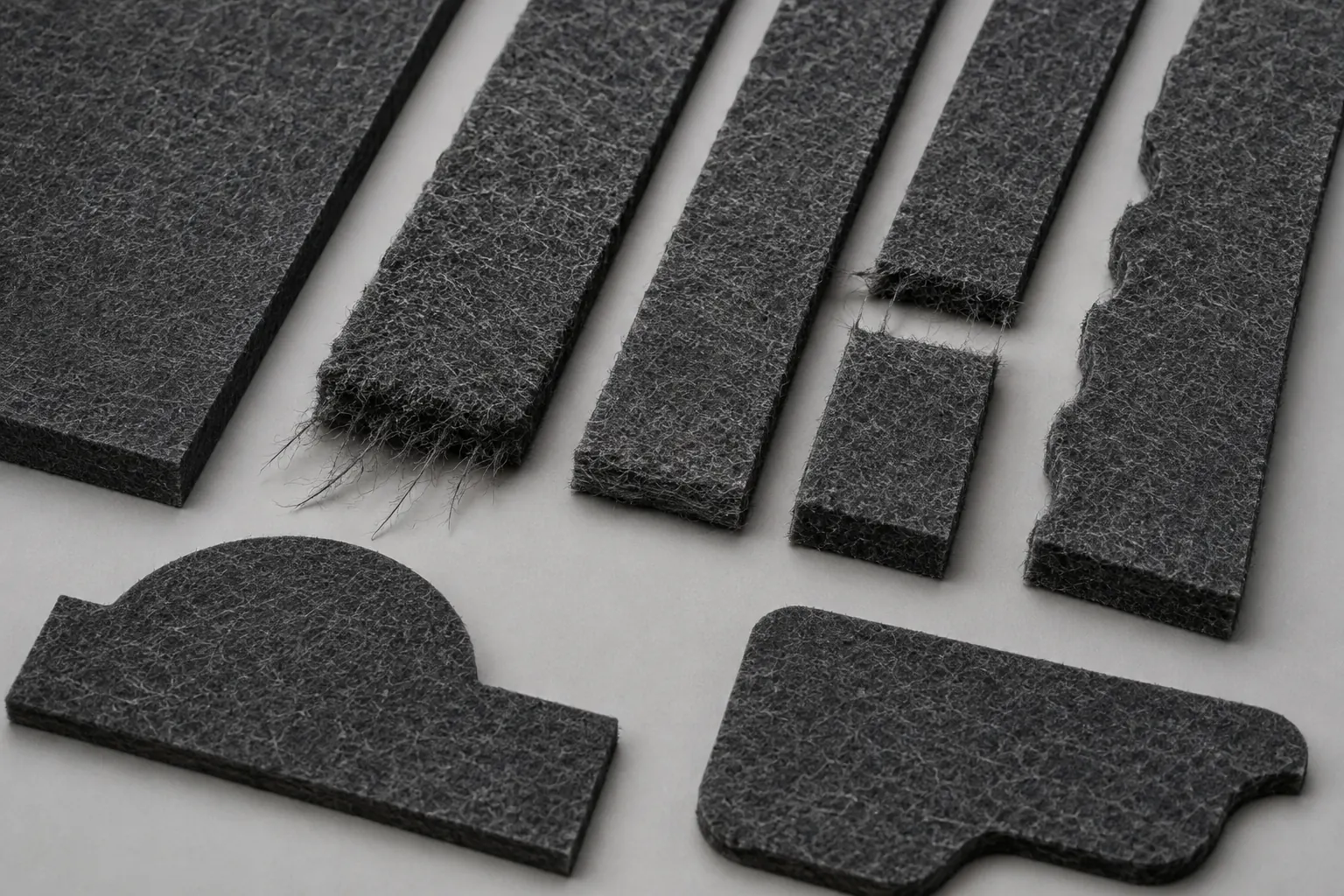
Needle-punched felt is a thick entangled fiber network that can vary in density through its width and thickness. Cutting force, local compression and fiber direction determine whether the edge separates cleanly or pulls a path through the web.
Updated
Where This Cutting Application Appears
Technical felt roll slitting
Converts wide rolls into strips for filtration, insulation, polishing or sealing applications.
Sheet and pad sizing
Cuts thick felt into rectangular blanks where squareness and dimensional recovery matter.
Programmed contour cutting
Produces gaskets, pads or insulation shapes with curves and internal features on a supported cutting table.
Sheet And Roll Cutting process boundary
sheet and roll cutting for needle-punched felt is a linked sequence: the output condition and datum from each operation become the controlled input for the next. It should not be evaluated as one generic cut or accepted only by the final dimension.
Sheet And Roll Cutting setup checkpoint
For needle-punched felt, define the operation order, intermediate dimensions, registration transfer, material support, web or part handling and waste route for every stage of sheet and roll cutting.
Sheet And Roll Cutting acceptance checkpoint
Verify both intermediate and final results from sheet and roll cutting, including dimensions, registration, edge or feature quality, material damage, waste separation and stable transfer between stages.
Define the Required Cut Result
- Fully severed fibers through the felt thickness
- Low fiber pullout and limited fuzzy edge
- Dimensions stable after compression recovery
- Accurate straight lines or programmed contours
Problems to Diagnose Before Changing the Knife
Fiber pullout
- Identify fiber type, length and needling density
- Inspect whether the edge is slicing or dragging
- Compare cut direction with machine direction
Compressed edge
- Measure felt thickness and recovery
- Reduce excessive hold-down near the line
- Compare included angle and penetration force
Incomplete cut
- Check penetration through the densest zone
- Inspect backing wear and table flatness
- Look for dull teeth or fiber accumulation
Wandering cut line
- Check lateral support and guide rigidity
- Measure density variation across the felt
- Compare feed direction and cutting speed
Knife Forms That May Be Considered
| Possible knife form | When it may be considered | What must be confirmed |
|---|---|---|
| serrated straight knife | Can give a progressive slicing action through thick entangled fibers when tooth pitch and marks suit the finished edge. | Confirm the mounting dimensions, cutting motion and edge details from the needle-felt cutting equipment, an unworn sample or an approved drawing before manufacture. |
| circular slitter | May suit continuous straight strips where the roll is guided and supported close to the rotary cutting point. | Confirm the mounting dimensions, cutting motion and edge details from the needle-felt slitting equipment, an unworn sample or an approved drawing before manufacture. |
| oscillating knife | Often considered for programmed shapes on a table because oscillation can separate fibers while following curves. | Confirm the mounting dimensions, cutting motion and edge details from the needle-felt contour cutting equipment, an unworn sample or an approved drawing before manufacture. |
Information to Send for Technical Review
You do not need to know the exact blade name. Send the available workpiece, machine, current-knife and cut-result information so the application can be reviewed against a drawing or sample.
- Cutting table or slitter make and model
- Fiber polymer, blend and nominal fiber length
- Basis weight, thickness and needling density
- Roll direction, layer or backing construction
- Straight slit, sheet size or contour drawing
- Support surface, hold-down and operating speed
- Accepted and rejected edge samples
- Knife dimensions, quantity and delivery destination
Questions About This Cutting Application
Why does felt pull fibers instead of separating cleanly?
A dragging edge, unsuitable tooth action, low local density or poor support can pull the entangled network. Compare direction and density at the defect.
Should felt dimensions be checked after recovery?
Yes when compression is significant. Define a conditioning time and measurement method for both trial and acceptance.
When is an oscillating knife appropriate?
It can suit contours on a supported table, but stroke, frequency, tip geometry and minimum radius must match the machine and drawing.
Can one edge cut different felt densities?
Possibly, but force, fiber pullout and travel speed can change substantially. Test the lowest and highest specified density.
What photographs help diagnose an incomplete cut?
Show the top edge, underside, backing surface and the point where fibers remain connected, with cutting direction identified.
Related product and service information
- Trimming Nonwoven Filter Media Rolls - nonwoven filter media · roll trimming and web slitting
- Slitting Spunbond Nonwoven Rolls - spunbond nonwoven rolls · longitudinal roll slitting
- Slitting Meltblown Nonwoven Web - meltblown nonwoven web · precision web slitting
Request a Custom Cutting-Knife Review
Send the workpiece details, machine or holder information, current knife photos or sample, required quantity and examples of the present cut problem. Final dimensions, material, edge geometry and tolerances are confirmed from the approved requirements.