
Blade Application Guides / Application Guide / presswork and fabrication
Trimming Sheet-Metal Blanks
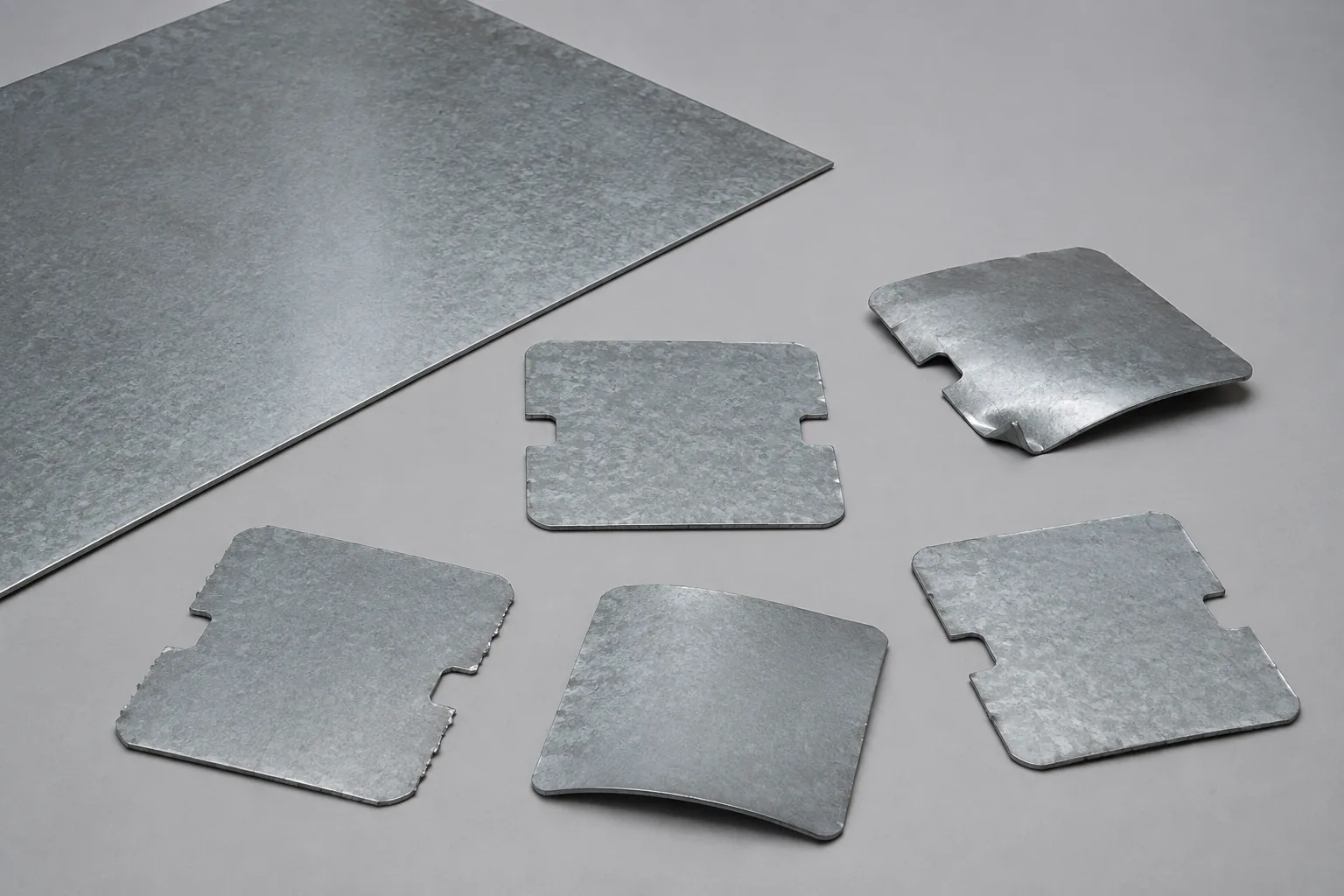
A sheet-metal blank may be rectangular, notched or fully profiled before it enters a forming die. Trimming should establish reliable datums and remove unstable edge material without bending unsupported corners or leaving a burr positioned to crack during a later flange or draw operation.
Updated
Where This Cutting Application Appears
Press-feed blank preparation
Squares or profiles sheets before deep drawing, bending or progressive press operations.
Appliance-panel blank sizing
Produces repeatable external dimensions and notches before embossing or edge forming.
Low-volume formed-part development
Trims trial blanks to controlled geometry while material utilization and forming margins are evaluated.
Blank Trimming process boundary
blank trimming for sheet-metal blanks is planned around repeatable full or controlled-depth formation of a defined shape using registered tooling and a managed waste path; it is not straight slitting, simple length separation or narrow edge cleanup.
Blank Trimming setup checkpoint
For sheet-metal blanks, confirm finished geometry, clearance or cutting depth, tool-to-anvil support, registration, feed orientation and waste or part release.
Blank Trimming acceptance checkpoint
For sheet-metal blanks, evaluate complete geometry, dimensions, registration, burr or fiber pull, corner integrity, waste separation and part flatness.
Define the Required Cut Result
- Blank dimensions referenced to clear datums
- Low burr at future formed edges
- Undistorted corners and notches
- Flat parts that stack and feed consistently
Problems to Diagnose Before Changing the Knife
Bent or dog-eared corner
- Check support through stroke completion
- Review hold-down distribution
- Inspect knife alignment near profile transitions
Burr on the forming side
- Confirm cutting direction and blank orientation
- Measure clearance around the perimeter
- Inspect local knife wear at corners
Blank bow or twist
- Compare rolling direction and residual stress
- Review asymmetric cut sequence
- Check ejection and stacking contact
Profile or size variation
- Verify stock location against datums
- Inspect guide and stop wear
- Measure tooling deflection across long edges
Knife Forms That May Be Considered
| Possible knife form | When it may be considered | What must be confirmed |
|---|---|---|
| straight shear knives | Upper and lower straight knives suit rectangular blank sizing when hold-down and back-gauge accuracy are adequate. | Confirm the final geometry and mounting from the sheet shear and lower knife, an unworn sample or an approved drawing before manufacture. |
| matched profile trim knives | Contoured upper and lower tooling can cut notches or perimeter features in a press when clearances are defined around the entire profile. | Confirm the final geometry and mounting from the blank-trimming die, an unworn sample or an approved drawing before manufacture. |
| rotary shear knives | May suit continuous straight or gently contoured edge preparation before individual blanks are separated. | Confirm the final geometry and mounting from the blanking-line rotary trim station, an unworn sample or an approved drawing before manufacture. |
Information to Send for Technical Review
You do not need to know the exact blade name. Send the available workpiece, machine, current-knife and cut-result information so the application can be reviewed against a drawing or sample.
- Shear, press or blanking-line model
- Sheet grade, temper and thickness
- Blank drawing with datums and tolerances
- Rolling direction and surface finish
- Cut sequence, stack height and cycle rate
- Hold-down, lower knife and ejection details
- Marked burr, bow, corner and dimensional samples
- Tool drawing, quantity and project schedule
Questions About This Cutting Application
Why do corners bend even when straight edges look clean?
Corners lose support in two directions and may see unequal clearance or hold-down near the end of the stroke.
Which way should the cutting burr face before forming?
That depends on the next bend or draw and the customer's process plan; specify blank orientation on the controlled drawing.
Can a worn blank be used to copy profile tooling?
It helps identify the nominal outline but not intended clearance, wear allowance or mounting; equipment data and an approved drawing remain necessary.
What causes blanks to bow after trimming?
Residual sheet stress, asymmetric edge removal, cutting sequence and stacking pressure can release or introduce curvature.
How are notched profiles inspected?
Use defined datums and gauges or coordinate measurements, and separate dimensional error from burr or corner rollover.
Related product and service information
- Cutting Thin Metal Gasket Sheet - thin metal gasket sheet · profile cutting and blanking
- Cutting Expanded Metal Mesh - expanded metal mesh · cross-cutting and edge trimming
- Aluminum Lithographic Printing Plate Trimming - lithographic aluminum printing plates · plate edge trimming and format sizing
Request a Custom Cutting-Knife Review
Send the workpiece details, machine or holder information, current knife photos or sample, required quantity and examples of the present cut problem. Final dimensions, material, edge geometry and tolerances are confirmed from the approved requirements.