
Blade Application Guides / Application Guide / offset printing plate manufacture and conversion
Aluminum Lithographic Printing Plate Trimming
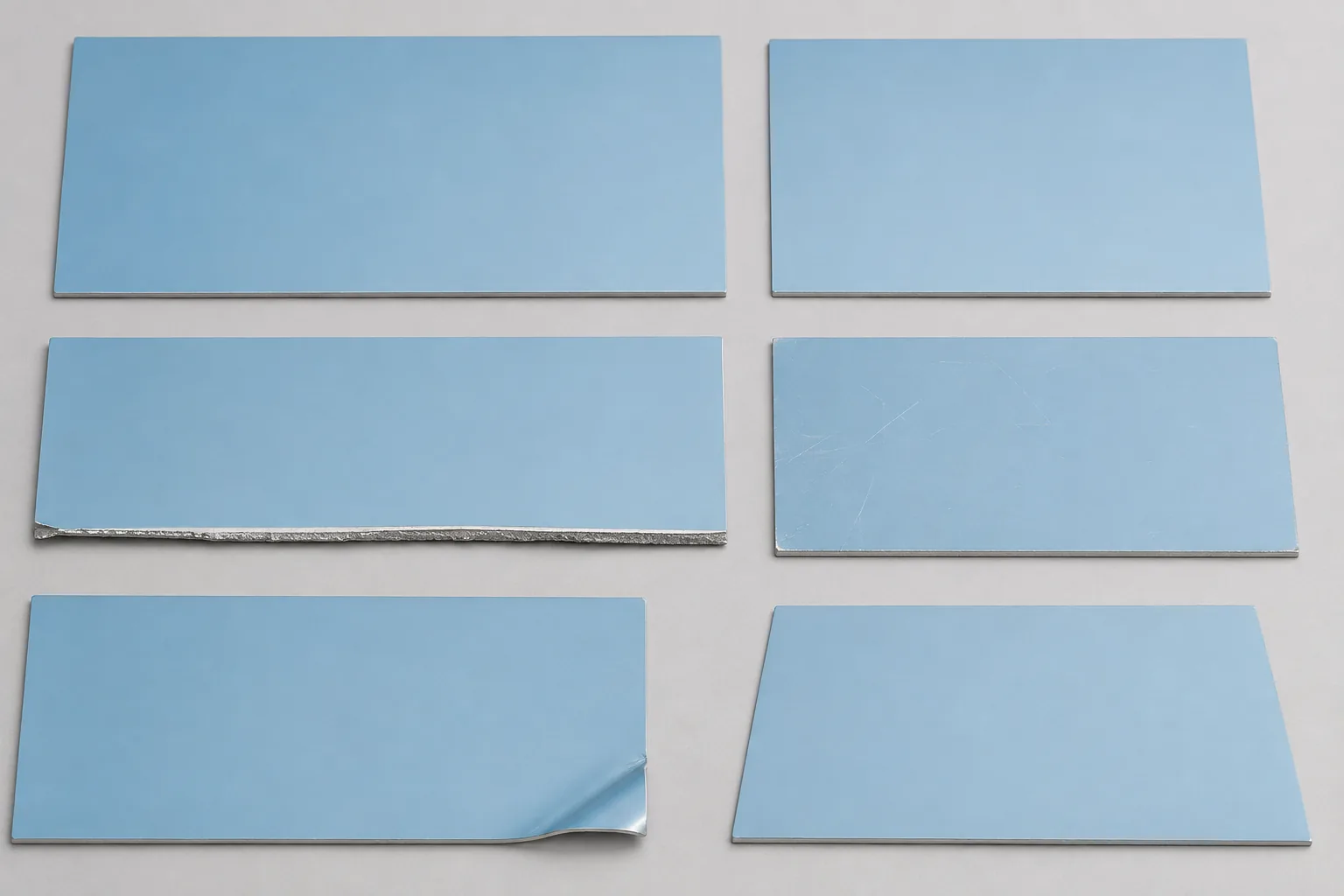
Lithographic plate stock is thin aluminum with a prepared and often coated imaging surface that must remain clean and flat. Format trimming has to restrain the sheet without marking that surface, and the finished edge must travel safely through downstream handling without raised burrs or dog-eared corners.
Updated
Where This Cutting Application Appears
Plate-line width trimming
Removes side margins after surface preparation while preserving the coated face and parallel edges.
Cut-to-format plate conversion
Squares large sheets into press formats with controlled length, width and corner condition.
Short-run plate resizing
Adapts stock plate sizes for proofing or specialized presses after the required gripper and image margins are confirmed.
Plate Edge Trimming And Format Sizing process boundary
plate edge trimming and format sizing for lithographic aluminum printing plates is a linked sequence: the output condition and datum from each operation become the controlled input for the next. It should not be evaluated as one generic cut or accepted only by the final dimension.
Plate Edge Trimming And Format Sizing setup checkpoint
For lithographic aluminum printing plates, define the operation order, intermediate dimensions, registration transfer, material support, web or part handling and waste route for every stage of plate edge trimming and format sizing.
Plate Edge Trimming And Format Sizing acceptance checkpoint
Verify both intermediate and final results from plate edge trimming and format sizing, including dimensions, registration, edge or feature quality, material damage, waste separation and stable transfer between stages.
Define the Required Cut Result
- Low edge burr on both faces
- Unmarked imaging surface
- Square corners and parallel sides
- Flat plates without bent leading edges
Problems to Diagnose Before Changing the Knife
Raised cutting burr
- Measure burr from the correct plate face
- Inspect knife-to-bed clearance
- Check edge wear and hold-down
Coating scratch or scuff
- Clean hold-down and support surfaces
- Trace handling contact before and after the cut
- Inspect chips trapped beneath the plate
Dog-eared corner
- Review end-of-stroke support
- Check knife alignment at both ends
- Inspect stack height and sheet slip
Out-of-square format
- Verify back-gauge calibration
- Measure knife parallelism
- Check plate seating against the datum
Knife Forms That May Be Considered
| Possible knife form | When it may be considered | What must be confirmed |
|---|---|---|
| straight guillotine shear knife | Provides full-width format cutting when the back gauge, hold-down, bed knife and blade angle are controlled for thin plate. | Confirm the final geometry and mounting from the plate guillotine and bed knife, an unworn sample or an approved drawing before manufacture. |
| paired rotary trim knives | May suit continuous plate-line side trimming where the coating is supported and slit debris is removed without contacting the face. | Confirm the final geometry and mounting from the lithographic plate-line trim station, an unworn sample or an approved drawing before manufacture. |
| flying straight shear knife | May serve in-line cut-to-length equipment that synchronizes the stroke with moving plate stock. | Confirm the final geometry and mounting from the plate-line flying shear, an unworn sample or an approved drawing before manufacture. |
Information to Send for Technical Review
You do not need to know the exact blade name. Send the available workpiece, machine, current-knife and cut-result information so the application can be reviewed against a drawing or sample.
- Plate cutter or production-line model
- Aluminum alloy, temper and plate thickness
- Surface treatment and imaging-coating side
- Plate format, tolerance and squareness method
- Single-sheet or stack-cut condition
- Hold-down, bed knife and back-gauge arrangement
- Marked burr, scratch and corner-defect samples
- Knife drawing, quantity and delivery requirement
Questions About This Cutting Application
Which side should face the knife during plate trimming?
Follow the cutter design and coating-protection method; identify the imaging face in every sample and drawing.
Why do only the last corners bend?
Sheet slip, uneven hold-down, end clearance or loss of support near stroke completion can distort a corner.
Can several plates be cut as a stack?
Only after stack height, coating protection, slip and burr transfer have been evaluated on the actual cutter.
How should squareness be specified?
State the datum edge, measuring method, plate condition and allowed diagonal or angular deviation.
Is an uncoated aluminum sample sufficient?
It can confirm size but not surface risk; a production-representative coated plate is needed for handling and marking review.
Related product and service information
- Trimming Sheet-Metal Blanks - sheet-metal blanks · blank trimming
- Cutting Expanded Metal Mesh - expanded metal mesh · cross-cutting and edge trimming
- Cutting Thin Metal Gasket Sheet - thin metal gasket sheet · profile cutting and blanking
Request a Custom Cutting-Knife Review
Send the workpiece details, machine or holder information, current knife photos or sample, required quantity and examples of the present cut problem. Final dimensions, material, edge geometry and tolerances are confirmed from the approved requirements.