
Blade Application Guides / Application Guide / sealing component production
Cutting Thin Metal Gasket Sheet
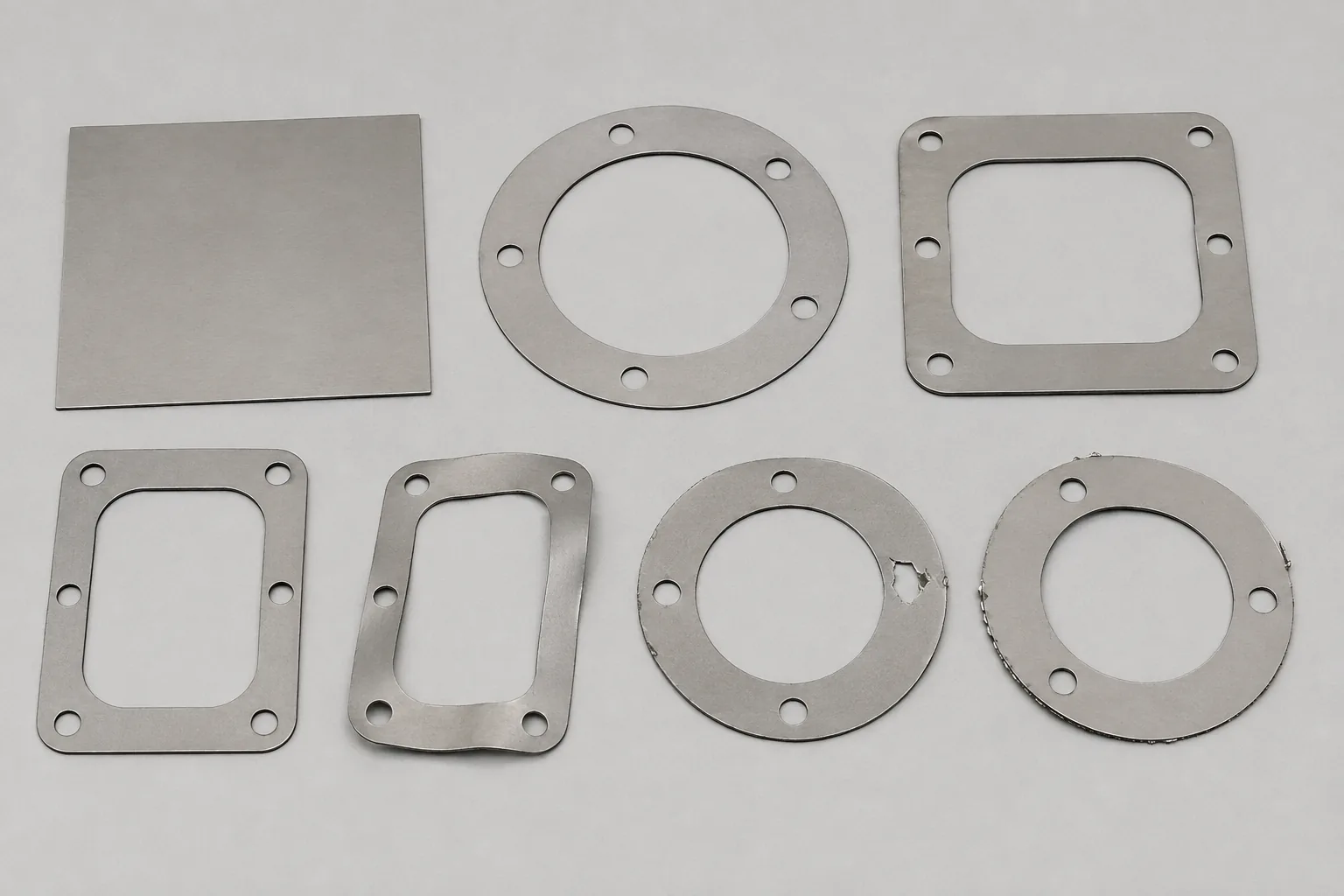
Metal gasket blanks often combine a thin, springy sheet with narrow bridges, bolt holes and sealing contours. Cutting sequence and support are critical because a profile can meet its outline dimensions yet arrive twisted, burred or cracked at the smallest ligaments.
Updated
Where This Cutting Application Appears
Flat gasket and shim blanking
Cuts stainless, copper or aluminum sheet into controlled outer profiles and registration features.
Ring and flange gasket production
Forms concentric inside and outside edges while preserving the narrow annulus between them.
Preform preparation for embossed seals
Produces accurately oriented blanks before beads or sealing features are formed in a later operation.
Profile Cutting And Blanking process boundary
profile cutting and blanking for thin metal gasket sheet is a linked sequence: the output condition and datum from each operation become the controlled input for the next. It should not be evaluated as one generic cut or accepted only by the final dimension.
Profile Cutting And Blanking setup checkpoint
For thin metal gasket sheet, define the operation order, intermediate dimensions, registration transfer, material support, web or part handling and waste route for every stage of profile cutting and blanking.
Profile Cutting And Blanking acceptance checkpoint
Verify both intermediate and final results from profile cutting and blanking, including dimensions, registration, edge or feature quality, material damage, waste separation and stable transfer between stages.
Define the Required Cut Result
- Accurate outer profile and hole position
- Flat blank without twist or dish
- Low burr on designated sealing faces
- Intact narrow bridges and ring sections
Problems to Diagnose Before Changing the Knife
Narrow section bends or twists
- Review cut sequence between inner and outer profiles
- Check hold-down near thin ligaments
- Measure sheet temper and residual stress
Bolt hole tears out
- Inspect punch-to-die clearance
- Check distance from hole to edge
- Review slug release and local support
Intermittent perimeter burr
- Map burr to profile transitions
- Inspect localized knife or die wear
- Verify tool alignment through the stroke
Profile shifts from datum
- Check stock location and pilot condition
- Inspect sheet slip under hold-down
- Separate tooling error from springback after release
Knife Forms That May Be Considered
| Possible knife form | When it may be considered | What must be confirmed |
|---|---|---|
| matched profile blanking knives | Upper and lower contoured tooling suits repeated gasket outlines when clearance is controlled around holes, radii and narrow bridges. | Confirm final geometry and mounting from the gasket blanking die, an unworn sample or an approved drawing before manufacture. |
| straight shear knives | Straight shearing may prepare rectangular blanks or strip widths before detailed profile cutting. | Confirm final geometry and mounting from the thin-sheet shear, an unworn sample or an approved drawing before manufacture. |
| rotary strip-slitting knives | Paired circular tools may convert master coil into gasket feed widths while burr direction and strip camber are managed. | Confirm final geometry and mounting from the gasket-stock slitter, an unworn sample or an approved drawing before manufacture. |
Information to Send for Technical Review
You do not need to know the exact blade name. Send the available workpiece, machine, current-knife and cut-result information so the application can be reviewed against a drawing or sample.
- Press, cutter or slitter model
- Metal grade, temper and sheet thickness
- Gasket drawing with datums and tolerances
- Minimum bridge, hole and corner dimensions
- Required burr direction and flatness method
- Feed form, stack height and cut sequence
- Marked breakout, twist and burr samples
- Tool drawing, quantity and production schedule
Questions About This Cutting Application
Why does a thin gasket become dished after blanking?
Uneven clearance, residual stress, cut sequence or ejection force can release the profile asymmetrically.
Which profile should be cut first on a narrow ring?
The correct sequence depends on how the annulus is supported and located; review the actual die layout rather than applying a universal rule.
Can burr be removed after blanking?
A secondary process may be possible, but it can alter thickness, flatness and sealing edges; define the permitted condition before tooling is finalized.
Why do bolt holes crack toward the outside edge?
A short ligament, excessive deformation or poor local support can connect the hole fracture to the perimeter.
Is a finished gasket enough to reproduce the cutting tool?
It shows the released part, not die clearance, springback or mounting; provide the controlled drawing and press details as well.
Related product and service information
- Coated Canvas Leatherette Cut To Size Blades - coated canvas leatherette · cut to size
- Trimming Sheet-Metal Blanks - sheet-metal blanks · blank trimming
- Cutting Expanded Metal Mesh - expanded metal mesh · cross-cutting and edge trimming
Request a Custom Cutting-Knife Review
Send the workpiece details, machine or holder information, current knife photos or sample, required quantity and examples of the present cut problem. Final dimensions, material, edge geometry and tolerances are confirmed from the approved requirements.