
Blade Application Guides / Application Guide / metal mesh fabrication
Cutting Expanded Metal Mesh
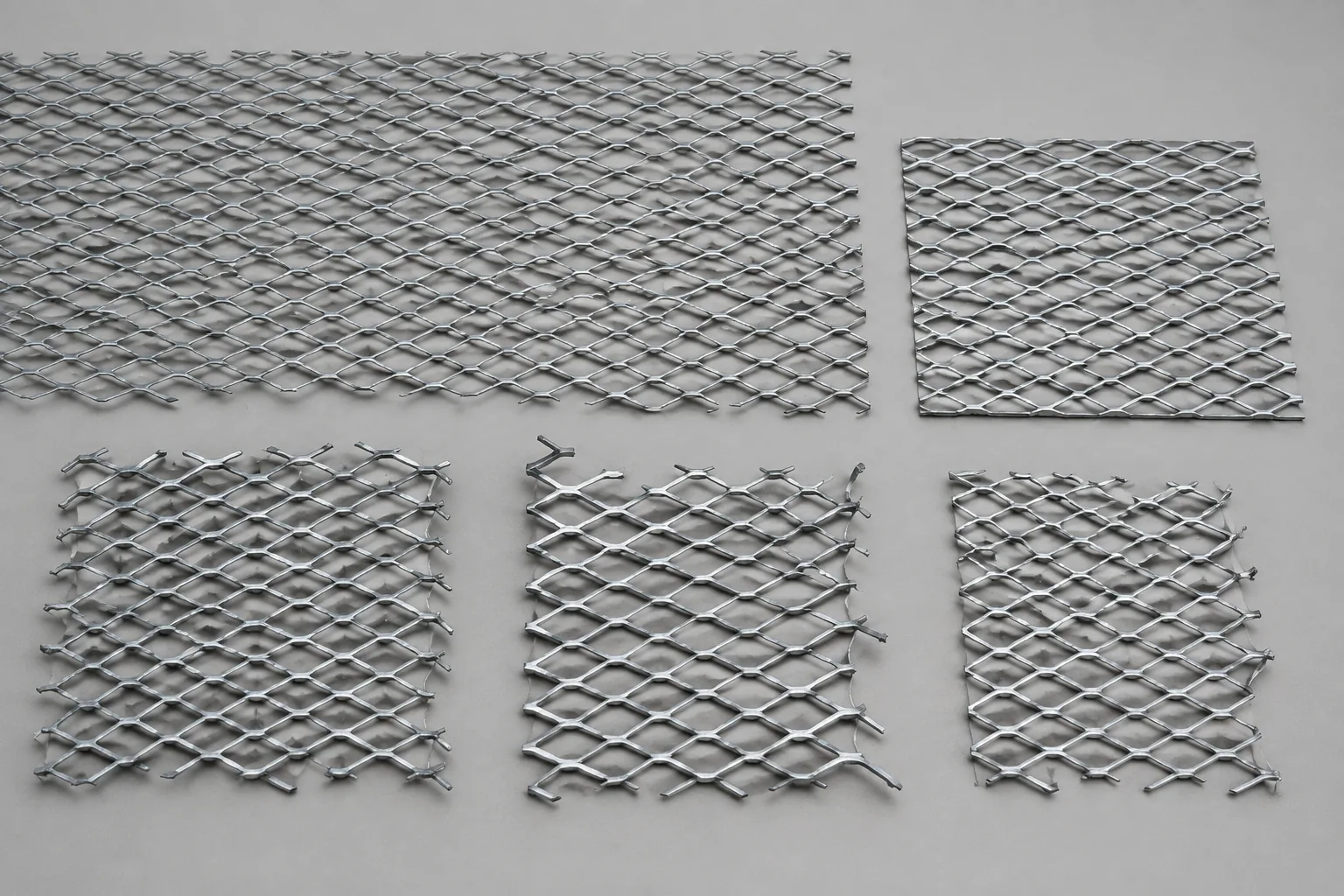
Expanded metal is slit and stretched into connected strands, so the cutter meets alternating open cells, knuckles and solid margins rather than a uniform sheet. The mesh must be restrained without flattening its profile, and the cut line should be planned around diamond orientation and the required finished border.
Updated
Where This Cutting Application Appears
Guard and enclosure panel sizing
Cuts expanded-metal sheets into framed inserts while retaining enough solid border for fastening.
Walkway and platform infill
Squares raised mesh panels while controlling sharp projections along load-bearing edges.
Architectural screen conversion
Produces repeated decorative panels whose diamond direction, flatness and visible edge must remain consistent.
Cross-Cutting And Edge Trimming process boundary
cross-cutting and edge trimming for expanded metal mesh is a linked sequence: the output condition and datum from each operation become the controlled input for the next. It should not be evaluated as one generic cut or accepted only by the final dimension.
Cross-Cutting And Edge Trimming setup checkpoint
For expanded metal mesh, define the operation order, intermediate dimensions, registration transfer, material support, web or part handling and waste route for every stage of cross-cutting and edge trimming.
Cross-Cutting And Edge Trimming acceptance checkpoint
Verify both intermediate and final results from cross-cutting and edge trimming, including dimensions, registration, edge or feature quality, material damage, waste separation and stable transfer between stages.
Define the Required Cut Result
- Complete separation without uncut strands
- Controlled diamond geometry at the border
- Flat panel without local crushing
- Low burr and no hooked projections
Problems to Diagnose Before Changing the Knife
Strand pulls instead of shearing
- Identify strand width, thickness and alloy
- Support the exit-side knuckle
- Inspect clearance and local edge wear
Diamond cells distort
- Check hold-down contact pattern
- Review cut direction relative to mesh orientation
- Separate raised from flattened mesh conditions
Panel snags during release
- Locate hooked partial strands
- Inspect ejection and scrap clearance
- Check whether the cut crosses solid margins
Edge line wanders
- Establish a datum independent of cell openings
- Verify mesh squareness before cutting
- Check sheet movement under the hold-down
Knife Forms That May Be Considered
| Possible knife form | When it may be considered | What must be confirmed |
|---|---|---|
| straight guillotine shear knives | Full-width shearing may suit mesh panels when the hold-down bridges openings and the lower edge supports knuckles along the cut. | Confirm final geometry and mounting from the mesh guillotine and lower knife, an unworn sample or an approved drawing before manufacture. |
| matched profile trim knives | Contoured press tooling may cut repeated borders or notches where mesh location is positively controlled. | Confirm final geometry and mounting from the expanded-metal trimming die, an unworn sample or an approved drawing before manufacture. |
| powered rotary shear cutter | Guided rotary shearing may serve long straight trims if the mesh profile and border remain supported through the cut. | Confirm final geometry and mounting from the expanded-metal rotary trim station, an unworn sample or an approved drawing before manufacture. |
Information to Send for Technical Review
You do not need to know the exact blade name. Send the available workpiece, machine, current-knife and cut-result information so the application can be reviewed against a drawing or sample.
- Cutter or press manufacturer and model
- Metal grade and surface coating
- Raised or flattened mesh designation
- Strand width, strand thickness and overall thickness
- Diamond size and long-way orientation
- Panel size, border layout and tolerance
- Marked tear, distortion and burr samples
- Tool drawing, quantity and delivery destination
Questions About This Cutting Application
Why does the mesh stretch at the cut instead of separating?
Unsupported strands can rotate or pull before fracture; review diamond direction, hold-down coverage and knife clearance.
Can raised and flattened expanded metal share one setup?
Do not assume so. Their overall thickness, contact points and response to clamping are different.
How should panel size be measured when edge diamonds are open?
Define datums at solid borders, strand centerlines or an agreed envelope so inspection does not depend on irregular tips.
What creates a dangerous hooked edge?
A partially severed strand, knife chip or unsupported exit can leave a projection; map it to the cell and cutting position.
Is a small mesh coupon enough for tool review?
A coupon shows strand geometry, but full panel support, border layout and machine stroke still require drawings and equipment data.
Related product and service information
- Aluminum Lithographic Printing Plate Trimming - lithographic aluminum printing plates · plate edge trimming and format sizing
- Trimming Sheet-Metal Blanks - sheet-metal blanks · blank trimming
- Cutting Thin Metal Gasket Sheet - thin metal gasket sheet · profile cutting and blanking
Request a Custom Cutting-Knife Review
Send the workpiece details, machine or holder information, current knife photos or sample, required quantity and examples of the present cut problem. Final dimensions, material, edge geometry and tolerances are confirmed from the approved requirements.