
Blade Application Guides / Application Guide / pipe extrusion
Cutting Extruded Plastic Pipe to Length
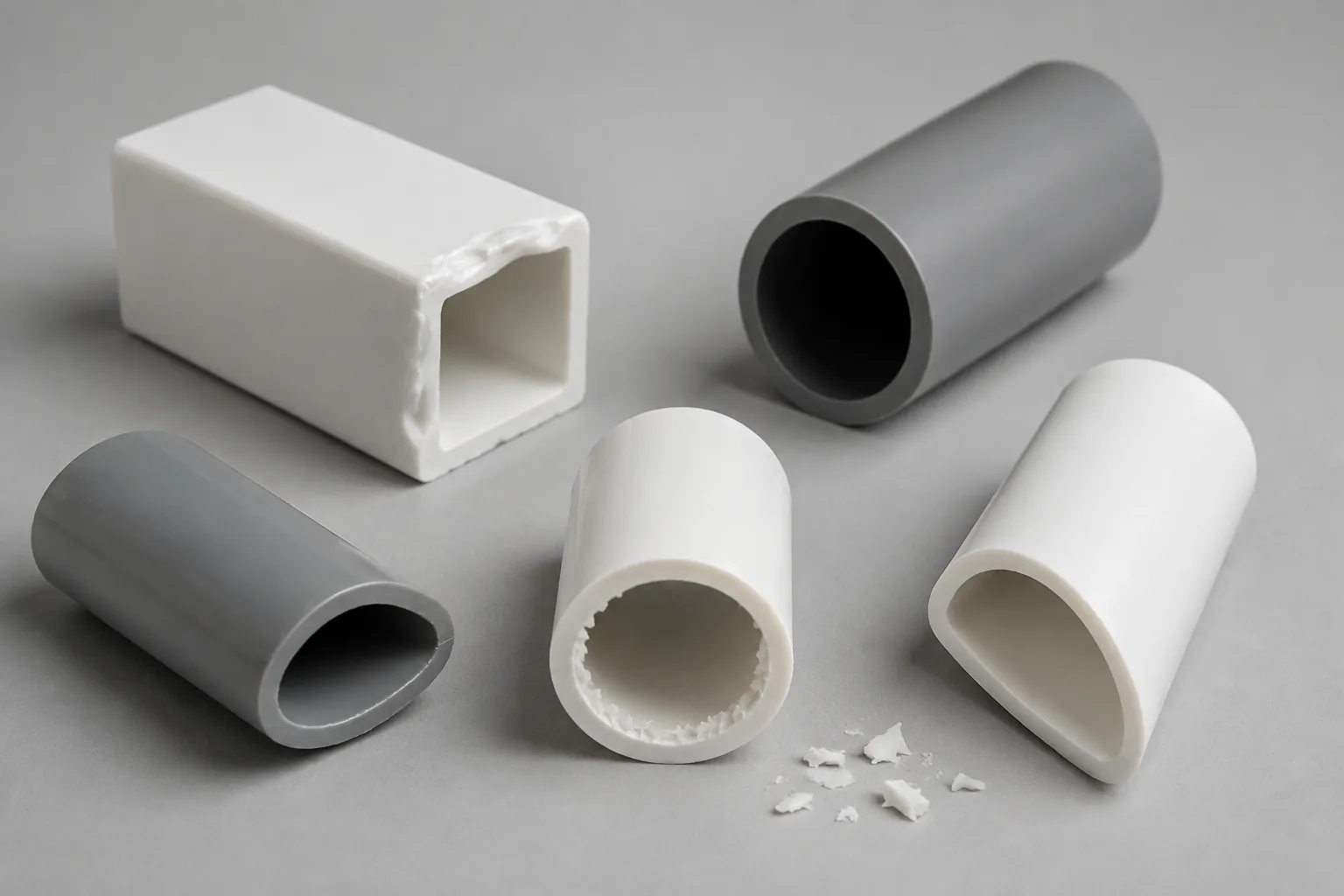
Extruded pipe remains warm and can be round, multilayer or thin-walled at cutoff. The cutoff motion must synchronize with line travel and support the circumference so the wall separates without collapsing or rubbing long enough to melt.
Updated
Where This Cutting Application Appears
Flying extrusion cutoff
Cuts moving pipe to length with a carriage synchronized to the haul-off.
Socket and fitting preparation
Produces square ends suitable for later chamfering, belling or joining.
Thin-wall tube changeover
Revises support and cutting speed when wall stiffness drops.
In-Line Cut-To-Length process boundary
in-line cut-to-length for rigid plastic pipe is planned around separation across the material flow or part axis to establish a controlled repeat length or finished end; it is not longitudinal width conversion, shaped contour production or particle-size reduction.
In-Line Cut-To-Length setup checkpoint
For rigid plastic pipe, confirm target length, datum or registration reference, feed indexing, support on both sides, cut timing and post-cut transfer.
In-Line Cut-To-Length acceptance checkpoint
For rigid plastic pipe, evaluate length distribution, squareness or cutoff angle, both cut faces, deformation, registration drift and stacking or discharge consistency.
Define the Required Cut Result
- Square face around the circumference
- Open round bore without collapse
- Low internal and external burr
- No melted smear or heat distortion
Problems to Diagnose Before Changing the Knife
Melted edge
- Check cutting speed and dwell
- Inspect edge friction and deposits
- Record pipe temperature
Oval end
- Review clamp pressure
- Support thin wall evenly
- Measure recovery after release
Bore burr
- Inspect exit-side support
- Check tooth or edge wear
- Confirm feed per revolution
Angled face
- Verify carriage synchronization
- Check pipe-axis alignment
- Measure guide and spindle runout
Knife Forms That May Be Considered
| Possible knife form | When it may be considered | What must be confirmed |
|---|---|---|
| planetary circular cutter | Cuts around the circumference and may reduce one-sided wall collapse on compatible extrusion equipment. | Confirm the final geometry and mounting from the planetary pipe cutter equipment, an unworn sample or an approved drawing before manufacture. |
| toothed cutoff blade | May suit rigid thick-wall pipe when tooth pitch, chip removal and speed avoid melting. | Confirm the final geometry and mounting from the pipe cutoff saw equipment, an unworn sample or an approved drawing before manufacture. |
| supported shear knife | May suit small profiles captured in shaped tooling where deformation is controlled. | Confirm the final geometry and mounting from the pipe shear station equipment, an unworn sample or an approved drawing before manufacture. |
Information to Send for Technical Review
You do not need to know the exact blade name. Send the available workpiece, machine, current-knife and cut-result information so the application can be reviewed against a drawing or sample.
- Extrusion and cutoff model
- Polymer and layer construction
- Outside diameter and wall range
- Pipe temperature at cutoff
- Line speed and cut cycle
- Clamp or mandrel support
- End-face and bore-burr samples
- Knife drawing, quantity and destination
Questions About This Cutting Application
Why does plastic melt at cutoff?
Excess rubbing, dull edges, unsuitable speed or hot pipe can raise interface temperature.
How is squareness checked?
Define datum, circumference locations and allowed face angle.
Can thin-wall pipe be clamped firmly?
Excess force can ovalize it; support must match wall stiffness.
Does multilayer pipe need special review?
Yes. Layers may differ in toughness and adhesion.
What sample is useful?
Send a full-ring cut section with entry, exit and machine direction marked.
Related product and service information
- Trimming Composite Honeycomb Panels - sandwich composite honeycomb panels · panel edge trimming
- Trimming PET Sheet Edges - PET sheet and thin gauge strip · edge trimming
- Slitting Cross-Linked PE Foam Sheets - cross-linked PE foam sheets · slitting and strip cutting
Request a Custom Cutting-Knife Review
Send the workpiece details, machine or holder information, current knife photos or sample, required quantity and examples of the present cut problem. Final dimensions, material, edge geometry and tolerances are confirmed from the approved requirements.