
Blade Application Guides / Application Guide / thermoforming sheet production
Trimming PET Sheet Edges
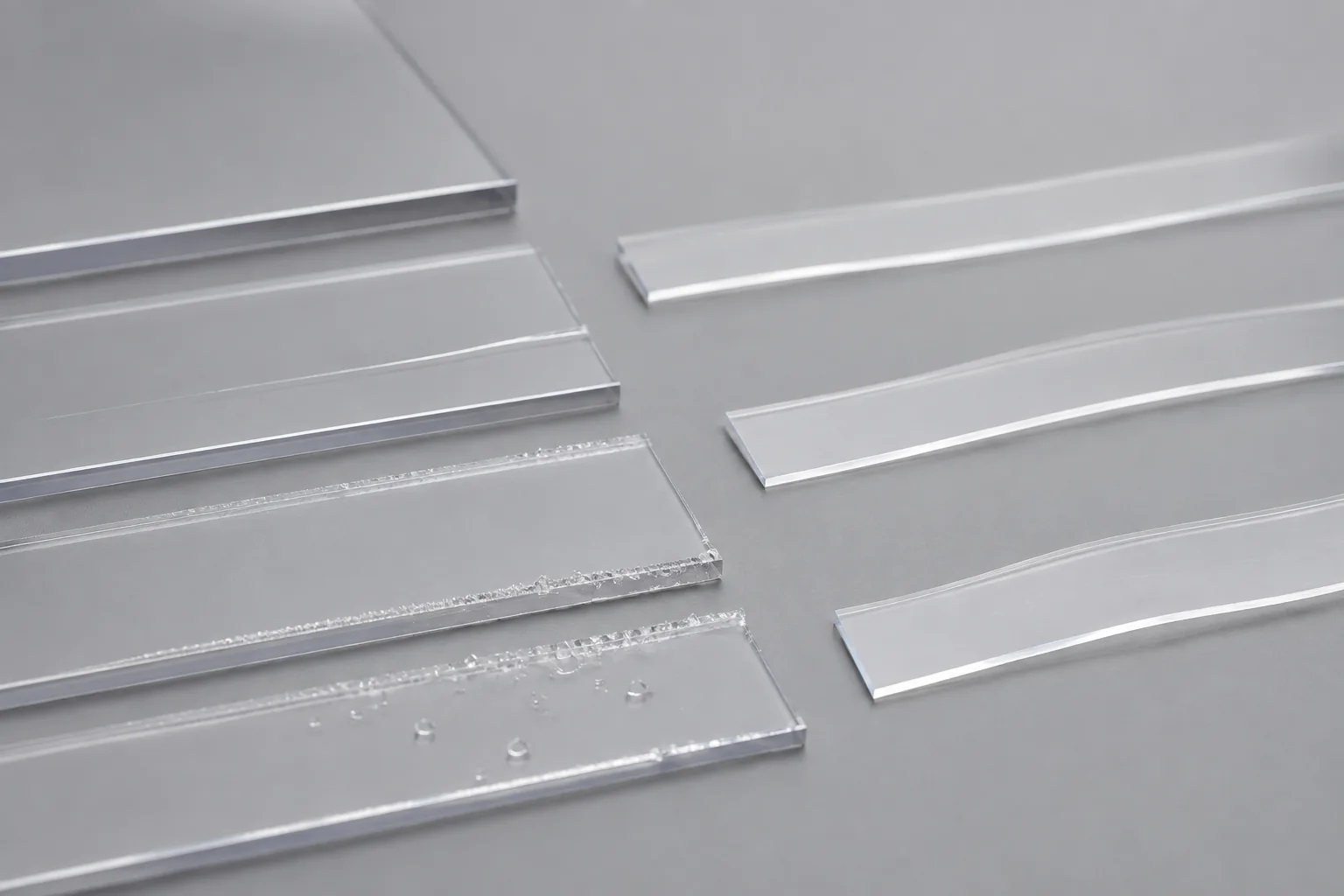
PET sheet can be amorphous, crystallized, oriented or recycled-content stock, and its edge response changes with gauge and temperature. Trim quality depends on supporting the sheet without creating local tensile stress that later opens into cracks during thermoforming.
Updated
Where This Cutting Application Appears
Extrusion-line edge trim
Removes unstable margins before winding or sheet stacking.
Thermoforming feed-stock sizing
Sets sheet width while protecting edges that will later be heated and drawn.
Recycled-content grade change
Rechecks fracture and burr behavior when formulation or crystallinity changes.
Edge Trimming process boundary
Edge trimming removes a narrow irregular, damaged or excess margin to finish an existing edge; it does not divide the full workpiece into several production widths.
Edge Trimming setup checkpoint
Define the trim allowance, reference edge, support close to the cut and a waste path that prevents the narrow offcut from re-entering the product.
Edge Trimming acceptance checkpoint
Inspect the finished edge for straightness, local tearing or crushing, surface scuffing and continuity from the start to the end of the trim.
Define the Required Cut Result
- Clear edge without stress whitening
- No cracks propagating from the trim
- Low burr and particulate generation
- Stable sheet width and flatness
Problems to Diagnose Before Changing the Knife
White stress line
- Check sheet temperature and crystallinity
- Inspect edge angle and penetration force
- Look for unsupported bending at separation
Edge cracking
- Condition samples before inspection
- Check notch sensitivity and recycled content
- Inspect microchips along the working edge
Plastic burr
- Review clearance and overlap
- Check edge wear and heat
- Compare burr direction on both sides
Width drift
- Verify web guiding
- Measure holder runout
- Compare sheet gauge across width
Knife Forms That May Be Considered
| Possible knife form | When it may be considered | What must be confirmed |
|---|---|---|
| circular shear slitter | Provides supported shear for continuous sheet when overlap and side clearance suit PET gauge. | Confirm the final geometry and mounting from the PET sheet slitter equipment, an unworn sample or an approved drawing before manufacture. |
| straight shear knife | May suit indexed sheet sizing with rigid clamping and a matched bed edge. | Confirm the final geometry and mounting from the PET sheet shear equipment, an unworn sample or an approved drawing before manufacture. |
| carbide-tipped trim tool | May be considered where abrasive additives or long runs justify a wear-resistant edge and the holder supports it. | Confirm the final geometry and mounting from the PET extrusion trim station equipment, an unworn sample or an approved drawing before manufacture. |
Information to Send for Technical Review
You do not need to know the exact blade name. Send the available workpiece, machine, current-knife and cut-result information so the application can be reviewed against a drawing or sample.
- Extruder or slitter model
- PET grade, crystallinity and recycled content
- Sheet gauge and temperature at trim
- Master and finished widths
- Speed, tension and support span
- Knife overlap, clearance and runout
- White-edge, crack and burr samples
- Knife quantity and destination
Questions About This Cutting Application
Why does PET turn white at the cut?
Local tensile deformation can craze the polymer. Check support, temperature and edge penetration.
Can a clean-looking edge crack during forming?
Yes. Small notches may open under heat and draw, so retain formed trial parts.
Does recycled content affect trimming?
It can alter consistency and fracture response; provide the actual grade range.
How should burr be specified?
Define side, direction and measurement method, not only a visual limit.
Can the current knife be copied?
Use an unworn sample and equipment data; wear can conceal the intended clearance and edge.
Related product and service information
- Cutting Extruded Plastic Pipe to Length - rigid plastic pipe · in-line cut-to-length
- Slitting Cross-Linked PE Foam Sheets - cross-linked PE foam sheets · slitting and strip cutting
- Trimming Composite Honeycomb Panels - sandwich composite honeycomb panels · panel edge trimming
Request a Custom Cutting-Knife Review
Send the workpiece details, machine or holder information, current knife photos or sample, required quantity and examples of the present cut problem. Final dimensions, material, edge geometry and tolerances are confirmed from the approved requirements.