
Blade Application Guides / Application Guide / aerospace and transport composites
Trimming Composite Honeycomb Panels
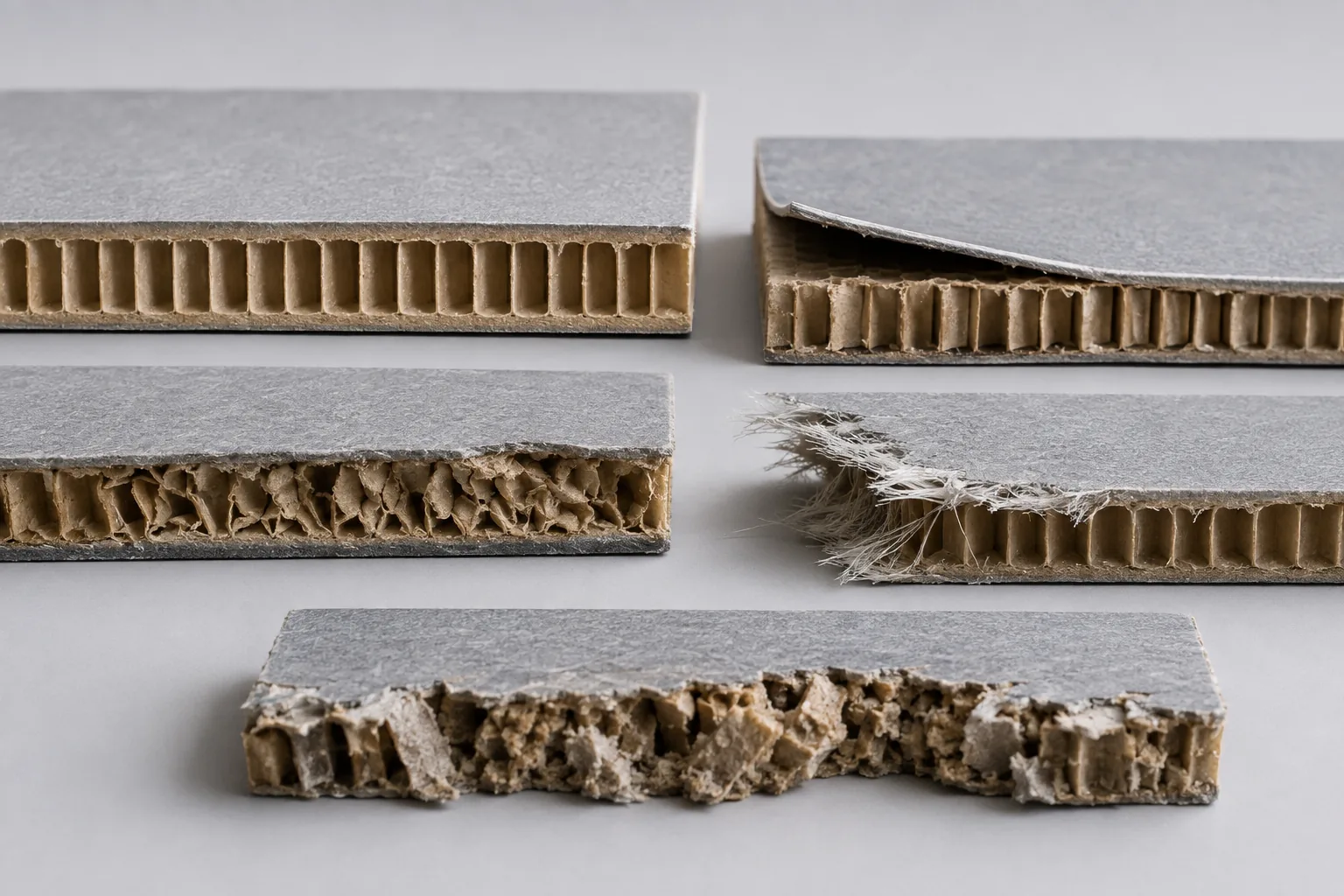
A sandwich panel places stiff composite skins over a lightweight cellular core. Trimming must support the skins and core together; otherwise cutting force can peel the bond line, crush cells or break reinforcement beyond the finished edge.
Updated
Where This Cutting Application Appears
Cured panel perimeter trim
Cuts molded sandwich panels to final outline.
Insert-area preparation
Sizes local edges before inserts or closeouts.
Prototype panel conversion
Produces low-volume development panels from flat stock.
Panel Edge Trimming process boundary
panel edge trimming for sandwich composite honeycomb panels is planned around removal of a defined excess allowance to establish a finished edge, end or perimeter without changing the intended main part geometry; it is not multi-width slitting, primary blank formation or general material size reduction.
Panel Edge Trimming setup checkpoint
For sandwich composite honeycomb panels, confirm trim allowance, finished datum, local support, positional control, part orientation and reliable removal of narrow or irregular waste.
Panel Edge Trimming acceptance checkpoint
For sandwich composite honeycomb panels, evaluate final dimension and edge position, straightness or contour continuity, burr or fray, surface damage and uninterrupted waste removal.
Define the Required Cut Result
- Bonded skin-to-core edge
- Uncrushed honeycomb cells
- Low fiber breakout
- Accurate final profile
Problems to Diagnose Before Changing the Knife
Skin delamination
- Inspect bond quality
- Support exit skin
- Review cutting direction
Core crushing
- Check local support
- Reduce normal load
- Identify core cell and density
Fiber breakout
- Identify reinforcement
- Inspect edge wear
- Control exit-side action
Rough edge
- Separate skin and core defects
- Check speed
- Review debris extraction
Knife Forms That May Be Considered
| Possible knife form | When it may be considered | What must be confirmed |
|---|---|---|
| toothed circular cutter | May suit rigid guided trimming where tooth form and support manage both skins and core. | Confirm the final geometry and mounting from the panel trimming equipment, an unworn sample or an approved drawing before manufacture. |
| straight shear tool | May suit flat stock with continuous support and a compatible shear press. | Confirm the final geometry and mounting from the sandwich-panel shear equipment, an unworn sample or an approved drawing before manufacture. |
| abrasion-resistant trim knife | May be considered where glass or carbon skins dominate wear. | Confirm the final geometry and mounting from the composite trim station equipment, an unworn sample or an approved drawing before manufacture. |
Information to Send for Technical Review
You do not need to know the exact blade name. Send the available workpiece, machine, current-knife and cut-result information so the application can be reviewed against a drawing or sample.
- Panel equipment
- Skin material and layup
- Core material, cell size and density
- Panel thickness
- Profile and tolerance
- Cure and bond condition
- Defect cross-sections
- Tool quantity and destination
Questions About This Cutting Application
Why does the face skin lift at the edge?
Exit-side force or weak bonding can peel the skin; inspect a cross-section.
Can core crushing be cosmetic only?
Do not assume so; define allowable cell damage with the panel engineer.
Does glass skin accelerate wear?
Yes, abrasive reinforcement can change material and maintenance choices.
What support is needed?
Support should restrain both skins without crushing the core.
Can a sample replace the drawing?
It aids review, but final profile and acceptance require controlled data.
Related product and service information
- Silver Metal Foil Coil Slitting Blades - silver metal foil · coil slitting
- Trimming PET Sheet Edges - PET sheet and thin gauge strip · edge trimming
- Cutting Extruded Plastic Pipe to Length - rigid plastic pipe · in-line cut-to-length
Request a Custom Cutting-Knife Review
Send the workpiece details, machine or holder information, current knife photos or sample, required quantity and examples of the present cut problem. Final dimensions, material, edge geometry and tolerances are confirmed from the approved requirements.