
Blade Application Guides / Application Guide / wire harness manufacturing
Heat-Shrink Insulation Tube Cutting
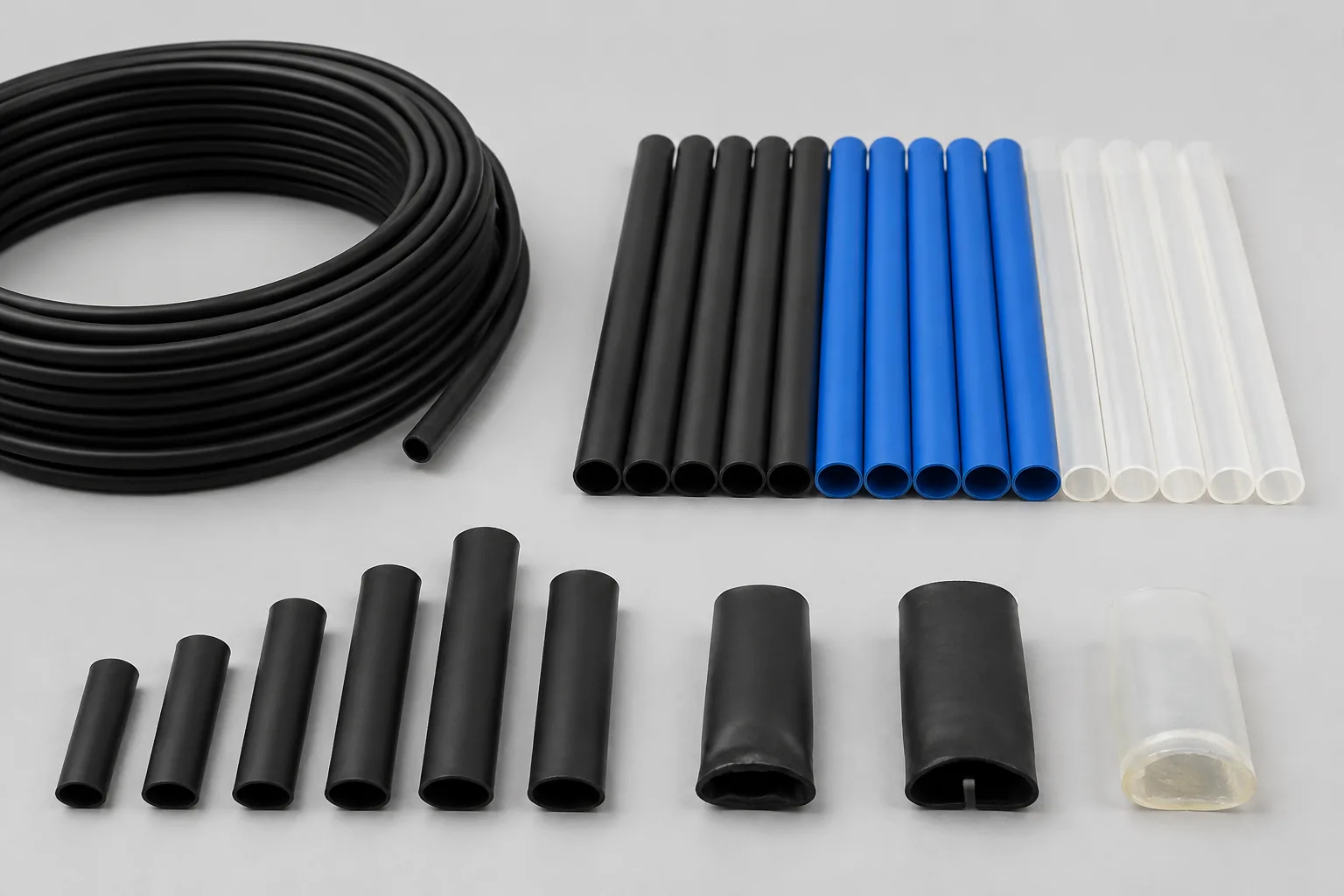
Heat-shrink tubing is flexible, hollow and easily flattened before it is installed or recovered. Length cutting must separate both walls without collapsing the tube, dragging it out of position or leaving a tab where the lower wall deflects from the edge.
Updated
Where This Cutting Application Appears
Cutting harness insulation sleeves
Produce defined lengths that will later cover splices, terminals or identified wire sections.
Portioning thin-wall heat-shrink tube
Separate small flexible tubing without closing the bore or stretching the cut end.
Cutting adhesive-lined tubing
Divide thicker multilayer tube while limiting liner smear and incomplete separation.
Length Cutting process boundary
Length cutting repeatedly separates continuous, bundled or elongated stock to a specified linear dimension; it differs from end cleanup, outline profiling and cuts that form notches or other local features.
Length Cutting setup checkpoint
Confirm the finished length, indexing or feed reference, stock straightness, support on both sides of separation and compensation for material recovery after release.
Length Cutting acceptance checkpoint
Check length distribution, end-face angle, deformation, incomplete separation and repeatability from the first piece through a representative production interval.
Define the Required Cut Result
- Square ends with an open, usable bore
- Complete separation through both tube walls
- Repeatable relaxed length without feed stretch
- Low fray, burr or adhesive smear at the end
Problems to Diagnose Before Changing the Knife
The tube flattens before cutting
Check clamp pressure, support mandrel or groove, edge thickness and distance from restraint to cut.
A tab remains on the lower wall
Review penetration, backing shape, tube position, edge continuity and ovality.
Cut lengths vary after release
Inspect feed-wheel slip, tubing stretch, clamp sequence and when length is measured.
Adhesive liner smears across the bore
Check tube temperature, liner state, edge finish, compression and release motion.
Knife Forms That May Be Considered
| Possible knife form | When it may be considered | What must be confirmed |
|---|---|---|
| straight cutoff knife | A straight knife can suit clamp-and-cut equipment when the tube is supported against collapse. | Confirm cutting width, bevel, stroke, holder, backing groove and tubing size range. |
| serrated cutoff knife | Progressive teeth may help enter thicker or reinforced tube, but can leave tooth marks or pull soft walls. | Confirm tooth geometry, direction and accepted end appearance with representative tube and the actual holder. |
Information to Send for Technical Review
You do not need to know the exact blade name. Send the available workpiece, machine, current-knife and cut-result information so the application can be reviewed against a drawing or sample.
- Tubing polymer and shrink or recovery category
- Unrecovered inside diameter, wall thickness and ovality
- Adhesive lining or reinforcement layers
- Tube condition and temperature at cutting
- Target relaxed length and inspection tolerance
- Feed wheels, clamps, guides and backing geometry
- Current knife dimensions, bevel or tooth profile
- Samples showing collapse, lower-wall tabs, smear or length variation
Questions About This Cutting Application
Why is the bottom tube wall not fully cut?
The hollow section can deflect away from the edge. Check tube support, position and backing contact.
Can a mandrel prevent collapse?
It may support the bore if the machine and tubing range allow it, but the full feed and release sequence must be reviewed.
Why does tubing length change after cutoff?
Feed tension can stretch flexible tube, followed by recovery. Define the measurement state and delay.
Should adhesive-lined tubing use the same edge as plain tubing?
Do not assume so. Liner thickness and tack can alter compression, buildup and release.
What dimensions are needed for a replacement knife?
Provide the holder interface, cutting width, section, mounting, bevel orientation, stroke and backing details, not tube size alone.
Related product and service information
- Pleated Filter Media Pack Cross-Cutting Blades - Pleated multilayer filter media pack · Pleated-pack cross-cutting
- Bread Loaf Slicing and Scoring - bread loaves and bakery products · slicing and scoring
- Medical Gauze Roll Cutting - medical gauze rolls · slitting and length cutting
Request a Custom Cutting-Knife Review
Send the workpiece details, machine or holder information, current knife photos or sample, required quantity and examples of the present cut problem. Final dimensions, material, edge geometry and tolerances are confirmed from the approved requirements.