
Blade Application Guides / Application Guide / commercial baking
Bread Loaf Slicing and Scoring
Bread combines a fragile crust with a compressible, cellular crumb, so the edge must penetrate the crust without crushing the loaf. Slice quality depends on tooth form, loaf cooling, product support and the relative motion between the knife and bread.
Updated
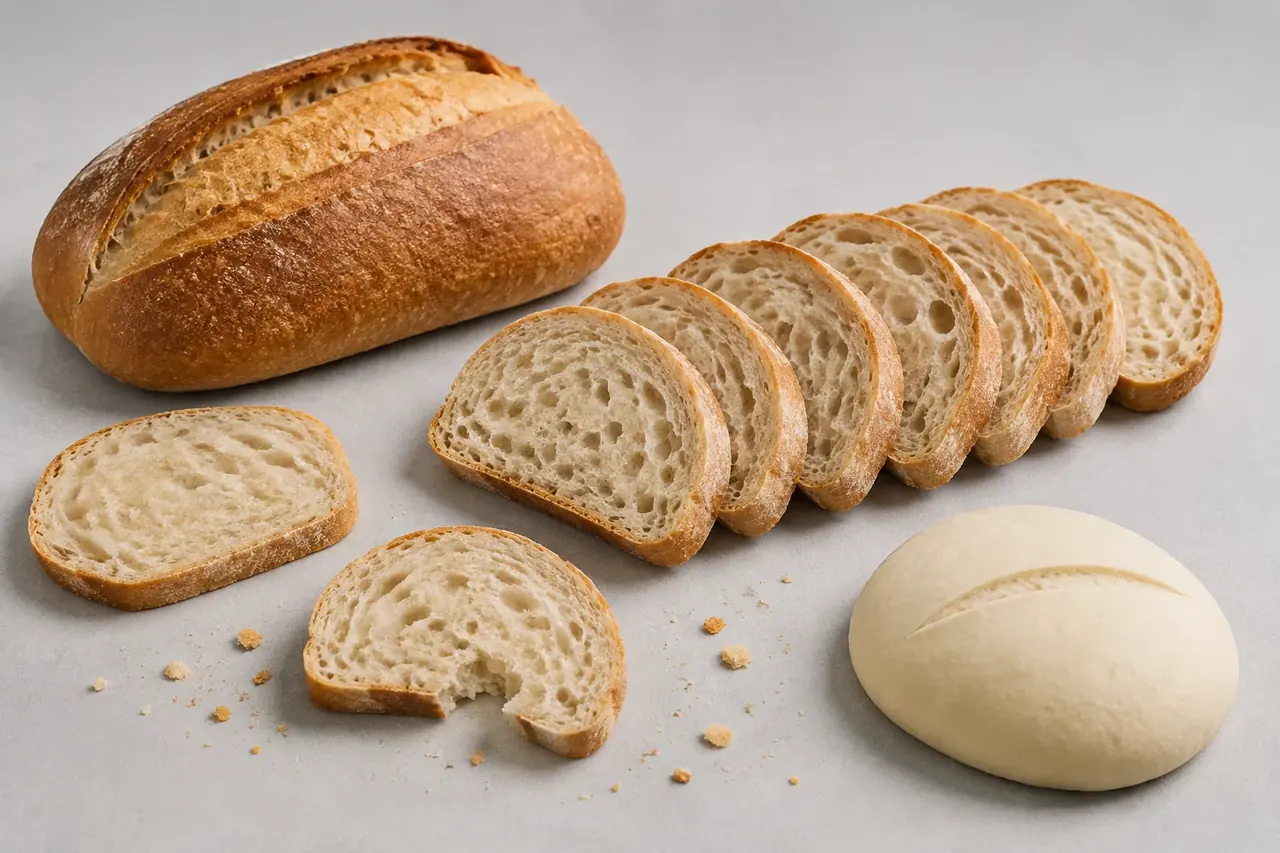
Where This Cutting Application Appears
Slicing cooled sandwich loaves
Produce even slices after the crumb has set, with limited tearing and compression.
Cutting crusty artisan-style loaves
Use progressive tooth entry to pass through a firm crust without breaking away large flakes.
Scoring dough before baking
Create controlled surface openings in unbaked dough; this is a shallow scoring task, not the same specification as loaf slicing.
Slicing And Scoring process boundary
slicing and scoring for bread loaves and bakery products is a linked sequence: the output condition and datum from each operation become the controlled input for the next. It should not be evaluated as one generic cut or accepted only by the final dimension.
Slicing And Scoring setup checkpoint
For bread loaves and bakery products, define the operation order, intermediate dimensions, registration transfer, material support, web or part handling and waste route for every stage of slicing and scoring.
Slicing And Scoring acceptance checkpoint
Verify both intermediate and final results from slicing and scoring, including dimensions, registration, edge or feature quality, material damage, waste separation and stable transfer between stages.
Define the Required Cut Result
- Clean crust entry with limited flaking
- Open crumb cells rather than compressed bands
- Consistent slice thickness across the loaf
- Controlled scoring depth and path where dough scoring applies
Problems to Diagnose Before Changing the Knife
Crumb builds up between teeth
Review loaf cooling, moisture, tooth gullet space, cleaning interval and whether the motion clears material from the edge.
The loaf compresses before the cut
Check hold-down force, edge sharpness, tooth entry, support spacing and whether the loaf has cooled sufficiently.
Slices tear at the bottom crust
Inspect exit support, knife travel, tooth condition and any mismatch between loaf height and cutting stroke.
Scoring depth changes across dough pieces
Review proofing variation, dough skin tension, piece height, blade projection and the scoring path.
Knife Forms That May Be Considered
| Possible knife form | When it may be considered | What must be confirmed |
|---|---|---|
| serrated slicing knife | Progressive teeth are commonly considered for baked loaves because they can enter crust with less whole-edge compression. | Confirm tooth pitch, profile, set if any, blade dimensions, motion and acceptable slice marks using actual loaves. |
| scoring blade | A small scoring edge suits shallow dough opening when projection and angle are controlled by the scoring equipment. | Confirm holder style, exposed depth, path, sanitation and dough condition; do not derive it from a bread-slicing blade. |
Information to Send for Technical Review
You do not need to know the exact blade name. Send the available workpiece, machine, current-knife and cut-result information so the application can be reviewed against a drawing or sample.
- Bread type, formulation and crust style
- Loaf dimensions and variation after baking
- Cooling time and internal condition at slicing
- Target slice thickness and acceptable crumb level
- Machine cutting motion, guides and support spacing
- Existing tooth profile, blade dimensions and tensioning method
- Cleaning procedure and buildup location
- Photos of top crust, crumb face and bottom-exit defects
Questions About This Cutting Application
Why must bread cool before slicing?
A warm crumb may deform or adhere more readily. Provide the actual cooling window because product condition can be as important as the knife.
Does a finer tooth always make a cleaner slice?
No. Tooth pitch must suit crust, crumb, motion and clearing behavior; teeth that are too fine may load with product.
What causes a compressed band through the crumb?
Possible causes include a dull or thick edge, excessive hold-down, insufficient slicing motion or bread that has not stabilized.
Can the same blade slice bread and score dough?
These duties differ in depth, product state and holder design. Treat them as separate specifications unless the equipment documentation says otherwise.
What should a crumb complaint sample include?
Retain an intact slice, identify its position in the loaf and photograph the entry and exit crusts before handling changes the crumb.
Related product and service information
- Medical Gauze Roll Cutting - medical gauze rolls · slitting and length cutting
- Wet Wipe Nonwoven Cross-Cutting - wet wipe nonwoven webs · folded-web cross cutting
- Heat-Shrink Insulation Tube Cutting - heat-shrink insulation tubing · length cutting
Request a Custom Cutting-Knife Review
Send the workpiece details, machine or holder information, current knife photos or sample, required quantity and examples of the present cut problem. Final dimensions, material, edge geometry and tolerances are confirmed from the approved requirements.