
Blade Application Guides / Application Guide / medical textiles
Medical Gauze Roll Cutting
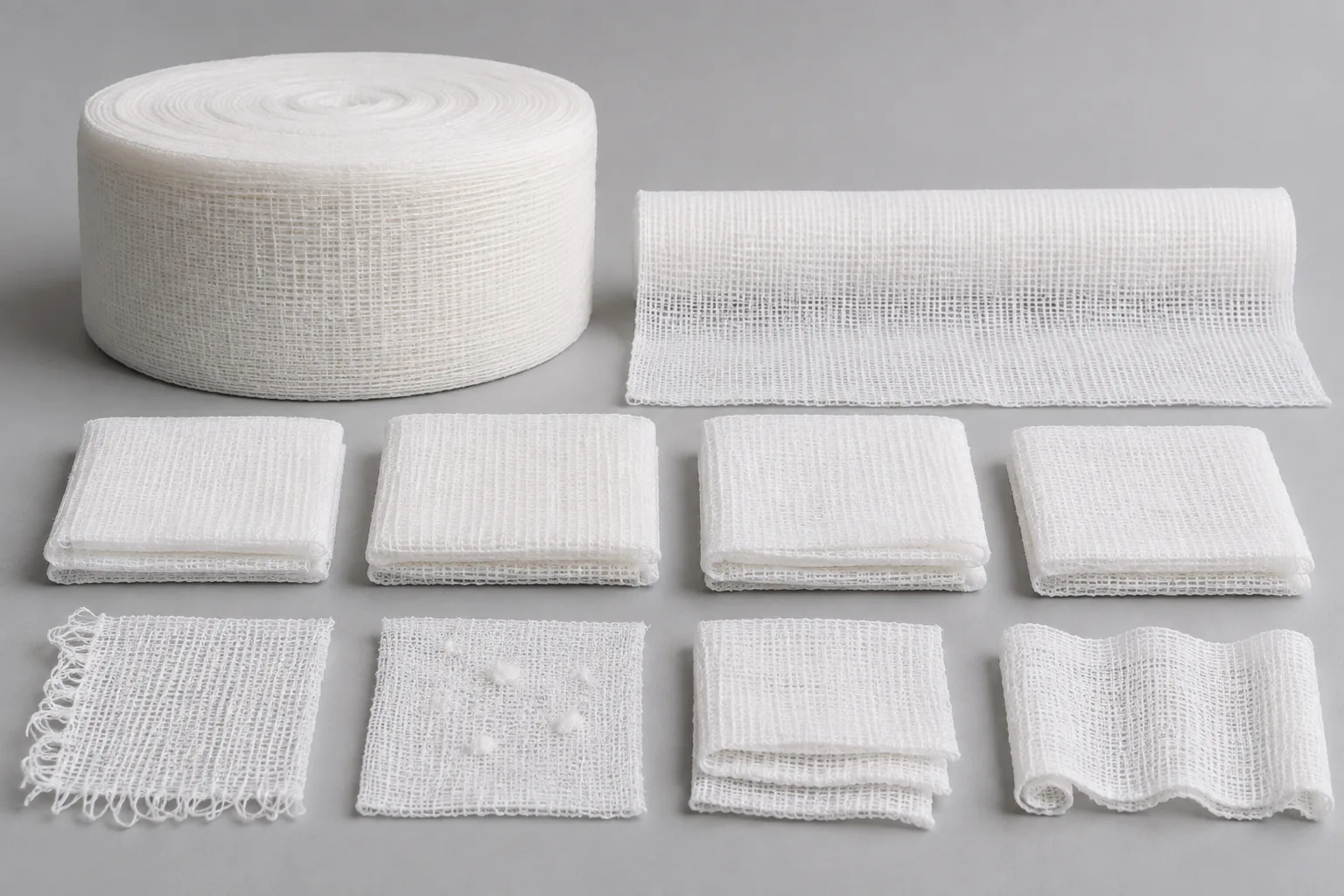
Medical gauze is an open woven structure that readily distorts when individual yarns are pulled or when stacked plies shift. A clean cut depends on restraining the weave close to the edge, completing every yarn and managing lint without compacting the product beyond its acceptable state.
Updated
Where This Cutting Application Appears
Slitting master gauze rolls
Divide wide woven material into narrower rolls before folding, layering or downstream conversion.
Cross-cutting folded gauze webs
Cut multiple folded plies to length for later product assembly while maintaining layer alignment.
Sizing gauze pads or strips
Separate supported woven blanks where loose yarns and edge distortion must be controlled.
Slitting And Length Cutting process boundary
slitting and length cutting for medical gauze rolls is a linked sequence: the output condition and datum from each operation become the controlled input for the next. It should not be evaluated as one generic cut or accepted only by the final dimension.
Slitting And Length Cutting setup checkpoint
For medical gauze rolls, define the operation order, intermediate dimensions, registration transfer, material support, web or part handling and waste route for every stage of slitting and length cutting.
Slitting And Length Cutting acceptance checkpoint
Verify both intermediate and final results from slitting and length cutting, including dimensions, registration, edge or feature quality, material damage, waste separation and stable transfer between stages.
Define the Required Cut Result
- Complete yarn separation without long pulled loops
- Low visible lint at slit and cross-cut edges
- Stable width and length despite the open weave
- Aligned plies without excessive compression or shifting
Problems to Diagnose Before Changing the Knife
Warp or weft yarns pull from the edge
Check cutting direction relative to weave, edge condition, support, tension and whether the fabric is dragged after separation.
Lint increases as the run continues
Review edge wear, accumulated fibers, cleaning or extraction, gauze finish and the time at which lint becomes visible.
Folded plies shift to different lengths
Inspect fold alignment, compression, hold-down, web slip and whether every layer reaches the backing surface.
Narrow rolls develop wavy edges
Check tension profile, web guiding, shaft runout, spacer accuracy and distortion introduced before rewinding.
Knife Forms That May Be Considered
| Possible knife form | When it may be considered | What must be confirmed |
|---|---|---|
| serrated knife | Progressive tooth engagement may help separate a supported gauze stack without loading the full width at once. | Confirm tooth pitch, depth and direction, blade stroke, backing and acceptable edge appearance with the declared ply count. |
| circular slitter | A rotary knife can suit continuous gauze roll conversion when the web is tensioned evenly and supported at the cut. | Confirm cutting mode, diameter, bore, bevel, rotation, lower interface, web speed and lint-control arrangement. |
Information to Send for Technical Review
You do not need to know the exact blade name. Send the available workpiece, machine, current-knife and cut-result information so the application can be reviewed against a drawing or sample.
- Gauze fiber type, yarn count and weave construction
- Finished, coated or untreated material condition
- Single-web thickness and maximum folded ply count
- Machine direction and cut direction relative to the weave
- Master-roll width, finished widths or target pad length
- Web tension, folding, hold-down and backing arrangement
- Current knife dimensions, tooth or edge style and cleaning interval
- Samples showing yarn pull-out, lint, ply shift or wavy roll edges
Questions About This Cutting Application
Why does gauze fray even when the knife feels sharp?
An open weave can move away from the edge if support or tension is uneven. Inspect individual yarn separation and the backing surface.
Should gauze be cut parallel or across the weave?
Both may be required, but they expose different yarn behavior. Mark warp, weft and machine direction on submitted samples.
Can a serrated edge reduce fabric movement?
Progressive engagement may help in some equipment, but tooth geometry can also pull loops. Verify the actual weave and ply count.
What causes folded layers to have unequal lengths?
The plies may slip before or during compression, or penetration may vary through the stack. Review folding and hold-down timing.
How should lint performance be compared?
Use the customer's consistent collection or visual method, with the same gauze, run length and cleaning condition for each comparison.
Related product and service information
- Wet Wipe Nonwoven Cross-Cutting - wet wipe nonwoven webs · folded-web cross cutting
- Bread Loaf Slicing and Scoring - bread loaves and bakery products · slicing and scoring
- Heat-Shrink Insulation Tube Cutting - heat-shrink insulation tubing · length cutting
Request a Custom Cutting-Knife Review
Send the workpiece details, machine or holder information, current knife photos or sample, required quantity and examples of the present cut problem. Final dimensions, material, edge geometry and tolerances are confirmed from the approved requirements.