
Blade Application Guides / Application Guide / Filter element manufacturing
Pleated Filter Media Pack Cross-Cutting Blades
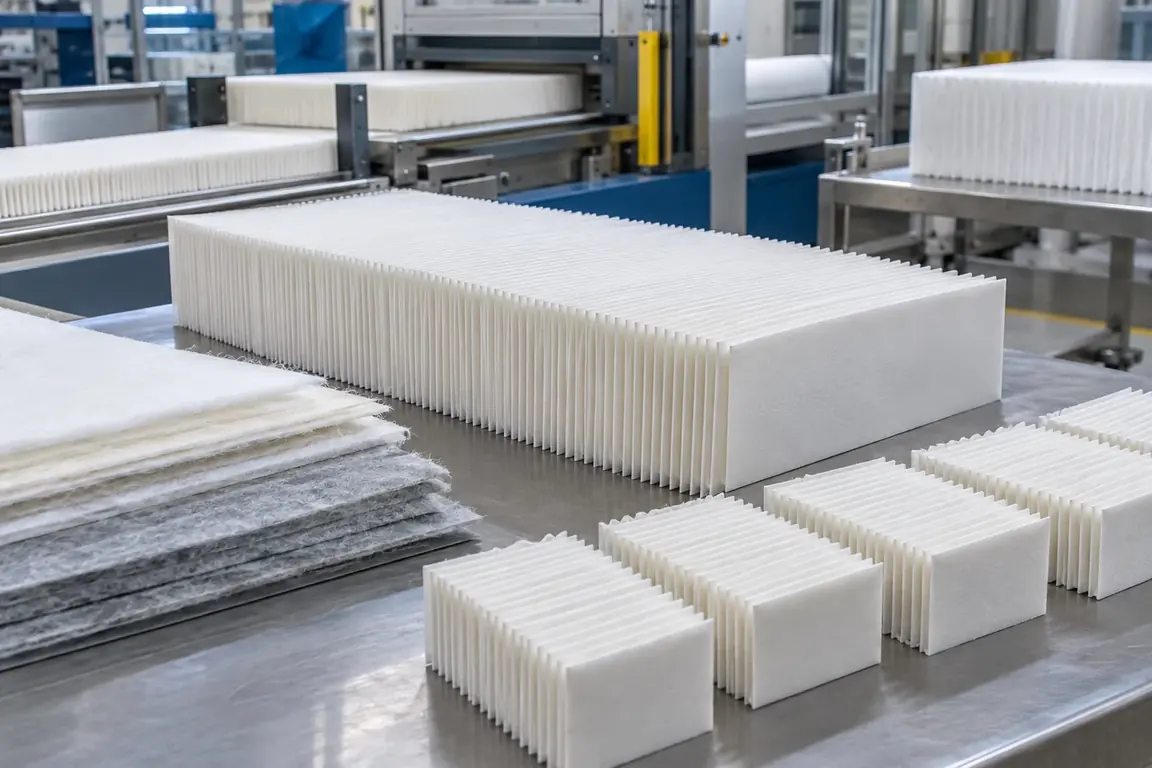
Pleated filter media pack cross-cutting blades separate folded media assemblies to the lengths required for later filter-element construction. This differs from flat-web slitting because the cut passes through repeated folds and may include support, drainage or separator layers. Review should document the actual pack construction, pleat orientation, support and compression condition, finished-end acceptance and debris-control method.
Where This Cutting Application Appears
Pleated-pack length preparation
Continuous or oversized pleated media is separated into controlled pack lengths for element assembly.
Multilayer filter-pack trimming
Media, support and drainage layers are cut together according to the approved pack construction.
End correction before assembly
Uneven or damaged pack ends are trimmed before bonding, framing or installation into a filter housing.
Common Ways to Describe This Cutting Problem
- pleated filter media pack cross cutting blades
- filter pleat pack length cutting knife
- multilayer pleated media cutoff blade
- square end filter pack cutting tools
- pleated cartridge media cross cutter knife
- filter pleat layer separation cutting blade
- supported pleated media pack trimming knife
- clean cut pleated filter element pack blade
Define the Required Cut Result
- Square continuous pack ends across peaks, valleys and included support layers.
- Complete separation without crushed pleats, pulled layers or connected fibers.
- Controlled finished length measured under the customer's defined support condition.
- Reduced loose debris and orderly handling before the next element-assembly step.
Problems to Diagnose Before Changing the Knife
Pleats collapse or shift near the cut end
- Record how the pleated pack is supported and restrained during cutting.
- Inspect pleat spacing before cutting and after the pack is released.
- Compare deformation at peaks, valleys and outer pack faces.
Support or drainage layer remains uncut
- Document every layer included in the supplied pleated construction.
- Identify the layer and fold position where incomplete separation occurs.
- Review layer alignment and local support on repeated cut samples.
Pack end is angled or irregular
- Confirm the measurement datum and support condition used by the customer.
- Check pack alignment and movement through the cutoff station.
- Compare both outer faces and selected internal pleats across the cut end.
Loose fibers or fragments remain inside pleats
- Separate debris generated at the cut end from material already present in the pack.
- Inspect collection, cleaning and transfer steps before element assembly.
- Use the customer's inspection method to compare accepted and rejected pack ends.
Knife Forms That May Be Considered
| Possible knife form | When it may be considered | What must be confirmed |
|---|---|---|
| Oscillating serrated cross-cutting knife | For thicker or resilient pleated packs when a controlled reciprocating sawing action suits the existing machine. | Pack construction, pleat orientation, support, cutting motion, debris control, finished-length datum and accepted end sample. |
| Straight guillotine cutoff knife | When a firmly supported pleated assembly can be separated in one controlled transverse stroke. | Pack support, hold-down condition, complete layer stack, press interface, measurement condition and end acceptance. |
| Continuous band-knife cutting arrangement | For supported pleated packs when the production equipment is designed to guide the assembly through a continuous moving blade. | Pack presentation, guide and support geometry, feed method, blade path, debris collection and downstream handling. |
Information to Send for Technical Review
You do not need to know the exact blade name. Send the available workpiece, machine, current-knife and cut-result information so the application can be reviewed against a drawing or sample.
- Pleated filter-media description, complete layer construction and representative pack samples.
- Pleat orientation, supplied pack condition and identification of support or drainage layers.
- Controlled finished-length or end-profile drawing with datum and revision.
- Support, compression, hold-down and measurement conditions used in production.
- Machine station, tooling interface, feed method, cutting motion and collection arrangement.
- Accepted and rejected ends showing collapse, angled cuts, uncut layers and debris.
- Inspection, cleanliness, debris-removal, handling and downstream bonding requirements.
- Trial quantity, element-assembly sequence and current tooling information if available.
Questions About This Cutting Application
Why is pleated-pack cutting different from flat filter-media slitting?
The blade crosses repeated folds and may cut several media, support and drainage layers under a defined support condition.
How should finished pack length be measured?
Use the customer's approved datum and state how the flexible pleated pack is supported or restrained during measurement.
What samples are useful for blade review?
Provide uncut pack material and accepted and rejected cut ends showing outer faces and representative internal pleats.
Why must support and drainage layers be identified?
They can separate differently from the filter medium and may be the layer that remains attached or shifts at the end.
Can a cutting arrangement be chosen from pleat count alone?
No. The complete construction, support, machine motion, end geometry and accepted condition must be reviewed together.
Request a Custom Cutting-Knife Review
Send the workpiece details, machine or holder information, current knife photos or sample, required quantity and examples of the present cut problem. Final dimensions, material, edge geometry and tolerances are confirmed from the approved requirements.