
Blade Application Guides / Application Guide / Gasket manufacturing
Gasket Sheet Profile Cutting for Clean Bolt Holes
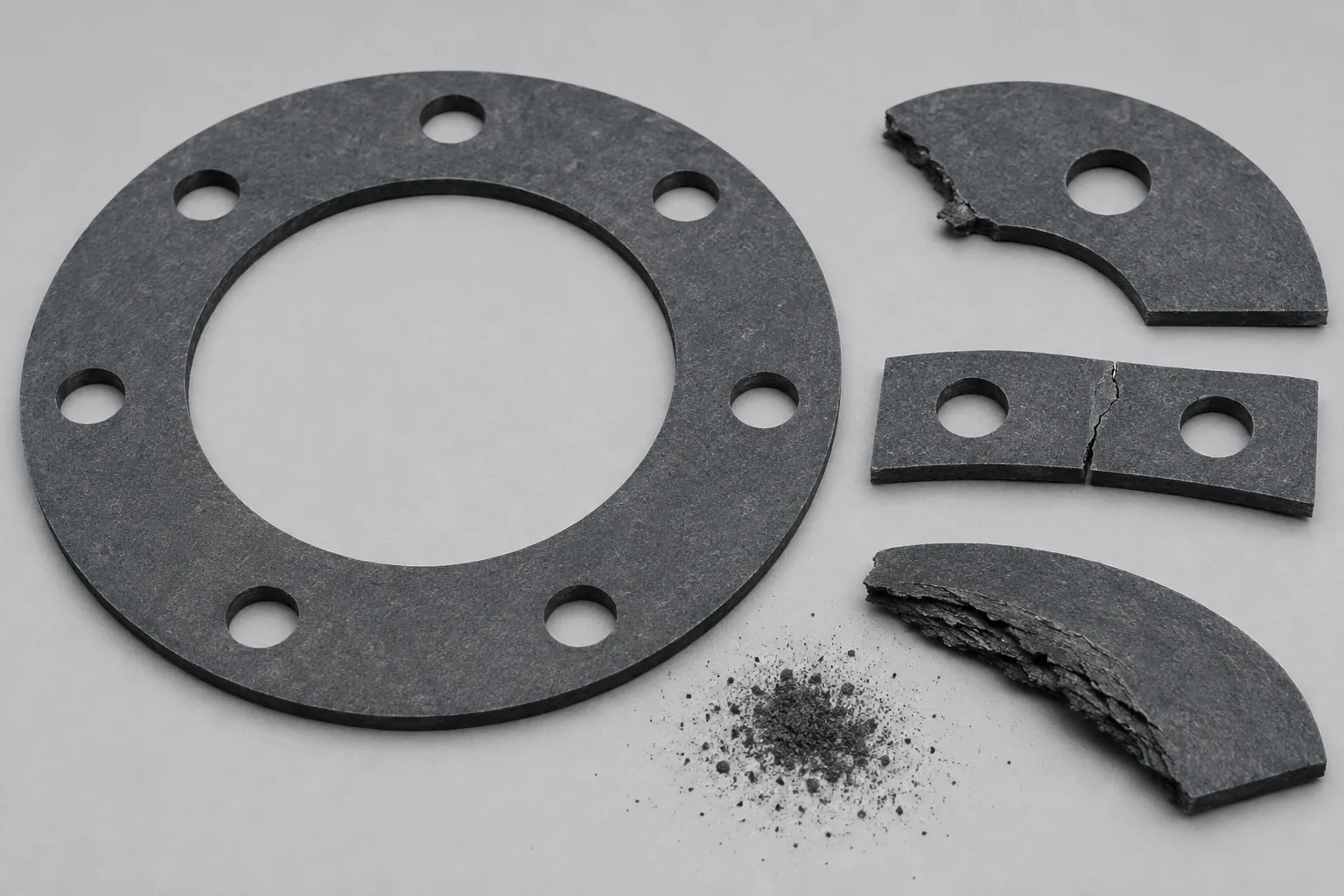
Compressed gasket sheet can contain fibers, elastomer binders, graphite, fillers, or reinforcement that fracture differently at an outer contour and a small bolt hole. Tool choice should follow the approved material grade, sheet thickness, minimum bridge width, hole-to-edge distance, dimensional method, and dust-control requirement.
Updated
Where This Cutting Application Appears
Ring and full-face flange gaskets
Inner and outer diameters plus bolt-hole patterns are cut from approved sheet while annular width and hole position remain tied to the drawing datum.
Irregular equipment-cover gaskets
Asymmetric contours, slots, notches, and mounting holes are produced for housings or covers with narrow bridges protected from fracture.
Nested gasket kits from mixed profiles
Several related shapes are arranged on one sheet to reduce waste while maintaining material identity and sufficient separation between adjacent cuts.
Profile Cutting process boundary
Profile cutting follows the specified finished outline, including shaped or non-rectangular boundaries; it is distinct from straight sizing and narrow edge cleanup.
Profile Cutting setup checkpoint
Review the finished outline, inside and outside radii, start and stop points, material support near corners and the method used to remove shaped waste.
Profile Cutting acceptance checkpoint
Compare the complete profile to the drawing or template, including corners, holes, narrow features, edge condition and fit in the downstream assembly.
Define the Required Cut Result
- Form round, fully separated bolt holes without chipped rims or retained plugs
- Keep narrow lands between holes and outer edges intact during cutting and part removal
- Match the approved contour after the sheet has relaxed from clamping pressure
- Collect fiber, filler, or graphite dust without grinding it into the gasket faces
Problems to Diagnose Before Changing the Knife
Bolt holes show breakout, ovality, or a hanging plug
Review punch-to-die clearance, hole diameter, sheet support, compression, tool concentricity, wear, material direction, and plug-ejection path.
A narrow bridge cracks between the hole and gasket edge
Check drawing geometry, cut sequence, sheet brittleness, fiber orientation, local density, clamping, adjacent-tool spacing, and handling during stripping.
Layers or reinforcement separate along the profile
Examine sheet construction, storage condition, bond integrity, penetration, clearance, blade finish, cutting direction, and whether peel starts during ejection.
Fine dust obscures the edge or contaminates finished parts
Identify dust source by layer, then review abrasion, tool wear, cutting speed, repeated passes, extraction, static, support debris, and post-cut cleaning.
Knife Forms That May Be Considered
| Possible knife form | When it may be considered | What must be confirmed |
|---|---|---|
| Steel-rule profile die | Consider for repeated gasket outlines and hole patterns when the sheet, press, backing, and stripping method suit rule-die conversion. | Confirm profile, rule height and bevel, ejection, joint locations, press condition, make-ready, sheet stack, and accepted part sample. |
| Matched punch and die set | Consider for defined circular holes or profiles where clearance and plug discharge can be controlled by the installed press. | Confirm material construction, thickness range, hole diameter, clearance, punch entry, die support, slug removal, mounting, and tolerance. |
| Oscillating profile knife | Consider for short runs or varied contours where a programmed path can avoid crushing the sheet with a full profile tool. | Confirm corner radii, path order, blade type, support bed, hold-down, feed rate, dust collection, and dimensioned drawing. |
Information to Send for Technical Review
You do not need to know the exact blade name. Send the available workpiece, machine, current-knife and cut-result information so the application can be reviewed against a drawing or sample.
- Gasket-sheet grade and manufacturer specification, construction, binder, filler, and reinforcement if present
- Sheet thickness, density or compressibility data when available, surface finish, grain direction, and storage condition
- Dimensioned profile with hole sizes, center distances, slots, radii, narrow lands, and tolerances
- Inspection datum, conditioning or relaxation time, edge-breakout limits, and hole-roundness method
- Single-sheet or stacked cutting, press type, available force, stroke, support, and hold-down arrangement
- Tool mounting interface, cut sequence, nesting layout, ejection, plug removal, and finished-part stripping
- Dust extraction and cleaning requirements plus any restrictions on release agents or process fluids
- Uncut material, failed holes and profiles, accepted reference parts, annual or batch quantity, and packing method
Questions About This Cutting Application
Why does a small gasket hole tear instead of producing a clean plug?
Hole diameter relative to sheet thickness, clearance, support, punch condition, material brittleness, fiber direction, and slug ejection can prevent complete shearing.
Should inner holes or the outer profile be cut first?
The best sequence depends on nesting, material strength, hold-down, narrow lands, part retention, and stripping. Confirm the sequence on the actual drawing and sheet.
How can a narrow gasket bridge be protected during removal?
Reduce bending during ejection, support the part near the bridge, manage cut order, and avoid tool joints or excessive compression near the weak geometry.
Does a smooth gasket edge guarantee sealing performance?
No. The cut must meet the drawing, but sealing also depends on approved material, flange condition, loading, installation, service media, and application validation.
What should be checked when graphite-rich sheet creates dark dust?
Review whether dust comes from normal fracture or tool abrasion, then assess wear, path repetition, extraction, face contamination, and the purchaser's cleanliness limit.
Related product and service information
- Foam Sealing Strip Cutting Without Compression Set - foam sealing strips · length and profile cutting
- Rubber Diaphragm Blank and Profile Cutting - reinforced rubber diaphragm sheet · blanking and profile cutting
- Industrial Filter Paper Cutting Without Fiber Pullout - industrial filter paper · profile cutting
Request a Custom Cutting-Knife Review
Send the workpiece details, machine or holder information, current knife photos or sample, required quantity and examples of the present cut problem. Final dimensions, material, edge geometry and tolerances are confirmed from the approved requirements.