
Blade Application Guides / Application Guide / diaphragm and sealing component production
Rubber Diaphragm Blank and Profile Cutting
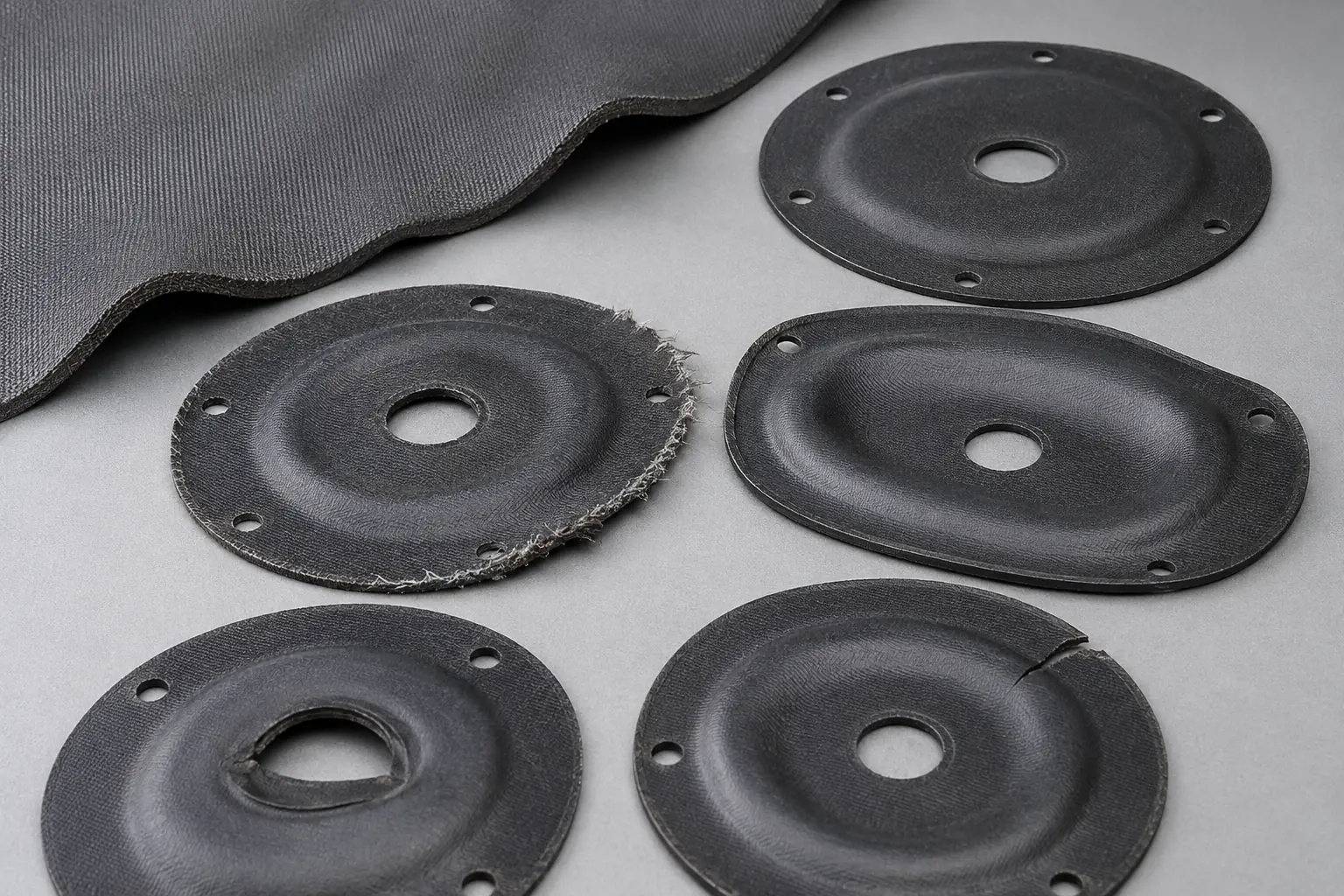
A diaphragm blank must retain flexible working zones and a reliable clamping perimeter after cutting. Rubber hardness, molded or sheet construction, reinforcement orientation and small port features determine how the profile should be supported and separated.
Updated
Where This Cutting Application Appears
Flat diaphragm blanking
Cuts circular or shaped blanks from reinforced sheet before molding, assembly or secondary hole operations.
Finished-diaphragm perimeter trim
Removes flash or excess flange material while preserving the designed sealing land.
Port and bolt-feature cutting
Produces small openings and mounting features whose position must remain referenced to reinforcement or molded geometry.
Blanking And Profile Cutting process boundary
blanking and profile cutting for reinforced rubber diaphragm sheet is a linked sequence: the output condition and datum from each operation become the controlled input for the next. It should not be evaluated as one generic cut or accepted only by the final dimension.
Blanking And Profile Cutting setup checkpoint
For reinforced rubber diaphragm sheet, define the operation order, intermediate dimensions, registration transfer, material support, web or part handling and waste route for every stage of blanking and profile cutting.
Blanking And Profile Cutting acceptance checkpoint
Verify both intermediate and final results from blanking and profile cutting, including dimensions, registration, edge or feature quality, material damage, waste separation and stable transfer between stages.
Define the Required Cut Result
- Smooth sealing perimeter without nicks
- Undamaged reinforcement at flexing zones
- Accurate ports and mounting features
- Stable dimensions after rubber recovery
Problems to Diagnose Before Changing the Knife
Frayed reinforcement at the perimeter
- Identify fabric type and orientation
- Inspect support beneath the cloth layer
- Compare edge direction with the weave
Distorted sealing flange
- Check clamping and ejector pressure
- Measure after defined relaxation
- Inspect whether the edge displaces rubber
Incomplete small features
- Compare feature radius with tool geometry
- Check penetration and backing wear
- Inspect material trapped in narrow openings
Cracks or nicks in a flex zone
- Verify that the cut avoids the designed flex area
- Inspect edge damage and corner transitions
- Check molded-sheet aging and surface condition
Knife Forms That May Be Considered
| Possible knife form | When it may be considered | What must be confirmed |
|---|---|---|
| profile cutting rule | May suit repeated flat blanks where joint, radius, backing and ejection are engineered for the reinforced sheet. | Confirm the mounting dimensions, cutting motion and edge details from the diaphragm blanking equipment, an unworn sample or an approved drawing before manufacture. |
| matched profile knife and die | May support tighter feature position when the press and tooling guide the diaphragm between matched cutting members. | Confirm the mounting dimensions, cutting motion and edge details from the diaphragm cutting equipment, an unworn sample or an approved drawing before manufacture. |
| oscillating knife | May suit lower-volume programmed profiles when the sheet is fully supported and minimum radii match the tool path. | Confirm the mounting dimensions, cutting motion and edge details from the diaphragm profile cutting equipment, an unworn sample or an approved drawing before manufacture. |
Information to Send for Technical Review
You do not need to know the exact blade name. Send the available workpiece, machine, current-knife and cut-result information so the application can be reviewed against a drawing or sample.
- Diaphragm drawing with sealing and flex zones
- Rubber type, hardness and sheet or molded condition
- Reinforcement fabric, ply count and orientation
- Overall thickness and local thickness changes
- Port, hole, radius and position tolerances
- Press or cutting-table support and ejection method
- Accepted and rejected perimeter samples
- Order quantity, packing flatness and destination
Questions About This Cutting Application
Why is reinforcement visible on the diaphragm edge?
The edge may pull the fabric before severing it, or support may be insufficient. Review weave direction and the complete tool interface.
When should a diaphragm be measured after cutting?
Use an agreed conditioning time because rubber recovery and released molding stress can alter the profile.
Can small ports be cut with the outer perimeter?
Possibly, but feature size, spacing, ejection and positional tolerance may justify a separate operation.
Why must the flex zone be shown on the drawing?
A nick or cut transition in the working flex area can be more significant than a cosmetic mark elsewhere.
Can MEIRENTE work from a finished diaphragm sample?
A sample supports measurement, but reinforcement, molded stress and wear can obscure design intent. Confirm a controlled drawing before production.
Related product and service information
- Rubber Hose Cutoff for Square Uncollapsed Ends - rubber hose · length cutoff
- Gasket Sheet Profile Cutting for Clean Bolt Holes - compressed gasket sheet · profile cutting
- Industrial Rubber Sheet Cutting Without Edge Deformation - industrial rubber sheets · sheet cutting
Request a Custom Cutting-Knife Review
Send the workpiece details, machine or holder information, current knife photos or sample, required quantity and examples of the present cut problem. Final dimensions, material, edge geometry and tolerances are confirmed from the approved requirements.