
Blade Application Guides / Application Guide / leather goods manufacturing
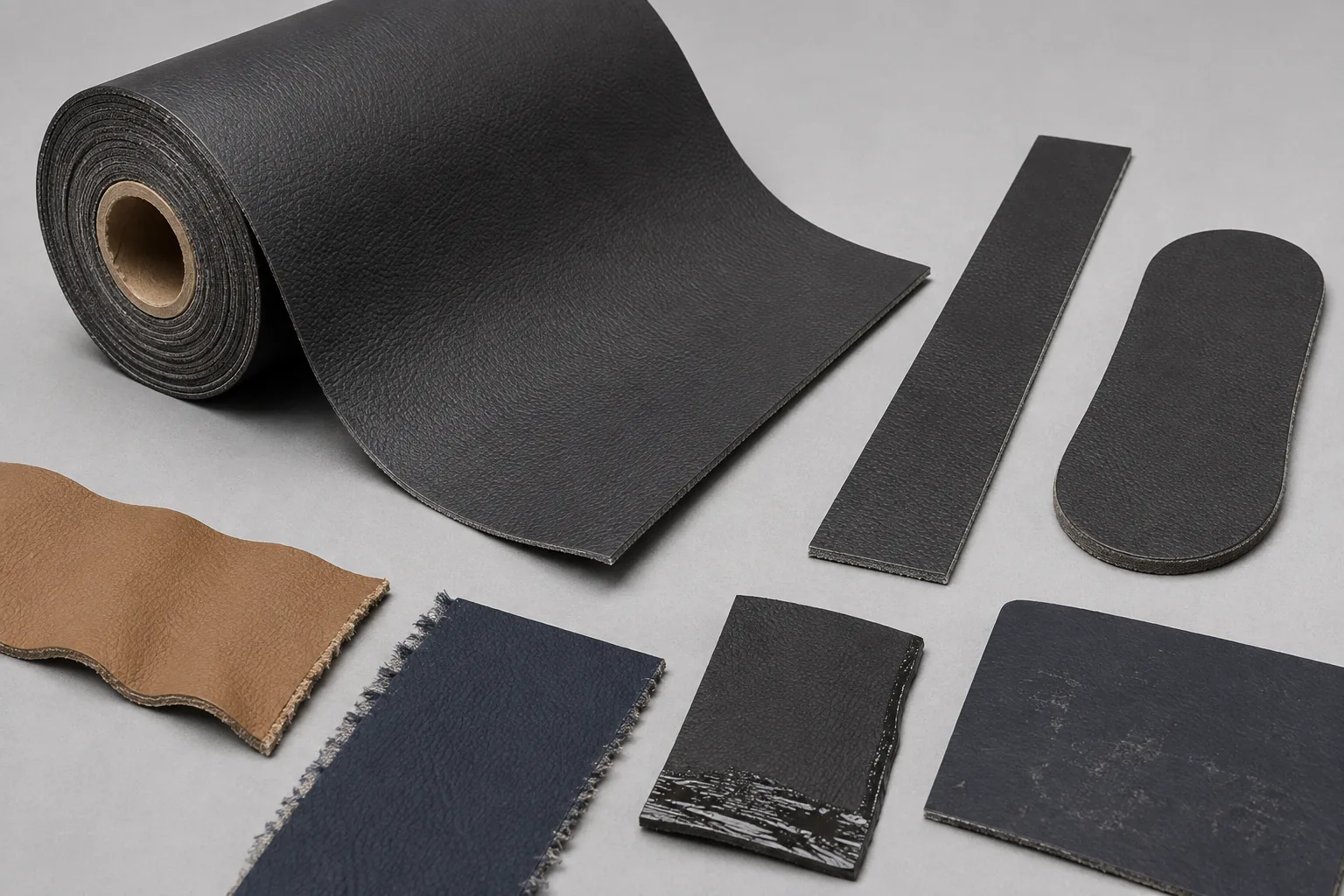
Synthetic Leather Roll Cutting
Synthetic leather is a layered flexible material whose coated face, foam and woven or knitted backing can stretch by different amounts. Roll slitting focuses on tracking and clean lane edges, while pattern cutting adds direction, surface-marking and part-release decisions.
Updated
Where This Cutting Application Appears
Slitting upholstery master rolls
Produce narrower rolls while protecting the decorative grain and keeping backing fibers contained.
Trimming coated roll margins
Remove uneven coating or backing edges before inspection, lamination or shipment.
Cutting repeated component patterns
Profile panels or blanks where grain direction, stretch and visible-face marking must be controlled.
Roll Slitting And Pattern Cutting process boundary
roll slitting and pattern cutting for synthetic leather rolls is a linked sequence: the output condition and datum from each operation become the controlled input for the next. It should not be evaluated as one generic cut or accepted only by the final dimension.
Roll Slitting And Pattern Cutting setup checkpoint
For synthetic leather rolls, define the operation order, intermediate dimensions, registration transfer, material support, web or part handling and waste route for every stage of roll slitting and pattern cutting.
Roll Slitting And Pattern Cutting acceptance checkpoint
Verify both intermediate and final results from roll slitting and pattern cutting, including dimensions, registration, edge or feature quality, material damage, waste separation and stable transfer between stages.
Define the Required Cut Result
- Straight slit edges without backing-fiber tails
- Accurate profiles with limited elastic distortion
- Decorative faces free from pressure marks and scratches
- Complete separation of coating, foam and textile backing
Problems to Diagnose Before Changing the Knife
The coated face stretches or waves at the edge
Review tension, knife drag, unsupported span, coating softness and differential layer recovery.
Backing yarns fray beyond the cut
Check knit or weave direction, edge condition, support and whether the backing is pulled during release.
The face coating smears onto tooling
Inspect polymer type, temperature, friction, surface finish and cleaning interval.
Pattern pieces relax out of shape
Record machine and cross direction, stretch under restraint, hold-down and measurement time after cutting.
Knife Forms That May Be Considered
| Possible knife form | When it may be considered | What must be confirmed |
|---|---|---|
| circular slitter | A rotary edge may suit longitudinal roll conversion where guiding and web tension are stable. | Confirm diameter, bore, bevel, rotation, cutting mode, lower interface and face orientation. |
| profiled cutting knife | A custom outline may suit repeated blanks when radii, stretch direction and part release are defined. | Confirm CAD geometry, knife section, backing, hold-down, grain direction and stripping method. |
Information to Send for Technical Review
You do not need to know the exact blade name. Send the available workpiece, machine, current-knife and cut-result information so the application can be reviewed against a drawing or sample.
- Face polymer and coating or grain construction
- Foam, fabric and adhesive layer sequence
- Total thickness and stretch in machine and cross directions
- Master width, slit plan or profile geometry
- Visible-face marking and edge-fuzz criteria
- Web tension, support, hold-down and release method
- Current knife and lower-interface details
- Samples showing wave, fray, smear, scratches or relaxed distortion
Questions About This Cutting Application
Why must stretch direction be marked?
Coated fabric may recover differently along and across the roll, affecting profile and width after release.
Can PU and PVC synthetic leather use one setup?
Do not assume so. Coating softness, backing and temperature response can differ.
What causes backing fibers to extend past a clean face cut?
The textile layer may deflect or pull during stripping. Inspect backing orientation and support.
How can decorative-face marking be diagnosed?
Map marks to guides, hold-downs and tooling contact, and submit samples before stacking hides the source.
When should a pattern piece be measured?
Use the customer's agreed relaxed condition and time after cutting, with grain direction identified.
Related product and service information
- Clay-Coated Label Paper Roll Slitting: Coating and Edge-Dust Control - clay-coated label paper · roll slitting
- Electrical Cable Jacket Cutting - electrical cable jackets · jacket stripping and scoring
- Cork Sheet and Roll Cutting - cork sheets and rolls · sheet slitting and profiling
Request a Custom Cutting-Knife Review
Send the workpiece details, machine or holder information, current knife photos or sample, required quantity and examples of the present cut problem. Final dimensions, material, edge geometry and tolerances are confirmed from the approved requirements.