
Blade Application Guides / Application Guide / cork converting
Cork Sheet and Roll Cutting
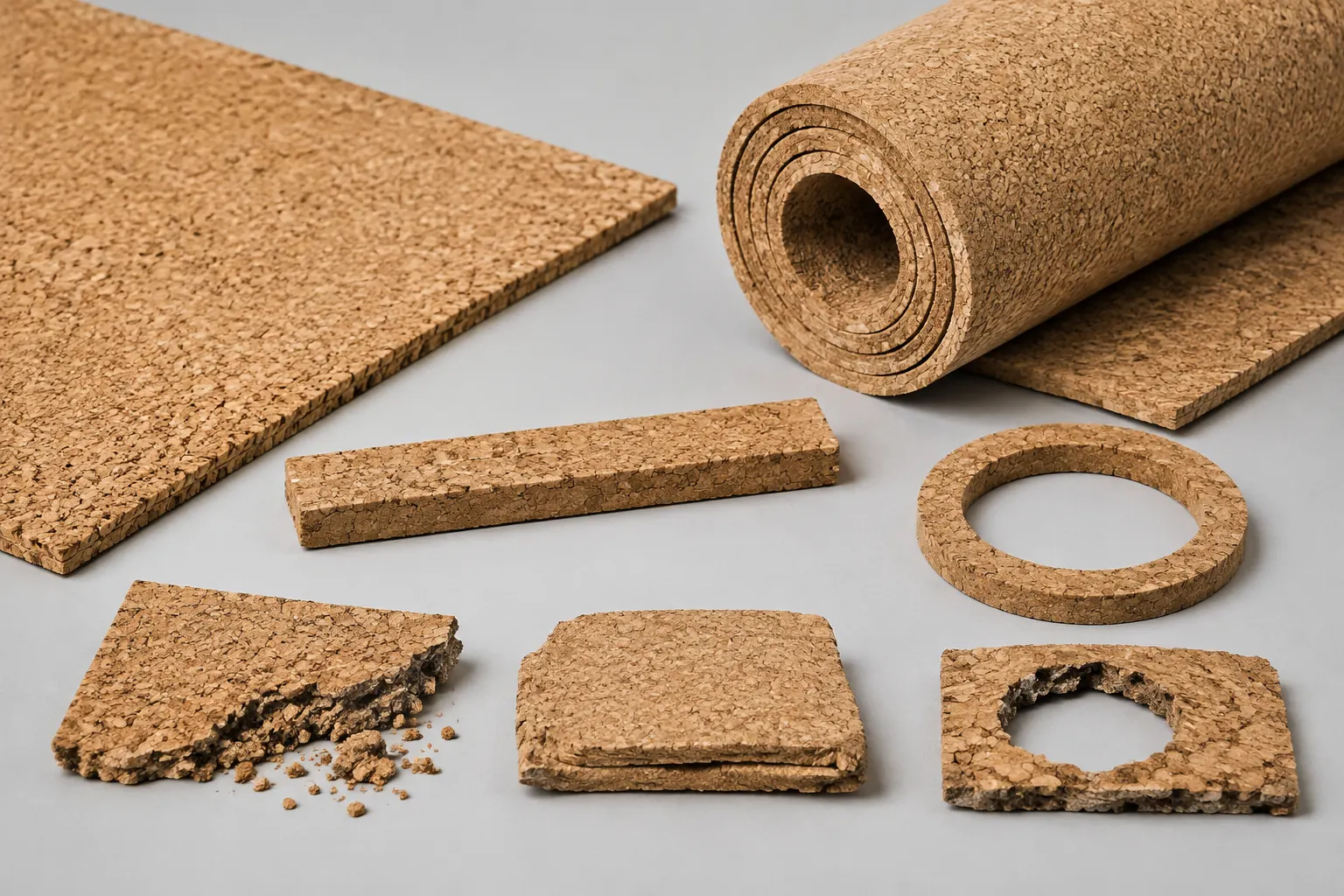
Natural cork sheet contains cellular granules and grain variations, while agglomerated cork adds binder and a more uniform structure. Both compress before cutting and may crumble at unsupported edges, so the intended surface finish and recovery-based dimensions should guide knife and support decisions.
Updated
Where This Cutting Application Appears
Slitting cork rolls into strips
Convert flexible roll stock for seals, lining or decorative fabrication while controlling width and edge crumble.
Sizing natural cork sheets
Trim sheets with visible grain and local density variation before assembly or further machining.
Profiling agglomerated cork parts
Cut gaskets, pads or inserts from binder-held cork according to an approved outline.
Sheet Slitting And Profiling process boundary
sheet slitting and profiling for cork sheets and rolls is a linked sequence: the output condition and datum from each operation become the controlled input for the next. It should not be evaluated as one generic cut or accepted only by the final dimension.
Sheet Slitting And Profiling setup checkpoint
For cork sheets and rolls, define the operation order, intermediate dimensions, registration transfer, material support, web or part handling and waste route for every stage of sheet slitting and profiling.
Sheet Slitting And Profiling acceptance checkpoint
Verify both intermediate and final results from sheet slitting and profiling, including dimensions, registration, edge or feature quality, material damage, waste separation and stable transfer between stages.
Define the Required Cut Result
- Continuous edges with limited loose granules
- Accurate dimensions after compression recovery
- Clean internal radii and holes without tearing
- Stable strip width without roll-edge wander
Problems to Diagnose Before Changing the Knife
Granules crumble from the cut edge
Review cork type, density, binder, support, edge wedge and stripping direction.
The sheet compresses and recovers out of tolerance
Define measurement time, then inspect hold-down pressure, knife thickness and material density.
A slit follows grain or density bands
Check web tension, lateral guidance, knife drag and natural structural variation.
Small profile features tear during release
Review corner radius, ligament width, cut completeness and matrix-removal direction.
Knife Forms That May Be Considered
| Possible knife form | When it may be considered | What must be confirmed |
|---|---|---|
| circular slitter | A rotary knife can suit continuous cork roll conversion when the web is guided and supported close to the cut. | Confirm diameter, bore, bevel, rotation, backing or lower interface, tension and cork construction. |
| straight guillotine knife | A straight edge may suit sheet sizing with uniform support and controlled hold-down. | Confirm cutting length, bevel, stroke, bed, stack height and recovery-based tolerance. |
| profiled cutting knife | A closed or contoured knife can suit repeated cork shapes if radii and part release match the material. | Confirm CAD profile, knife section, backing, penetration, stripping and representative cork samples. |
Information to Send for Technical Review
You do not need to know the exact blade name. Send the available workpiece, machine, current-knife and cut-result information so the application can be reviewed against a drawing or sample.
- Natural, composition or agglomerated cork type
- Density, granule size and binder where applicable
- Sheet or roll thickness and compression behavior
- Visible grain or preferred material direction
- Strip plan or profile drawing with radii
- Measurement condition and tolerance after recovery
- Machine, holder, backing and stripping arrangement
- Samples showing crumble, drift, compression or torn features
Questions About This Cutting Application
Why does natural cork cut differently across one sheet?
Grain, pores and density vary locally. Mark where each rejected edge came from.
Can higher hold-down prevent crumbling?
It may stabilize the sheet but can distort dimensions. Evaluate the part after pressure is released.
Does agglomerated cork need the same edge as natural cork?
Not necessarily. Granule size, binder and density change fracture and buildup.
How should a cork gasket be measured?
Use the customer's agreed conditioning and recovery period, especially for thick compressible stock.
What causes a slit to wander?
Material variation, web guiding, tension, knife drag or shaft alignment may all contribute.
Related product and service information
- Electrical Cable Jacket Cutting - electrical cable jackets · jacket stripping and scoring
- Synthetic Leather Roll Cutting - synthetic leather rolls · roll slitting and pattern cutting
- Decorative Veneer Roll Slitting - decorative veneer rolls · continuous veneer slitting
Request a Custom Cutting-Knife Review
Send the workpiece details, machine or holder information, current knife photos or sample, required quantity and examples of the present cut problem. Final dimensions, material, edge geometry and tolerances are confirmed from the approved requirements.