
Blade Application Guides / Application Guide / wire and cable
Electrical Cable Jacket Cutting
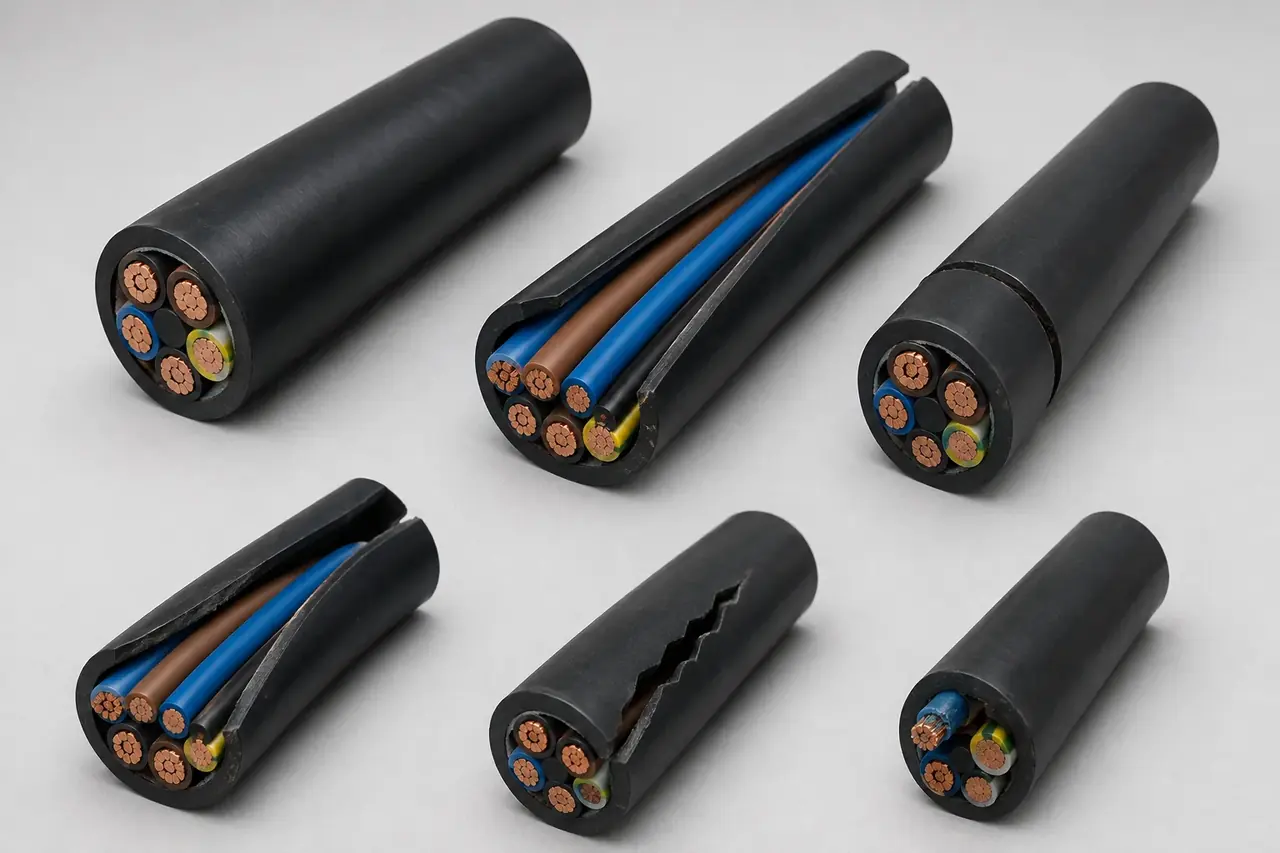
Jacket cutting opens or removes polymer insulation while the conductor, shield or inner layer should remain usable. Unlike recycling chopping, success depends on controlled penetration and cable location: diameter variation, eccentric conductors and curved cable can all turn a nominal depth into conductor damage.
Updated
Where This Cutting Application Appears
Longitudinally opening cable jackets
Score or slit along a cable so the outer jacket can be peeled away for termination or processing.
Ring cutting insulation at a strip length
Create a circumferential cut that defines where a jacket section will be removed.
Removing outer jackets before conductor recovery
Open long cable sections while preserving copper, shielding or inner insulation for the next operation.
Jacket Stripping And Scoring process boundary
jacket stripping and scoring for electrical cable jackets is a linked sequence: the output condition and datum from each operation become the controlled input for the next. It should not be evaluated as one generic cut or accepted only by the final dimension.
Jacket Stripping And Scoring setup checkpoint
For electrical cable jackets, define the operation order, intermediate dimensions, registration transfer, material support, web or part handling and waste route for every stage of jacket stripping and scoring.
Jacket Stripping And Scoring acceptance checkpoint
Verify both intermediate and final results from jacket stripping and scoring, including dimensions, registration, edge or feature quality, material damage, waste separation and stable transfer between stages.
Define the Required Cut Result
- Jacket penetration sufficient for clean removal
- No nicks in conductor, shield or inner insulation
- Consistent strip length and opening path
- Low jacket tearing beyond the intended cut
Problems to Diagnose Before Changing the Knife
Conductors show periodic nicks
Check cable concentricity, guide wear, penetration, runout, bend and synchronization with the scoring edge.
Jacket will not peel after scoring
Review cut depth, polymer toughness, score continuity, temperature and whether bonded inner layers are present.
The slit wanders around the cable
Inspect cable straightening, guide fit, rotation, ovality and lateral movement at the knife.
Ring cuts tear into long splits
Check jacket orientation or extrusion lines, edge wedge, stop position and force used during jacket removal.
Knife Forms That May Be Considered
| Possible knife form | When it may be considered | What must be confirmed |
|---|---|---|
| circular scoring knife | A rotary edge may suit longitudinal or circumferential scoring where guides control radial penetration. | Confirm diameter, bore, thickness, bevel, exposed depth, guide geometry, cable path and rotation. |
| straight stripping knife | A straight edge can suit indexed jacket opening or removal equipment with a defined stop and support. | Confirm mounting, bevel, stroke, penetration adjustment, cable nest and protected inner-layer clearance. |
Information to Send for Technical Review
You do not need to know the exact blade name. Send the available workpiece, machine, current-knife and cut-result information so the application can be reviewed against a drawing or sample.
- Jacket polymer and any bonded or multilayer construction
- Cable outside diameter, ovality and tolerance
- Conductor, shield and inner-insulation layout
- Minimum jacket wall and possible eccentricity
- Longitudinal slit, ring cut or complete strip requirement
- Allowed conductor or shield damage criteria
- Guide, cable nest, holder and depth-adjustment drawings
- Labelled samples showing incomplete peel, wander, jacket split or conductor nick
Questions About This Cutting Application
How is jacket scoring different from cable chopping?
Scoring controls depth so inner components remain usable; chopping cuts the complete cable into particles for material separation.
Why can a fixed depth still nick the conductor?
Jacket wall and conductor position may be eccentric, while cable bend or guide wear changes the cutting radius.
Does the score need to cut fully through the jacket?
Not always. Some jackets are opened by controlled residual thickness, but the required peel force and inner-layer protection must be defined.
What causes a longitudinal slit to wander?
Poor straightening, loose guides, cable ovality or lateral force at the edge can move the cut path.
What should be marked on a damaged cable sample?
Identify feed direction, conductor position, intended strip length and every nick or incomplete section without altering the cut area.
Related product and service information
- Synthetic Leather Roll Cutting - synthetic leather rolls · roll slitting and pattern cutting
- Cork Sheet and Roll Cutting - cork sheets and rolls · sheet slitting and profiling
- Decorative Veneer Roll Slitting - decorative veneer rolls · continuous veneer slitting
Request a Custom Cutting-Knife Review
Send the workpiece details, machine or holder information, current knife photos or sample, required quantity and examples of the present cut problem. Final dimensions, material, edge geometry and tolerances are confirmed from the approved requirements.