
Blade Application Guides / Application Guide / Tire manufacturing
Rubberized Tire Cord Slitting Without Cord Pullout
Rubberized tire cord is an anisotropic composite: textile or steel reinforcement carries direction, while uncured or tacky rubber holds the cut strip together. Bias-angle accuracy, cord spacing, ply tension, gum temperature, cut motion, and splice-edge requirements must be reviewed as one process rather than reduced to knife sharpness.
Updated
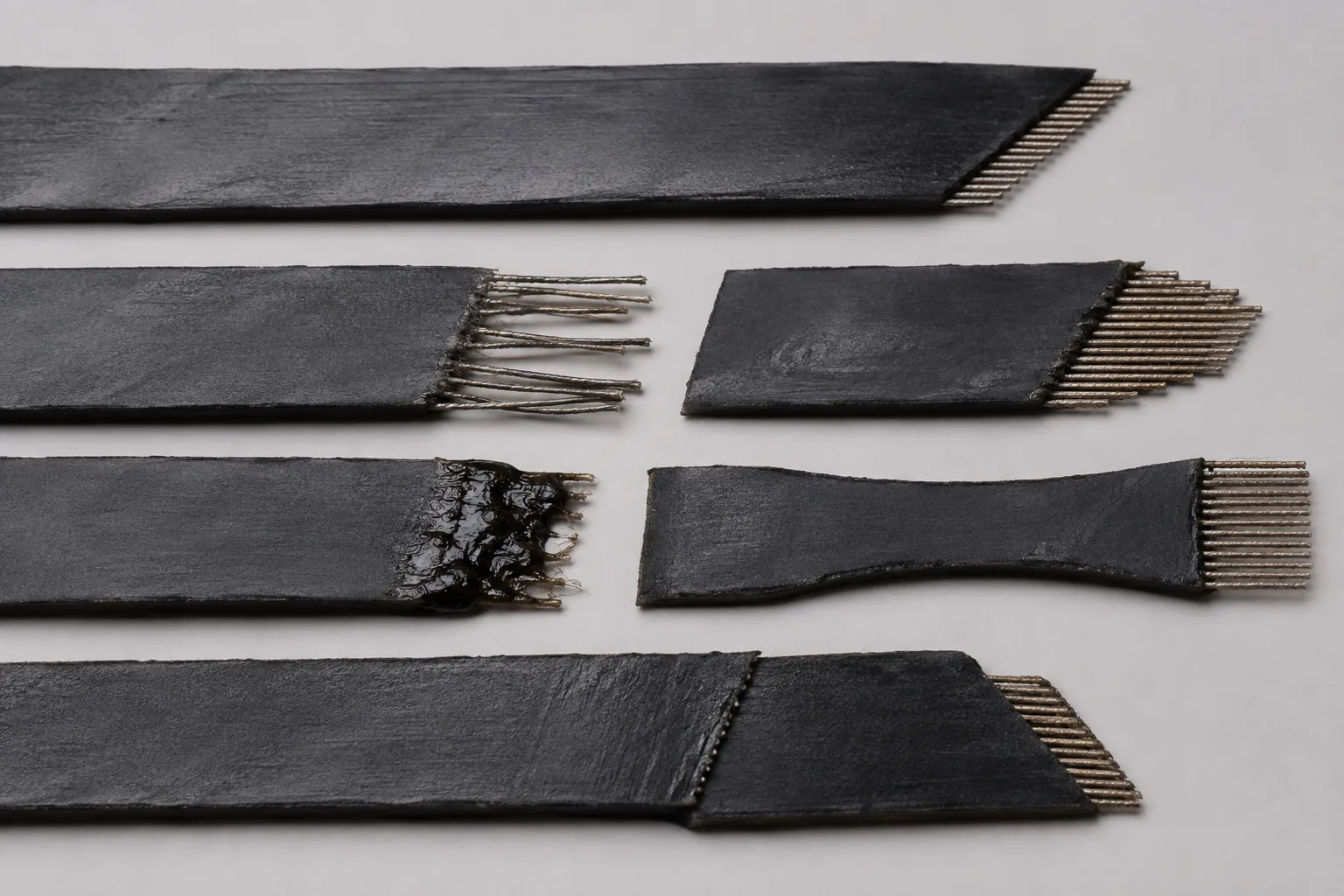
Where This Cutting Application Appears
Bias-cut textile body-ply strips
Rubberized textile cord is cut at the specified angle into strips that are later joined while cord spacing and splice-edge geometry remain controlled.
Steel-cord belt strip preparation
Calendered steel reinforcement is separated into angled belt components without leaving uncontrolled wire projection or shifting the outer cords.
Narrow reinforcement and chafer components
Rubber-coated fabric is converted into narrower strips used in designated tire-building layers, with tacky faces protected during transfer and stacking.
Bias And Strip Slitting process boundary
bias and strip slitting for rubberized tire cord fabric is a linked sequence: the output condition and datum from each operation become the controlled input for the next. It should not be evaluated as one generic cut or accepted only by the final dimension.
Bias And Strip Slitting setup checkpoint
For rubberized tire cord fabric, define the operation order, intermediate dimensions, registration transfer, material support, web or part handling and waste route for every stage of bias and strip slitting.
Bias And Strip Slitting acceptance checkpoint
Verify both intermediate and final results from bias and strip slitting, including dimensions, registration, edge or feature quality, material damage, waste separation and stable transfer between stages.
Define the Required Cut Result
- Maintain the specified cord angle and strip width from leading edge to trailing edge
- Sever reinforcement cleanly without pulling, bending, or displacing adjacent cords
- Control tacky gum smear so splice edges remain identifiable and repeatable
- Move and stack cut plies without stretching the bias geometry or trapping liner material
Problems to Diagnose Before Changing the Knife
Cords pull out or shift sideways at the cut edge
Review cord type and spacing, rubber coverage, calender bond, cutting angle, edge motion, hold-down, support, gum temperature, and knife condition.
Bias angle or strip width changes across successive pieces
Check web tracking, feed length, encoder datum, cord-line detection, cutter traverse, tension, liner release, splice passage, and measurement method.
Uncured rubber smears onto the cut edge or tool surface
Examine compound tack, stock temperature, bloom, dwell, blade finish, cut speed, release practice, cleaning interval, and liner orientation.
Cut plies distort during transfer or stacking
Compare bias angle, strip length, pickup method, unsupported span, tack between plies, conveyor speed match, stacking alignment, and relaxation before measurement.
Knife Forms That May Be Considered
| Possible knife form | When it may be considered | What must be confirmed |
|---|---|---|
| Traversing bias-cut knife | Consider where the cutter crosses a stopped or synchronized cord web at a controlled angle for ply-strip production. | Confirm bias-angle range, cord material, web width, traverse motion, support, hold-down, liner, temperature, and cutter interface drawing. |
| Rotary disc or shear slitter | Consider for continuous longitudinal separation or defined strip work supported by the existing tire-cord converting line. | Confirm cord orientation, strip width, rotation, overlap or pressure, side load, web tension, gum tack, and acceptable cord-end condition. |
Information to Send for Technical Review
You do not need to know the exact blade name. Send the available workpiece, machine, current-knife and cut-result information so the application can be reviewed against a drawing or sample.
- Textile or steel cord type, diameter or yarn specification, spacing, and direction in the web
- Rubber compound designation, uncured state, coating gauge, tack, bloom, and operating temperature
- Calendered web width, liner type, roll dimensions, winding direction, splices, and edge condition
- Specified bias angle, strip width and length, tolerance, cord-count rule, and measurement datum
- Required splice-edge style, allowable cord exposure or displacement, and accepted cut samples
- Feed mode, tension, cord-line or edge sensing, cut cycle, traverse speed, hold-down, and support drawing
- Transfer conveyor, pickup, liner removal, stacking sequence, and time before dimensional inspection
- Current tool interface, buildup pattern, defect map by cord and edge, cleaning method, and downstream tire-building step
Questions About This Cutting Application
Why can the measured bias angle change after a ply is moved?
Bias-cut material can shear geometrically when tension is released or when a tacky ply is stretched during transfer. Define handling and relaxation before measuring.
How should exposed steel cord at the edge be evaluated?
Use the purchaser's defined method for projection length, bent wires, loose fragments, cord displacement, and edge location; a visual description alone may be ambiguous.
What causes gum smear to worsen during a production run?
Stock temperature, tack transfer, accumulated rubber, longer dwell, changing liner release, and cleaning interval can progressively alter friction at the cut.
Can textile and steel tire cord use the same cutting setup?
Do not assume so. Reinforcement stiffness, cord spacing, rubber coverage, required edge condition, support, motion, and tool interface need separate confirmation.
What evidence is useful when only the outer cord moves?
Mark the cut direction, cord layout, lead and trail edges, gum temperature, support position, and images before and after transfer to locate when displacement begins.
Related product and service information
- ABF Build-Up Film Rotary Die Cutting Blades - ABF build-up film · rotary die cutting
- Industrial Rubber Sheet Cutting Without Edge Deformation - industrial rubber sheets · sheet cutting
- Gasket Sheet Profile Cutting for Clean Bolt Holes - compressed gasket sheet · profile cutting
Request a Custom Cutting-Knife Review
Send the workpiece details, machine or holder information, current knife photos or sample, required quantity and examples of the present cut problem. Final dimensions, material, edge geometry and tolerances are confirmed from the approved requirements.