
Blade Application Guides / Application Guide / Rubber converting
Industrial Rubber Sheet Cutting Without Edge Deformation
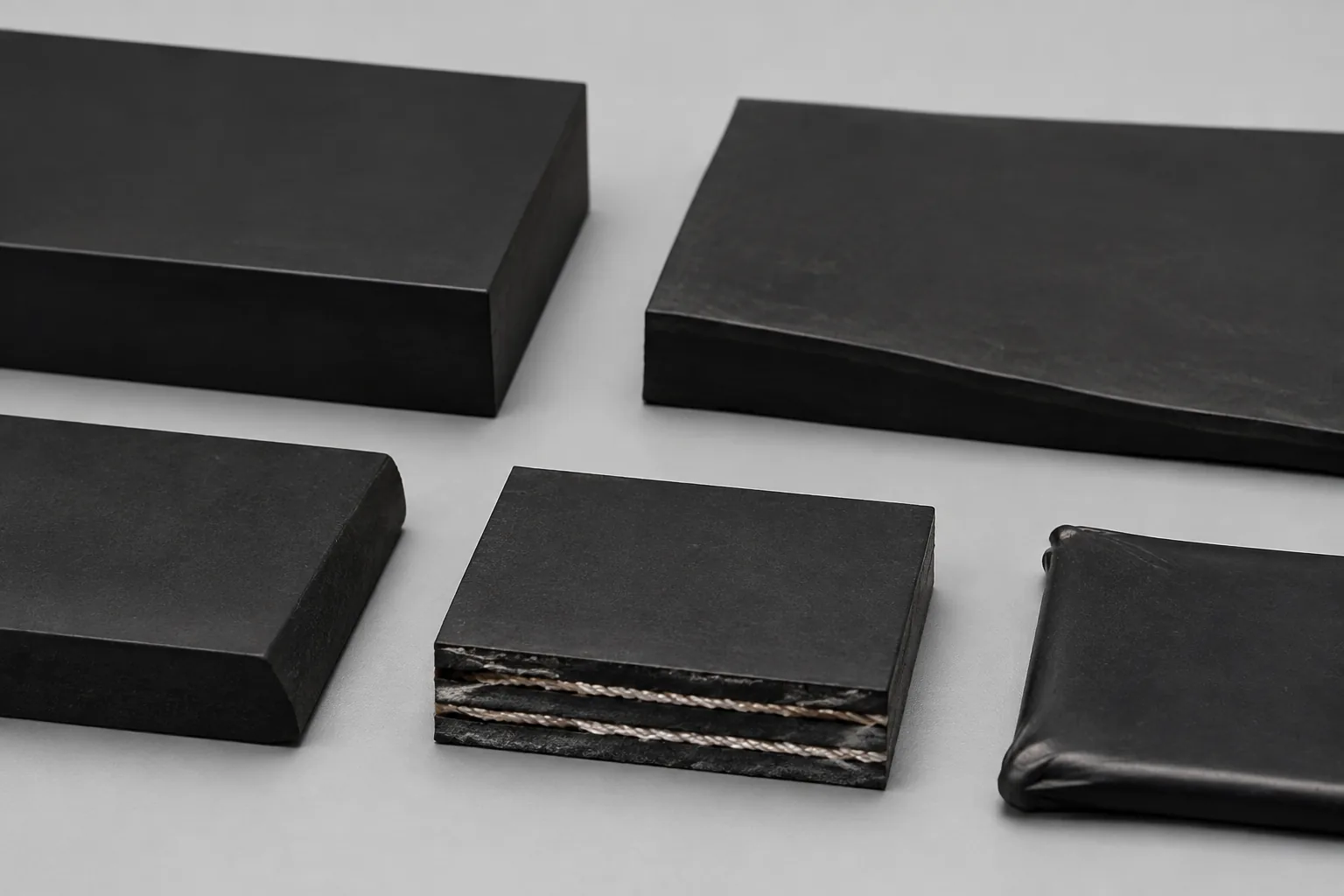
Industrial rubber sheet compresses under a hold-down and can stretch ahead of a moving edge, then recover after the cut has been measured. Compound, hardness, thickness, reinforcement, surface tack, temperature, and grain or calender direction therefore need to be considered together for strips, rectangles, or shaped blanks.
Updated
Where This Cutting Application Appears
Wear pads and protective lining blanks
Abrasion-resistant sheet is divided into rectangular or shaped pieces for later bonding, fastening, or fitting to a protected surface.
Vibration-isolation and spacer components
Elastomer sheet is cut into pads, strips, and washers whose recovered dimensions and parallel edges affect assembly positioning.
Fabric-reinforced rubber conversion
Rubberized textile sheet is cut across or along its reinforcement while exposed cord ends, ply shift, and edge gum are controlled.
Sheet Cutting process boundary
Sheet cutting separates sheet stock with straight cuts into manageable panels or sections; it differs from final two-axis sizing, shaped contour cutting and narrow edge cleanup.
Sheet Cutting setup checkpoint
Confirm sheet orientation, straight cut lines, support on both sides, hold-down method and the sequence used to reduce large stock into manageable sections.
Sheet Cutting acceptance checkpoint
Measure the specified cut dimension and squareness, then inspect edge breakout, compression, corner damage, surface marking and stack consistency.
Define the Required Cut Result
- Limit compression and forward stretch so dimensions recover inside the drawing tolerance
- Leave a square edge through the full sheet thickness rather than a bevel or rolled lip
- Separate embedded fabric cleanly without pulling cords out of the rubber matrix
- Release tacky blanks from the support without stretching corners or contaminating faces
Problems to Diagnose Before Changing the Knife
Cut blanks shrink or lengthen after they are removed
Review measurement timing, calender direction, sheet tension, hold-down compression, rubber temperature, feed drag, cut sequence, and relaxation behavior.
A thick sheet develops a beveled or concave edge
Check blade deflection, motion angle, side friction, penetration, support gap, sheet hardness, thickness, lubrication policy, and clamping distribution.
Reinforcing fabric frays or pulls from the rubber
Identify reinforcement material, ply angle, cord spacing, rubber coverage, knife geometry, cut direction, support, speed, and local bond condition.
Soft compound sticks to the edge or drags across the support
Examine surface tack, bloom, sheet temperature, blade finish, release liner, cutting rhythm, cleaning interval, stacking pressure, and support material.
Knife Forms That May Be Considered
| Possible knife form | When it may be considered | What must be confirmed |
|---|---|---|
| Straight guillotine or drop knife | Consider for strips and rectangular blanks where the sheet can be held flat and supported through a full-width stroke. | Confirm compound, hardness, thickness, reinforcement, blade motion, support gap, hold-down, maximum width, and recovered-size criteria. |
| Oscillating or reciprocating profile knife | Consider for contoured blanks or thick resilient sheet where a controlled traversing cut follows a programmed path. | Confirm profile drawing, corner radii, sheet restraint, oscillation or stroke, feed rate, nesting, cutting bed, and production sample. |
Information to Send for Technical Review
You do not need to know the exact blade name. Send the available workpiece, machine, current-knife and cut-result information so the application can be reviewed against a drawing or sample.
- Rubber family, compound designation, cured or uncured state, hardness range, and sheet temperature
- Sheet thickness, width, surface texture, tack or bloom, liner, and calender direction
- Reinforcement material, ply count, cord angle, spacing, and rubber coverage when present
- Finished drawing with lengths, widths, radii, holes, tolerances, and defined measurement condition
- Cutting sequence, stack height, nesting plan, feed direction, hold-down, and support surface
- Knife motion, stroke or traverse speed, available force, interface dimensions, and cleaning restrictions
- Required edge squareness, fabric exposure, burr or lip limits, and relaxation time before inspection
- Representative sheet, cut defect samples, current process settings, downstream bonding or assembly, and packing method
Questions About This Cutting Application
When should a rubber blank be measured after cutting?
Use the relaxation time and conditioning specified by the drawing or purchaser. Measuring under clamp pressure or immediately after a stretched cut can misrepresent final size.
Why is one face of a thick rubber cut wider than the other?
Blade deflection, side friction, oblique motion, an unsupported gap, and unequal hold-down can turn a nominally vertical cut into a bevel.
Does rubber hardness alone predict cutting behavior?
No. Elastic recovery, filler, reinforcement, thickness, temperature, surface tack, cure state, and cutting speed can change the result at the same nominal hardness.
How should reinforced-sheet edge quality be described?
Record rubber edge shape, exposed fiber length, pulled or displaced cords, ply separation, cut direction, and the reinforcement orientation relative to the profile.
Can release liquid be added to stop tacky rubber from sticking?
Only if the purchaser approves it for the material and downstream process. First review temperature, surface finish, liner handling, support, and cleaning options.
Related product and service information
- Rubber Diaphragm Blank and Profile Cutting - reinforced rubber diaphragm sheet · blanking and profile cutting
- Abrasive Paper Cutting With Controlled Grit Shedding - abrasive paper sheets · sheet cutting
- PVC Film Sheet Cutting Without Drag Marks - PVC film sheets · sheet cutting
Request a Custom Cutting-Knife Review
Send the workpiece details, machine or holder information, current knife photos or sample, required quantity and examples of the present cut problem. Final dimensions, material, edge geometry and tolerances are confirmed from the approved requirements.