
Blade Application Guides / Application Guide / Film extrusion and converting
PE Film Edge Trimming Without Stretching
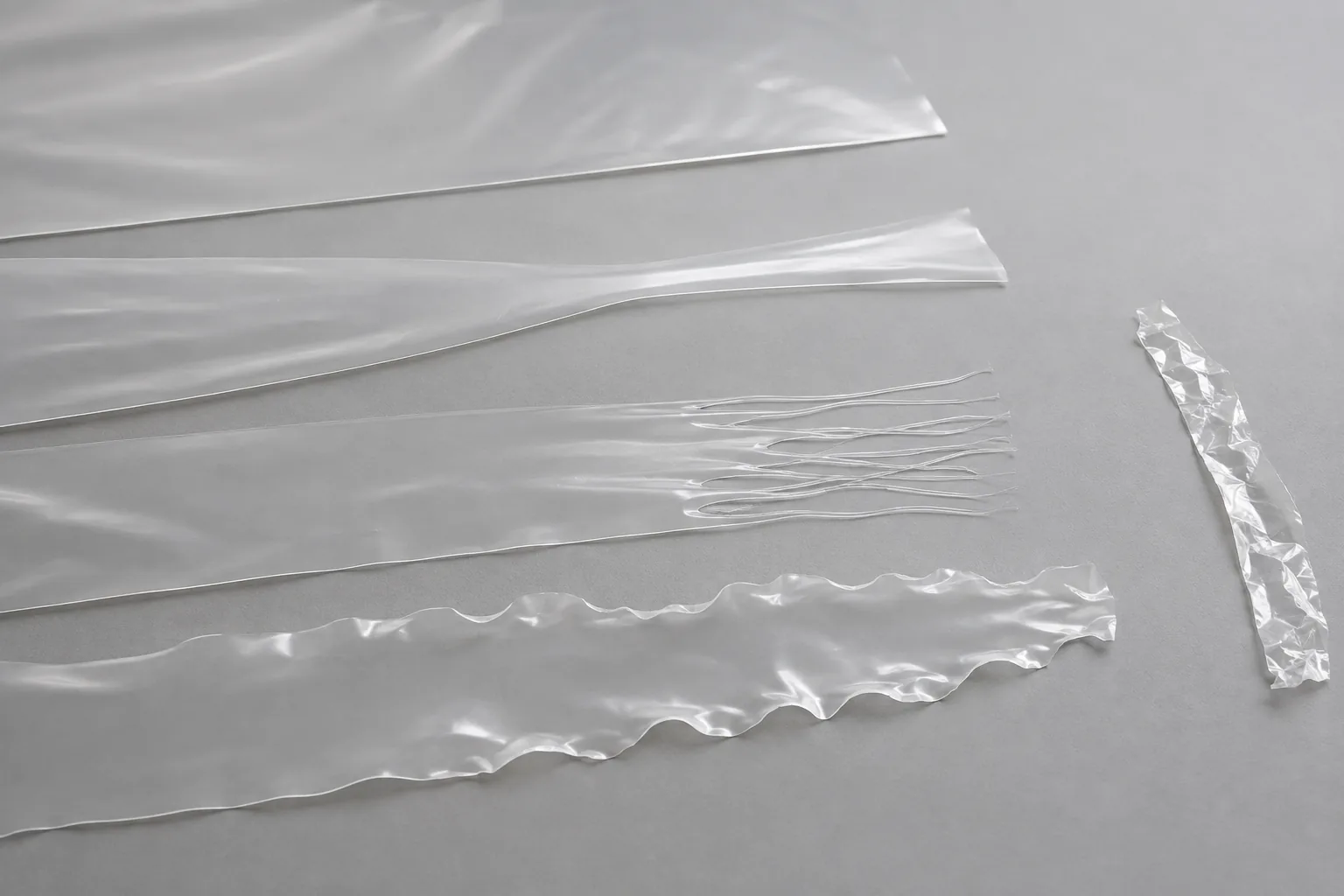
PE film can elongate, neck in, or cling under static instead of separating at a stable trim line. Extrusion gauge profile, melt history, temperature, web tension, edge-bead thickness, and trim-waste handling all influence the result.
Updated
Where This Cutting Application Appears
Extrusion edge-bead removal
Thicker or uneven edge beads are removed from freshly produced PE film before winding, with heat and gauge variation accounted for.
Bag-making web width preparation
Layflat or single-web PE is trimmed to the width required for sealing and conversion while avoiding a stretched or curled margin.
Lamination-ready PE web finishing
PE sealant film is edge-trimmed before lamination so loose tails, particles, and unstable width do not enter the bond or seal area.
Edge Trimming process boundary
Edge trimming removes a narrow irregular, damaged or excess margin to finish an existing edge; it does not divide the full workpiece into several production widths.
Edge Trimming setup checkpoint
Define the trim allowance, reference edge, support close to the cut and a waste path that prevents the narrow offcut from re-entering the product.
Edge Trimming acceptance checkpoint
Inspect the finished edge for straightness, local tearing or crushing, surface scuffing and continuity from the start to the end of the trim.
Define the Required Cut Result
- Separate extensible PE without drawing a long stretched tail
- Remove variable extrusion edge bead while holding usable web width
- Keep narrow trim waste continuous enough for controlled extraction
- Deliver flat edges that wind without curl or blocking
Problems to Diagnose Before Changing the Knife
Film stretches and necks in at the trim point
Compare resin grade, gauge, film temperature, web tension, unsupported span, trim width, cutting angle, and speed.
Trim waste strip breaks or wraps around rollers
Review strip width, edge-bead variation, static, extraction tension, route, splices, and where the break or wrap begins.
Thick edge bead deflects the trim position
Map gauge across the web, bead hardness and temperature, support, guide datum, lateral load, and finished-width readings.
Trimmed edge curls or blocks in the roll
Check residual orientation, cooling balance, corona treatment, tension, winding direction, nip pressure, and storage temperature.
Knife Forms That May Be Considered
| Possible knife form | When it may be considered | What must be confirmed |
|---|---|---|
| Razor-style trimming | Consider for thin supported PE webs where a low-drag entry path can be maintained. | Confirm resin, gauge, temperature, support span, entry angle, speed, and production samples. |
| Circular shear trimming | Consider where variable edge bead or thicker film benefits from supported shear separation. | Confirm bead range, overlap, side load, rotation, holder interface, and approved web-path drawing. |
Information to Send for Technical Review
You do not need to know the exact blade name. Send the available workpiece, machine, current-knife and cut-result information so the application can be reviewed against a drawing or sample.
- PE type, blend, additives, and film orientation
- Gauge profile across the web and edge-bead thickness range
- Film temperature and cooling condition at trimming
- Master width, required finished width, and trim width per side
- Line speed, web tension, unsupported span, and guide datum
- Trim-waste extraction, suction, winding, or conveying route
- Corona treatment, tack, static, curl, and blocking observations
- Current trimming interface, defect video, operating sample, and downstream process
Questions About This Cutting Application
Why does PE form a stretched thread instead of a clean trim edge?
Low modulus, warm film, narrow trim width, high tension, or unsupported entry can draw the polymer before separation. Record temperature and the full trim path.
How should changing extrusion edge bead be sampled?
Measure gauge and bead width across time and both web sides, then retain sections from stable and unstable periods with line settings.
What makes a trim waste strip easy to extract?
Adequate strip strength, consistent width, controlled static, a smooth route, and suitable extraction tension all matter. The cutting result alone does not define waste stability.
Can freshly extruded PE be reviewed using a room-temperature sample?
A cooled sample identifies material construction but may not reproduce softness, tack, or tension at the live trimming station. Provide operating temperature and video.
Does a wider trim automatically solve neck-in?
Not automatically. Resin, temperature, web tension, support, edge bead, and usable-width cost must be considered before changing trim allowance.
Related product and service information
- PET Film Slitting for Clean Narrow Reels - PET film webs · precision slitting
- Food Packaging Film Trimming for Seal-Area Cleanliness - food packaging film webs · edge trimming
- BOPP Film Slitting With Stable Edges and Tension - BOPP film webs · web slitting
Request a Custom Cutting-Knife Review
Send the workpiece details, machine or holder information, current knife photos or sample, required quantity and examples of the present cut problem. Final dimensions, material, edge geometry and tolerances are confirmed from the approved requirements.