
Blade Application Guides / Application Guide / Film converting
PET Film Slitting for Clean Narrow Reels
PET film offers dimensional stability but can form sharp edge lips, brittle chips, or scratches when the web is poorly supported or contaminated. The review should match film gauge, coating, optical surface, tension, and downstream handling to the required slit edge.
Updated
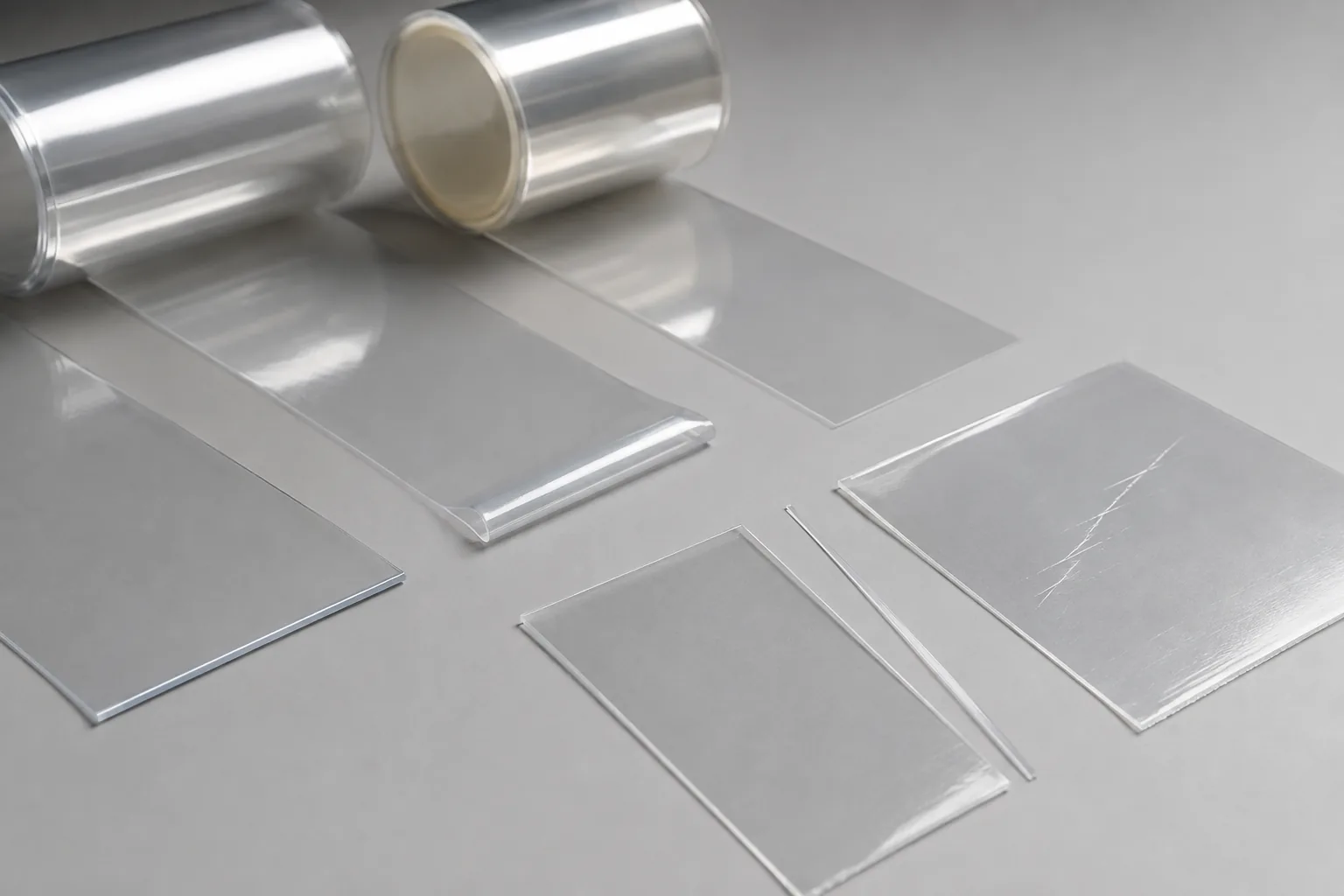
Where This Cutting Application Appears
Release-film narrow reel conversion
Silicone-coated PET release films are slit for adhesive and composite processes while protecting coating continuity and reel cleanliness.
Optical and graphic film preparation
Clear, matte, or treated PET webs are width-converted with strict attention to surface scratches, particles, and visible edge defects.
Printing and laminating feed reels
PET master rolls are slit to line-ready widths so registration, tracking, and edge flatness remain stable in the next process.
Precision Slitting process boundary
precision slitting for PET film webs is planned around longitudinal width conversion of a moving roll, web, sheet or strip into controlled lanes or daughter rolls; it is not transverse length cutting, profile formation or removal of only a narrow damaged margin.
Precision Slitting setup checkpoint
For PET film webs, confirm unwind and rewind tension, lane widths, knife positions, edge guidance, core alignment, trim removal and discharge behavior.
Precision Slitting acceptance checkpoint
For PET film webs, evaluate lane width, edge condition, camber or wandering, debris, telescoping, interleaving and stable winding or downstream transfer.
Define the Required Cut Result
- Produce a continuous PET edge without lips, chips, or projecting slivers
- Protect optical and coated surfaces from contact scratches
- Maintain narrow-lane width and straight tracking through rewind
- Control static and particles before clean downstream conversion
Problems to Diagnose Before Changing the Knife
Raised edge lip or burr-like PET ridge
Review gauge, modulus, edge support, overlap or penetration, side load, tension, and whether the ridge forms on one consistent side.
Brittle chips or thin slivers at the slit
Compare film grade, temperature, recycled content if known, coating, entry angle, speed, wear location, and static attraction.
Surface scratches parallel to web travel
Trace roller and guide contact, trapped particles, web flutter, coated-side orientation, cleaning, and when the scratch begins relative to slitting.
Narrow reel width or face alignment varies
Check guide datum, shaft runout, holder spacing, lane tension, core position, winding taper, and width after relaxation.
Knife Forms That May Be Considered
| Possible knife form | When it may be considered | What must be confirmed |
|---|---|---|
| Circular shear slitting | Consider for precision width conversion with controlled overlap, side load, and web support. | Confirm PET grade, gauge, coating, rotation, holder accuracy, and the approved slitting-interface drawing. |
| Razor-style slitting | Consider only for compatible thin PET webs where the path controls entry angle and unsupported span. | Confirm support, blade angle, film tension, speed, particle limits, and accepted edge samples on the intended web. |
Information to Send for Technical Review
You do not need to know the exact blade name. Send the available workpiece, machine, current-knife and cut-result information so the application can be reviewed against a drawing or sample.
- PET resin or film grade, gauge range, and modulus data if available
- Surface coating, release treatment, optical finish, and side orientation
- Master width, diameter, core size, and incoming roll condition
- Required lane widths, tolerances, minimum width, and reel diameter
- Line speed, tension zones, edge guiding, and roller layout
- Rewind type, lane tension, core alignment, and conditioning time
- Microscope or close-up images of lips, chips, slivers, and scratches
- Current slitting geometry, holder interface, clean handling, and downstream process
Questions About This Cutting Application
What is a burr-like ridge on slit PET film?
It is a raised or rolled edge condition rather than a metal burr. Record which side carries the ridge, its height or visual limit, and the film orientation.
Why can a clear PET reel scratch only after slitting?
Fresh particles, changed web tracking, edge flutter, or new guide contact may appear after lane separation. Map scratch direction and lane position.
Should release-coated PET be tested coated side up and down?
Use the actual production orientation. Reversing the web can change friction, contact, debris transfer, and the side on which edge deformation appears.
How should narrow PET reel width be measured?
Define conditioning time, measurement tension, axial locations, and temperature. Thin film can relax or telescope, so a single face reading is insufficient.
Can optical PET requirements be inferred from packaging PET?
No. Surface inspection, cleanliness, coating, allowable scratches, tension, and reel handling may differ. Review the exact production grade and acceptance sample.
Related product and service information
- Slitting Carbon Fiber Prepreg Tape - carbon fiber prepreg tape · roll slitting
- Metallized Film Slitting Without Layer Damage - metallized plastic film · web slitting
- BOPP Film Slitting With Stable Edges and Tension - BOPP film webs · web slitting
Request a Custom Cutting-Knife Review
Send the workpiece details, machine or holder information, current knife photos or sample, required quantity and examples of the present cut problem. Final dimensions, material, edge geometry and tolerances are confirmed from the approved requirements.