
Blade Application Guides / Application Guide / Paper drinking-straw production
Paper Straw Tube Cutoff Without End Delamination
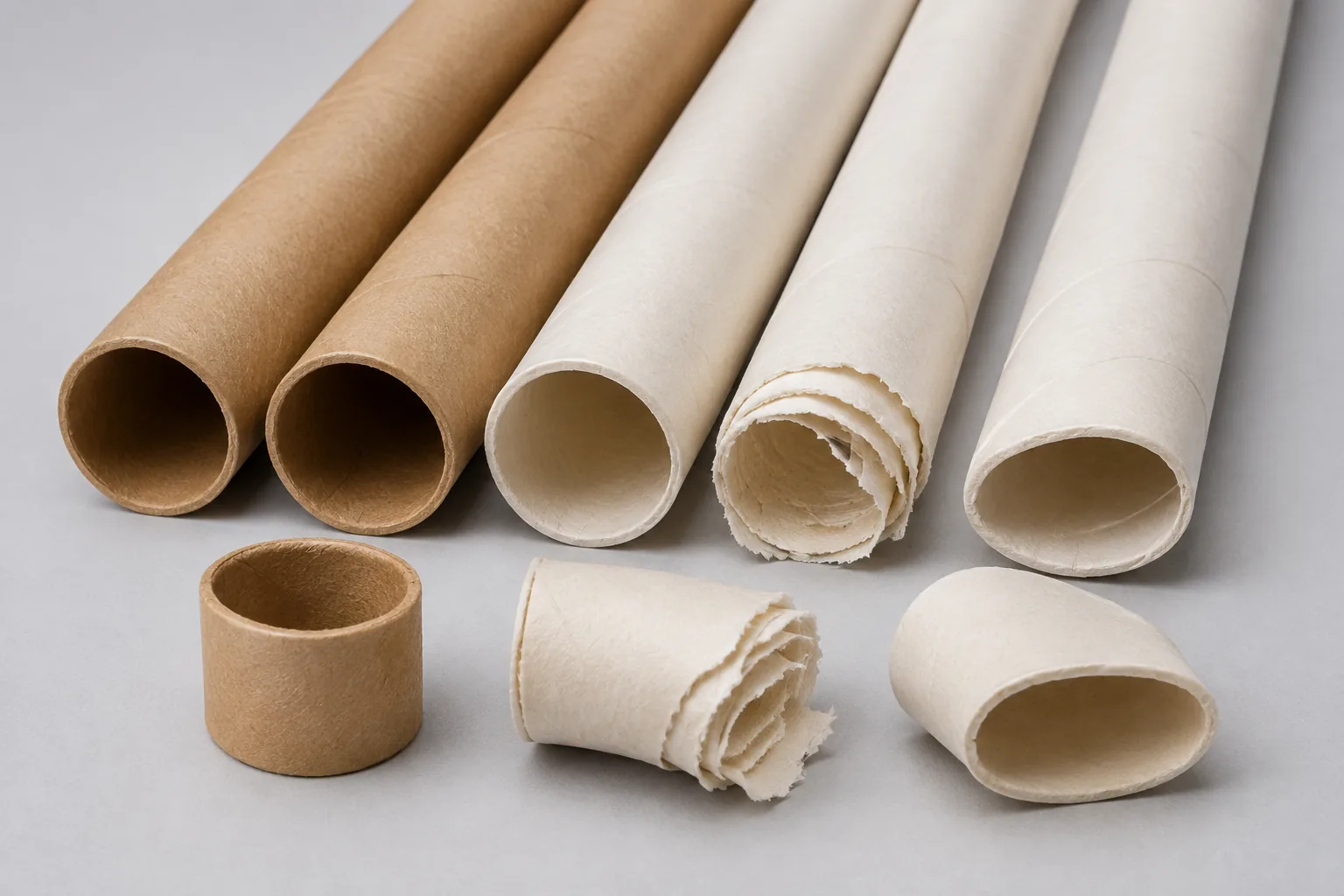
A paper straw is a small bonded tube whose cut face must remain open, round, and free of loose ply tails. Cutoff decisions depend on wall build, seam angle, adhesive cure, barrier coating, support, and the speed of the forming line.
Updated
Where This Cutting Application Appears
Continuous cutoff after straw forming
The newly wound tube is divided into straw lengths while adhesive and barrier layers may not yet have reached their final condition.
Wrapped-straw length preparation
Individual straws are sized for wrapping equipment, where length variation or an oval end can interrupt feeding and sealing.
Multi-ply straw sample qualification
New paper, adhesive, or coating combinations are cut in trial lots to compare seam integrity, bore opening, and liquid-contact edge condition.
Tube Cutoff process boundary
tube cutoff for paper straw tubes is planned around separation across the material flow or part axis to establish a controlled repeat length or finished end; it is not longitudinal width conversion, shaped contour production or particle-size reduction.
Tube Cutoff setup checkpoint
For paper straw tubes, confirm target length, datum or registration reference, feed indexing, support on both sides, cut timing and post-cut transfer.
Tube Cutoff acceptance checkpoint
For paper straw tubes, evaluate length distribution, squareness or cutoff angle, both cut faces, deformation, registration drift and stacking or discharge consistency.
Define the Required Cut Result
- Keep every ply bonded at both straw ends
- Preserve an open, round bore for downstream wrapping and use
- Control length without pulling the spiral seam
- Avoid loose fibers or coating flakes at the liquid-contact edge
Problems to Diagnose Before Changing the Knife
Spiral-ply delamination at the end
Mark seam position, paper sequence, adhesive application, cure time, cut direction, and whether separation starts at the inner or outer ply.
Oval or partially closed straw bore
Review tube diameter, wall stiffness, external clamp, internal support, cutoff pressure, and recovery after the straw leaves the station.
Loose inner-liner fibers
Inspect inner-ply grain, barrier coating, exit-side support, adhesive coverage, and whether fiber tags project into the bore.
Length variation at production speed
Check indexing signal, tube feed, forming speed, slip, cut timing, and length readings before and after conditioning.
Knife Forms That May Be Considered
| Possible knife form | When it may be considered | What must be confirmed |
|---|---|---|
| Rotary tube-cutoff form | Consider for continuous forming lines with synchronized straw feed and cutoff. | Confirm rotation, support, wall build, holder geometry, and an approved interface drawing using production straws. |
| Reciprocating cutoff form | Consider where the equipment indexes and supports each straw or grouped tube before separation. | Confirm stroke, entry direction, bore support, cycle rate, and acceptable end condition on representative samples. |
Information to Send for Technical Review
You do not need to know the exact blade name. Send the available workpiece, machine, current-knife and cut-result information so the application can be reviewed against a drawing or sample.
- Finished straw outside diameter and length range
- Ply count, individual paper grades, and grain directions
- Spiral angle, lap width, and inner-liner construction
- Adhesive type, application pattern, and cure time before cutoff
- Barrier coating and its condition at the cutting station
- Forming speed, cutoff rate, indexing, and tube support
- End-roundness, loose-fiber, delamination, and length acceptance criteria
- Current cutoff sample or dimensions, interface photos, and trial quantity
Questions About This Cutting Application
Why does only the inner ply form a loose tail?
The inner liner may have a different grain, coating, adhesive coverage, or exit support from the outer plies. Mark which end and seam position show the tail.
How soon after forming should cutoff samples be evaluated?
Inspect them immediately and again after the normal conditioning period. Adhesive cure and moisture redistribution can change roundness and delamination after cutting.
What should be measured besides paper straw length?
Record outside diameter, bore opening, end squareness, seam separation, loose fibers, coating damage, and performance in the wrapping or packing step.
Can one cutoff specification cover different straw wall builds?
It should not be assumed. Changes in ply count, paper, adhesive, coating, diameter, or line speed require comparison with actual samples and support conditions.
How can a review begin if the current cutoff part has no drawing?
Send the used part, dimensioned interface photos, motion details, straw samples, and accepted ends. A controlled drawing must be confirmed before production.
Related product and service information
- Pressed Pulp Sheet Cutting for Consistent Bale Size - pressed pulp sheets · size cutting
- Coated Paper Sheet Trimming Without Surface Damage - coated paper sheets · sheet trimming
- Tissue Log Cross Cutting and Compression Control - tissue logs · cross cutting
Request a Custom Cutting-Knife Review
Send the workpiece details, machine or holder information, current knife photos or sample, required quantity and examples of the present cut problem. Final dimensions, material, edge geometry and tolerances are confirmed from the approved requirements.