
Blade Application Guides / Application Guide / Tissue converting
Tissue Log Cross Cutting and Compression Control
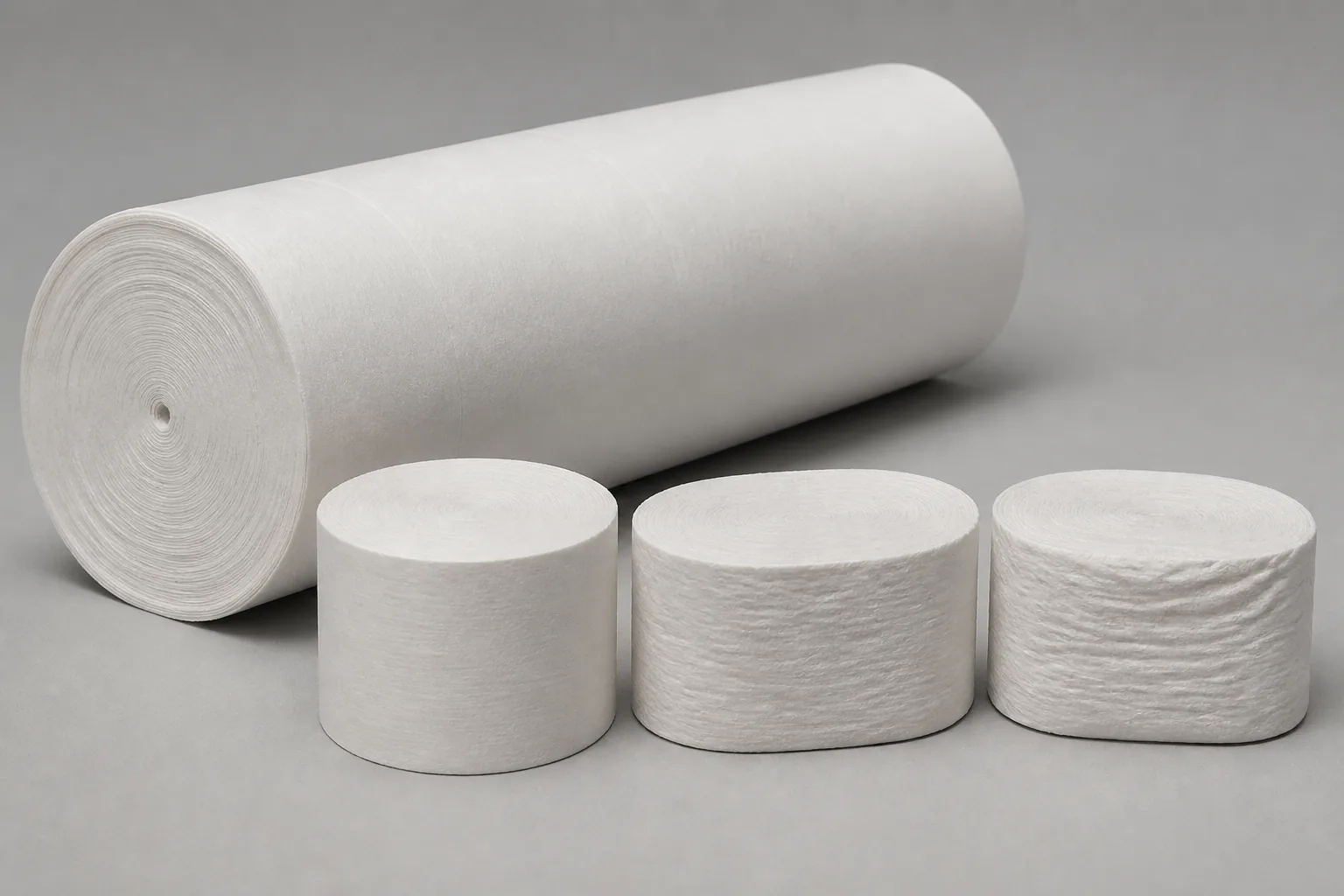
A tissue log is soft, porous and easily distorted before its plies are severed. Review therefore starts with log support, compression recovery, ply bonding and the required cut-face appearance rather than with a blade name.
Updated
Where This Cutting Application Appears
Toilet-roll log sawing
Long wound logs are divided into retail roll widths, requiring controlled compression and a face that will not hinder wrapping.
Kitchen-towel roll sizing
Larger-diameter embossed logs are cross cut while preserving ply registration, perforation alignment and an open core.
Facial-tissue roll conversion
Soft tissue formats are portioned for specialty packs where torn tails, dust and face deformation must be limited.
Cross Cutting process boundary
cross cutting for tissue logs is planned around separation across the material flow or part axis to establish a controlled repeat length or finished end; it is not longitudinal width conversion, shaped contour production or particle-size reduction.
Cross Cutting setup checkpoint
For tissue logs, confirm target length, datum or registration reference, feed indexing, support on both sides, cut timing and post-cut transfer.
Cross Cutting acceptance checkpoint
For tissue logs, evaluate length distribution, squareness or cutoff angle, both cut faces, deformation, registration drift and stacking or discharge consistency.
Define the Required Cut Result
- Control oval or crushed roll faces
- Maintain the required geometry for toilet-roll log sawing
- Protect material integrity during cross cutting
- Deliver a cut condition accepted by the next production step
Problems to Diagnose Before Changing the Knife
Oval or crushed roll faces
Record log density, outside diameter, core stiffness, support spacing, clamp force and recovery time after the cut.
Torn plies and loose tails
Review embossing, ply bond, perforation location, log rotation, feed rate and whether the tear begins at entry or exit.
Tissue dust and face fuzz
Compare furnish, lotion or additives, moisture, edge condition, extraction and dust accumulation over a production run.
Angled cuts or variable roll width
Check log indexing, axial movement, core straightness, support alignment and width measurements around the circumference.
Knife Forms That May Be Considered
| Possible knife form | When it may be considered | What must be confirmed |
|---|---|---|
| Rotary log-saw form | Consider for rotating or indexed tissue logs where the cut path crosses the full roll face. | Confirm this form only from the tissue logs sample, equipment interface, operating motion and approved drawing. |
| Serrated cutoff form | Consider only when the existing tissue-log equipment uses a compatible reciprocating or orbital action. | Confirm this form only from the tissue logs sample, equipment interface, operating motion and approved drawing. |
Information to Send for Technical Review
You do not need to know the exact blade name. Send the available workpiece, machine, current-knife and cut-result information so the application can be reviewed against a drawing or sample.
- Tissue grade, ply count, basis weight and additives
- Log outside diameter, core diameter, density and winding firmness
- Embossing and ply-bond pattern plus perforation pitch
- Required roll width and cut-face acceptance photographs
- Log support, clamping and indexing arrangement
- Cut cycle rate, log rotation method and feed direction
- Dust extraction location and examples of torn tails or crushed cores
- Existing cutting-part dimensions, holder interface and trial quantity
Questions About This Cutting Application
Why does a tissue roll recover to an oval shape after cutting?
The log may be compressed unevenly or lack support near the cut. Record clamp force, support spacing, density and recovery over time before changing the cutting geometry.
How should loose tissue tails be evaluated?
Note whether tails occur on the entry or exit face, their relation to perforations and embossing, and whether the ply bond separates. Photos taken before handling are most useful.
What makes kitchen-towel logs different from toilet-tissue logs?
Kitchen-towel logs can differ in diameter, embossing depth, ply bond, sheet stiffness and winding firmness. Those actual properties, not the product label, must guide the review.
Can a used cutting sample start the tissue-log review?
Yes, if it is paired with dimensions, rotation direction, holder details and representative logs. Production should still follow an approved drawing with agreed cut-face checks.
What belongs in a tissue-log cutting trial report?
Include log specification, start and end positions, roll-width readings, face photos, dust, loose plies, core condition, cycle rate and any change as the run progresses.
Related product and service information
- Liquid Packaging Board Profile-Cutting Blades - liquid packaging board · profile cutting
- Coated Paper Sheet Trimming Without Surface Damage - coated paper sheets · sheet trimming
- Book Block Three-Side Trimming for Square Clean Edges - bound book blocks · three-side trimming
Request a Custom Cutting-Knife Review
Send the workpiece details, machine or holder information, current knife photos or sample, required quantity and examples of the present cut problem. Final dimensions, material, edge geometry and tolerances are confirmed from the approved requirements.