
Blade Application Guides / Application Guide / Printing and paper converting
Coated Paper Sheet Trimming Without Surface Damage
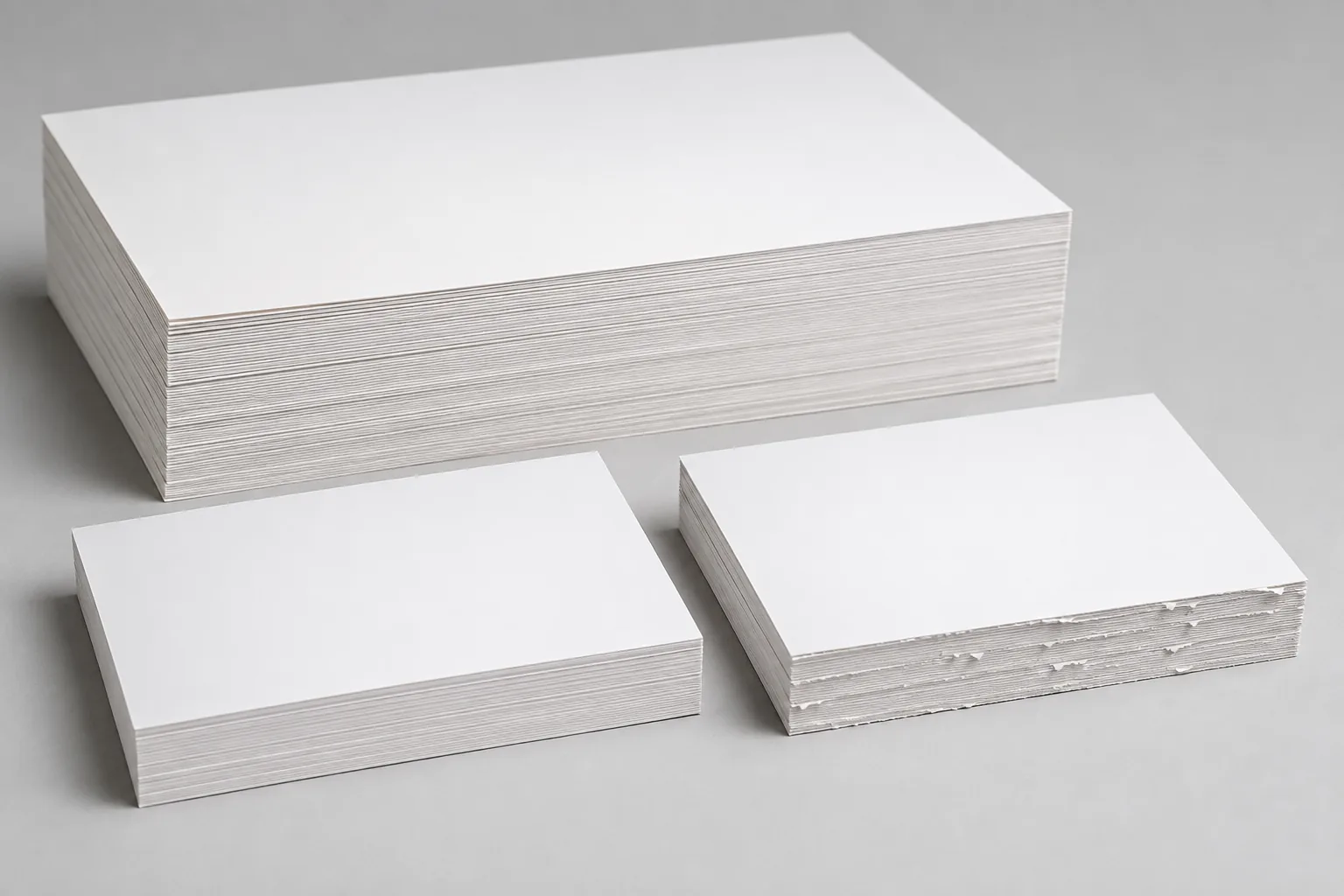
Coated paper combines a fibrous base with a surface layer that can scuff, chip or transfer under pressure. A useful trimming review distinguishes damage created during cutting from marks caused by stack handling, clamping or previous printing operations.
Updated
Where This Cutting Application Appears
Printed cover and brochure finishing
Coated cover stocks are trimmed after printing, where a chipped edge or clamp mark can remain visible on the finished publication.
Folding-carton sheet preparation
Coated board sheets are squared before die cutting or creasing, and edge damage can affect registration and appearance.
Art paper format conversion
Large coated sheets are cut into saleable or press-ready formats while protecting gloss, texture and stack squareness.
Sheet Trimming process boundary
sheet trimming for coated paper sheets is planned around removal of a defined excess allowance to establish a finished edge, end or perimeter without changing the intended main part geometry; it is not multi-width slitting, primary blank formation or general material size reduction.
Sheet Trimming setup checkpoint
For coated paper sheets, confirm trim allowance, finished datum, local support, positional control, part orientation and reliable removal of narrow or irregular waste.
Sheet Trimming acceptance checkpoint
For coated paper sheets, evaluate final dimension and edge position, straightness or contour continuity, burr or fray, surface damage and uninterrupted waste removal.
Define the Required Cut Result
- Control coating chips at the trimmed edge
- Maintain the required geometry for printed cover and brochure finishing
- Protect material integrity during sheet trimming
- Deliver a cut condition accepted by the next production step
Problems to Diagnose Before Changing the Knife
Coating chips at the trimmed edge
Inspect coating type and thickness, substrate grain direction, stack height, clamp pressure, edge support and the location of visible flakes.
Gloss scuffing or pressure marks
Trace sheet handling, clamp pads, trapped particles and sliding between sheets to determine whether the surface damage occurs before, during or after the cut.
Stack shift and out-of-square formats
Review back-gauge accuracy, stack alignment, sheet curl, clamp sequence and dimensional readings from the top, middle and bottom of the pile.
Fused, polished or compressed edge bands
Check stack height, cut speed, edge temperature, coating softness and whether compression prevents sheets from separating cleanly.
Knife Forms That May Be Considered
| Possible knife form | When it may be considered | What must be confirmed |
|---|---|---|
| Straight guillotine form | Consider for pile trimming with controlled clamping and a defined shear angle. | Confirm this form only from the coated paper sheets sample, equipment interface, operating motion and approved drawing. |
| Rotary sheet-cutting form | Consider when coated sheets are separated continuously rather than in a stationary stack. | Confirm this form only from the coated paper sheets sample, equipment interface, operating motion and approved drawing. |
Information to Send for Technical Review
You do not need to know the exact blade name. Send the available workpiece, machine, current-knife and cut-result information so the application can be reviewed against a drawing or sample.
- Coated-paper grade, substrate type and grain direction
- Coating type, finish, coat weight or supplier specification
- Sheet size, caliper, curl condition and stack height per cut
- Finished format, squareness tolerance and visible-edge criteria
- Printed or unprinted status and location of critical artwork
- Clamp type, clamp pressure and back-gauge arrangement
- Photos of coating chips, scuffs and edge compression by stack level
- Existing cutter geometry or sample, production volume and packing needs
Questions About This Cutting Application
Why can the coating chip even when the paper base cuts cleanly?
The coating may be more brittle than the substrate, especially near a printed, folded or highly compressed area. Grain direction, coat build, stack support and cutting condition should be compared.
How do we separate clamp damage from cutting damage?
Mark the top and bottom sheets before the cycle, inspect the clamp contact zone and compare damage position with the trim line. Scuffs away from the cut often point to handling or trapped particles.
Should trial sheets include printed stock?
Yes when ink, varnish or cured coatings are present in production. Unprinted samples may not reproduce surface friction, cracking or visible-edge requirements.
What dimensions are needed for a sheet-trimmer review?
Provide the current cutting-part sample or drawing, mounting dimensions, cut length, bevel orientation and clearance data, together with stack size and back-gauge information.
Can one setup be assumed suitable for every coated-paper grade?
No. Coating chemistry, substrate, caliper, finish and moisture can change the result. Confirm the grade range with samples and approve the drawing and inspection criteria for the intended work.
Related product and service information
- Industrial Filter Paper Cutting Without Fiber Pullout - industrial filter paper · profile cutting
- Tissue Log Cross Cutting and Compression Control - tissue logs · cross cutting
- Book Block Three-Side Trimming for Square Clean Edges - bound book blocks · three-side trimming
Request a Custom Cutting-Knife Review
Send the workpiece details, machine or holder information, current knife photos or sample, required quantity and examples of the present cut problem. Final dimensions, material, edge geometry and tolerances are confirmed from the approved requirements.