
Blade Application Guides / Application Guide / battery tab and electrical connection component converting
Nickel Strip Slitting for Battery Tabs
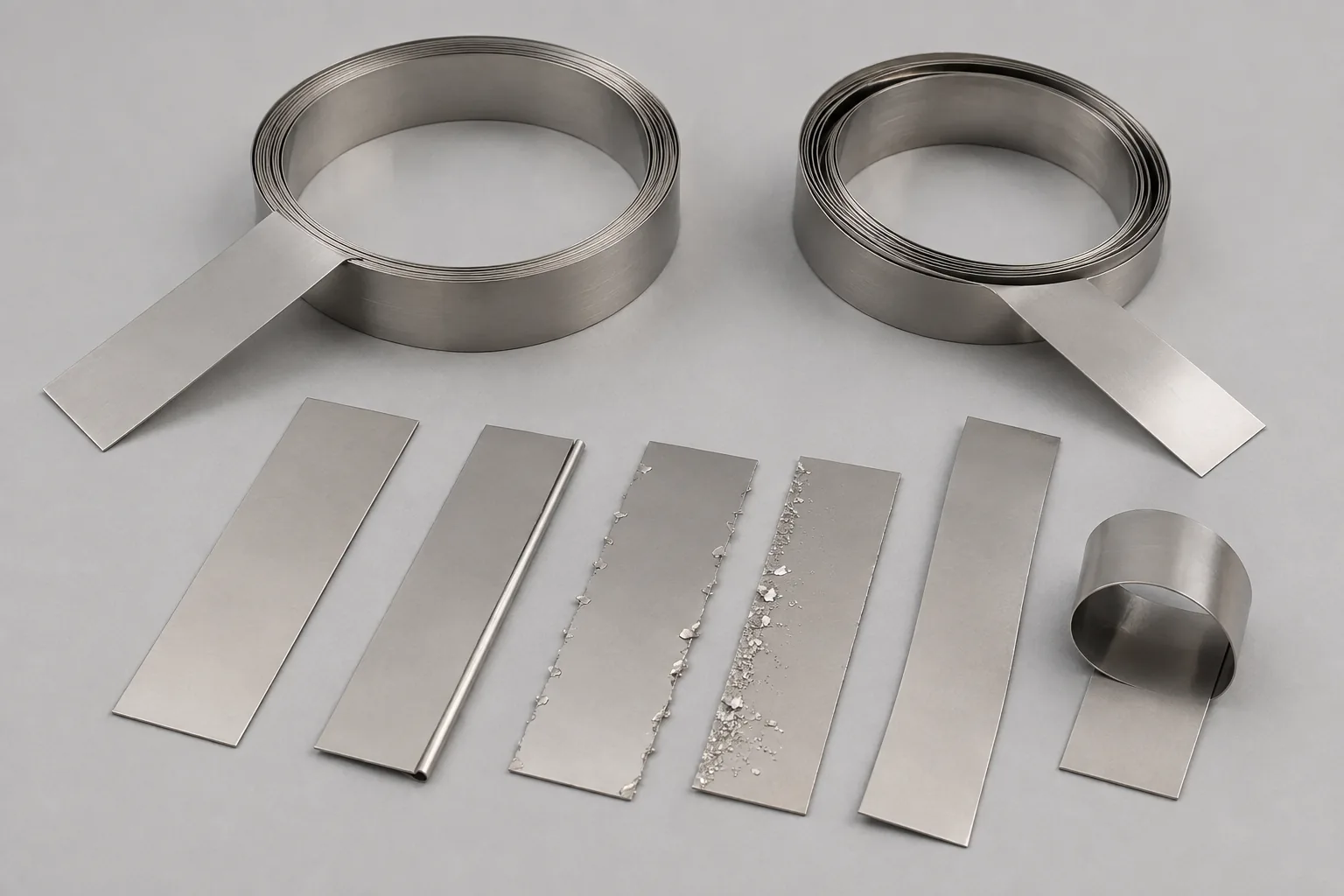
Battery-tab stock may be commercially pure nickel or a base-metal strip with a nickel-plated surface, and those constructions do not fracture or mark in the same way. Slitting must hold a narrow width without folding the edge, exposing damaged substrate or creating a coil build that interferes with later tab cutting and joining trials.
Updated
Where This Cutting Application Appears
Battery-tab master-coil conversion
Slits wide nickel or nickel-plated stock into narrow coils for later cut-to-length or shaped tab production.
Cell-connection strip preparation
Produces controlled widths for welded or mechanically joined links after material and joining requirements are confirmed.
Plated-strip grade changeover
Re-establishes clearance and handling when substrate strength, plating thickness or temper changes.
Precision Strip Slitting process boundary
precision strip slitting for nickel or nickel-plated strip for battery tabs is planned around longitudinal width conversion of a moving roll, web, sheet or strip into controlled lanes or daughter rolls; it is not transverse length cutting, profile formation or removal of only a narrow damaged margin.
Precision Strip Slitting setup checkpoint
For nickel or nickel-plated strip for battery tabs, confirm unwind and rewind tension, lane widths, knife positions, edge guidance, core alignment, trim removal and discharge behavior.
Precision Strip Slitting acceptance checkpoint
For nickel or nickel-plated strip for battery tabs, evaluate lane width, edge condition, camber or wandering, debris, telescoping, interleaving and stable winding or downstream transfer.
Define the Required Cut Result
- Low attached burr and rollover
- Stable narrow-strip width
- Intact plated surfaces away from the fracture edge
- Level coils without telescoping or edge damage
Problems to Diagnose Before Changing the Knife
Folded or rolled tab edge
- Check clearance against strip thickness and temper
- Inspect knife sharpness and overlap
- Compare deformation on both strip faces
Plating flakes beside the slit
- Identify substrate and plating process
- Inspect knife-face finish and exit support
- Compare damage before and after recoiling
Narrow strip camber
- Review incoming residual stress
- Measure arbor side load and runout
- Check separator pressure on narrow strands
Telescoped narrow coil
- Verify strand tension and core grip
- Inspect separator alignment
- Review acceleration and recoiler taper
Knife Forms That May Be Considered
| Possible knife form | When it may be considered | What must be confirmed |
|---|---|---|
| precision circular slitter knives | Closely controlled rotary pairs suit continuous tab-strip conversion when runout, clearance and face finish match the specific nickel construction. | Confirm final geometry and mounting from the battery-tab strip slitter arbor, an unworn sample or an approved drawing before manufacture. |
| thin-section rotary knives | Thin knives may enable closely spaced narrow strands if the arbor and spacers provide enough lateral support. | Confirm final geometry and mounting from the narrow-strip multicut slitter, an unworn sample or an approved drawing before manufacture. |
| carbide circular knives | Carbide can be reviewed for wear control only where holder rigidity, edge-impact risk and regrinding capability are suitable. | Confirm final geometry and mounting from the rigid nickel-strip slitting head, an unworn sample or an approved drawing before manufacture. |
Information to Send for Technical Review
You do not need to know the exact blade name. Send the available workpiece, machine, current-knife and cut-result information so the application can be reviewed against a drawing or sample.
- Slitter manufacturer, model and arbor details
- Pure nickel or plated-substrate construction
- Nickel grade, substrate grade, temper and plating thickness
- Strip thickness, master width and finished tab widths
- Burr, width, camber and surface acceptance
- Speed, separator layout and recoiling tension
- Marked edge, plating and coil-build samples
- Knife dimensions, set quantity and required date
Questions About This Cutting Application
Is pure nickel strip equivalent to nickel-plated strip for slitting?
No. Substrate strength, ductility and coating behavior differ, so identify the full construction before selecting geometry or clearance.
Where should burr be measured on a narrow tab strip?
Define the strip face, edge locations, sampling frequency and measurement method in relation to the downstream tab orientation.
Why does plating lift next to the cut?
Coating adhesion, excessive deformation, a rough knife face or poor exit support may initiate cracking or flaking.
Can a clean slit edge confirm welding suitability?
No. Joining must be evaluated separately with the actual material, surface and welding process.
What should be retained from a slitting trial?
Keep labeled coils and cross-sections for each strand position, together with the knife stack, clearance, tension and material lot.
Related product and service information
- Carbon-Coated Aluminum Current-Collector Foil Cut-To-Length Blades - carbon-coated aluminum current-collector foil · cut to length
- Slitting Carbon Steel Coil - carbon steel coil · coil slitting
- Slitting Stainless Steel Strip - stainless steel strip · coil slitting
Request a Custom Cutting-Knife Review
Send the workpiece details, machine or holder information, current knife photos or sample, required quantity and examples of the present cut problem. Final dimensions, material, edge geometry and tolerances are confirmed from the approved requirements.