
Blade Application Guides / Application Guide / tube and profile fabrication
Cutting Thin-Wall Metal Tube to Length
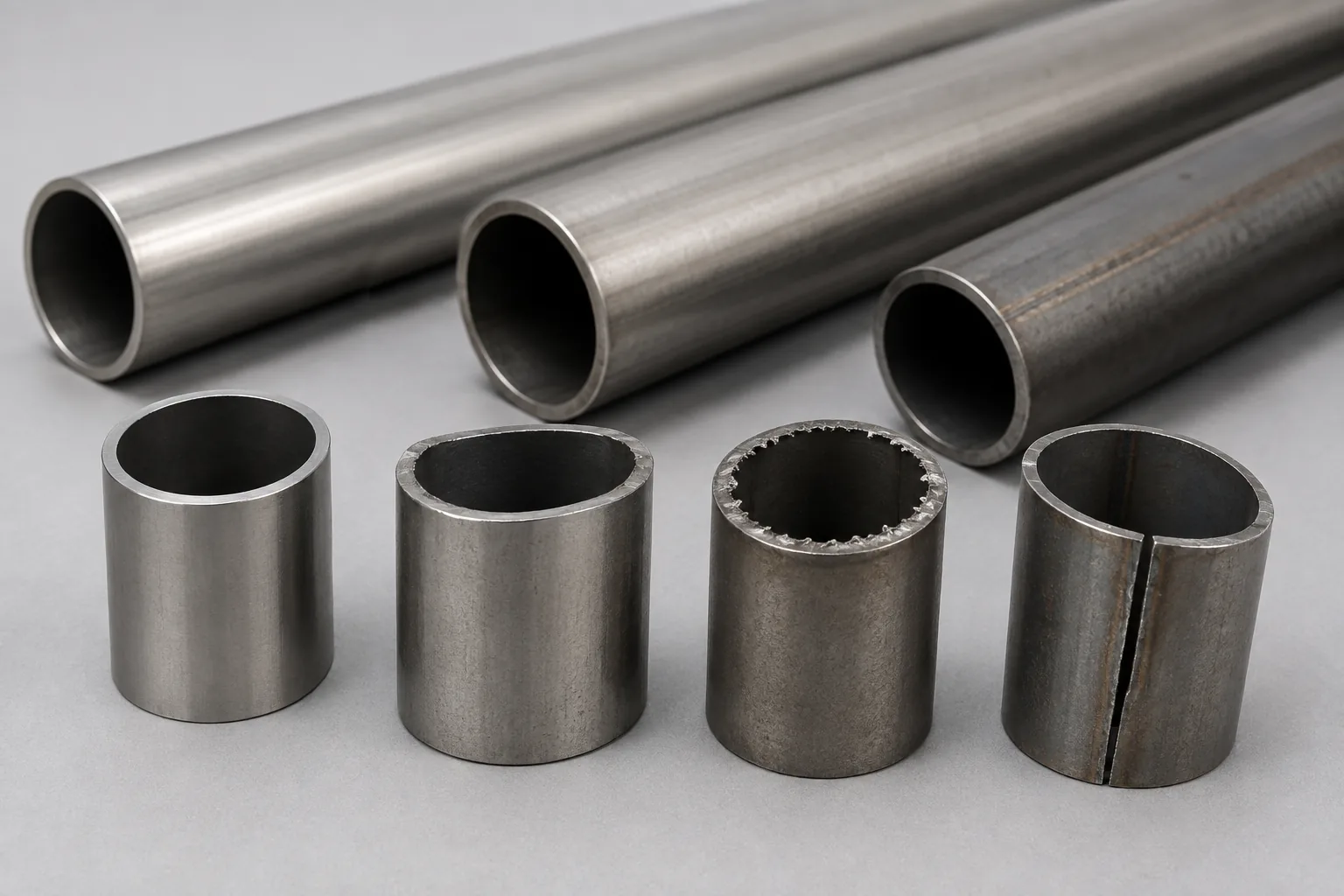
Thin-wall tube offers little radial support at the instant the cutter enters, and seam position or work-hardened areas can change resistance around the circumference. A successful cutoff coordinates clamping, internal support, tool path and part ejection so the end remains round and square.
Updated
Where This Cutting Application Appears
In-line welded-tube cutoff
Separates moving tube after forming while the cutoff carriage follows the mill speed.
Precision component blanking
Produces short tubular blanks for flaring, swaging, machining or assembly with an agreed end datum.
Soft nonferrous tube sizing
Cuts aluminum or copper tube using support that limits ovality and clamp witness marks.
Cut-To-Length Cutoff process boundary
cut-to-length cutoff for thin-wall metal tube is planned around separation across the material flow or part axis to establish a controlled repeat length or finished end; it is not longitudinal width conversion, shaped contour production or particle-size reduction.
Cut-To-Length Cutoff setup checkpoint
For thin-wall metal tube, confirm target length, datum or registration reference, feed indexing, support on both sides, cut timing and post-cut transfer.
Cut-To-Length Cutoff acceptance checkpoint
For thin-wall metal tube, evaluate length distribution, squareness or cutoff angle, both cut faces, deformation, registration drift and stacking or discharge consistency.
Define the Required Cut Result
- Round open bore after unclamping
- Square end face around the circumference
- Low internal and external burr
- No split seam or collapsed wall
Problems to Diagnose Before Changing the Knife
Oval or flattened end
- Measure clamp pressure and jaw profile
- Check mandrel or internal support position
- Record wall thickness and temper
Heavy bore burr
- Inspect exit-side support
- Review feed per revolution or stroke
- Map burr relative to weld seam
Angled end face
- Verify tube-axis and cutter alignment
- Check carriage synchronization
- Measure spindle, arbor or guide runout
Torn seam or split wall
- Identify seam location and quality
- Inspect edge chipping and penetration load
- Check work hardening from prior forming
Knife Forms That May Be Considered
| Possible knife form | When it may be considered | What must be confirmed |
|---|---|---|
| orbital circular cutoff knife | A cutter traveling around the tube may distribute the cut through the circumference on machines designed for orbital motion. | Confirm the final geometry and mounting from the orbital tube-cutoff head, an unworn sample or an approved drawing before manufacture. |
| paired rotary tube-cutoff knives | Opposed rotary tools may reduce one-sided collapse when their penetration and synchronization suit the tube line. | Confirm the final geometry and mounting from the rotary tube cutoff station, an unworn sample or an approved drawing before manufacture. |
| shaped shear knife | A contoured knife and nest may suit indexed soft tube if the wall is supported throughout the stroke. | Confirm the final geometry and mounting from the supported tube shear, an unworn sample or an approved drawing before manufacture. |
Information to Send for Technical Review
You do not need to know the exact blade name. Send the available workpiece, machine, current-knife and cut-result information so the application can be reviewed against a drawing or sample.
- Tube mill or cutoff machine model
- Metal grade, temper and welded or seamless condition
- Outside diameter, shape and wall-thickness range
- Cut length, tolerance and datum method
- Line speed or cutoff cycle
- Clamp jaws, mandrel and support layout
- Marked burr, ovality, angle and seam-failure samples
- Knife drawing, quantity and required date
Questions About This Cutting Application
Why is the burr heavier near the weld seam?
The seam can differ in hardness, thickness and local geometry; mark its clock position on every sample.
Can tighter clamping prevent ovality?
Excessive clamping can create the same defect, so jaw profile and internal support must be assessed with force.
How should tube-end squareness be measured?
Define the tube-axis datum, clock positions, cut condition and whether the end is checked before or after deburring.
Does an orbital cutoff eliminate internal burr?
Not automatically; penetration, support, wear and tube condition still govern the exit edge.
What sample length is useful for diagnosis?
Provide enough tube on both sides of the cut to preserve clamp marks, seam position and the undeformed body for comparison.
Related product and service information
- Coated Canvas Leatherette Edge Trimming Blades - coated canvas leatherette · edge trimming
- Slitting Carbon Steel Coil - carbon steel coil · coil slitting
- Slitting Stainless Steel Strip - stainless steel strip · coil slitting
Request a Custom Cutting-Knife Review
Send the workpiece details, machine or holder information, current knife photos or sample, required quantity and examples of the present cut problem. Final dimensions, material, edge geometry and tolerances are confirmed from the approved requirements.