
Blade Application Guides / Application Guide / food and medical tray thermoforming
Thermoformed Plastic Tray Web Trimming
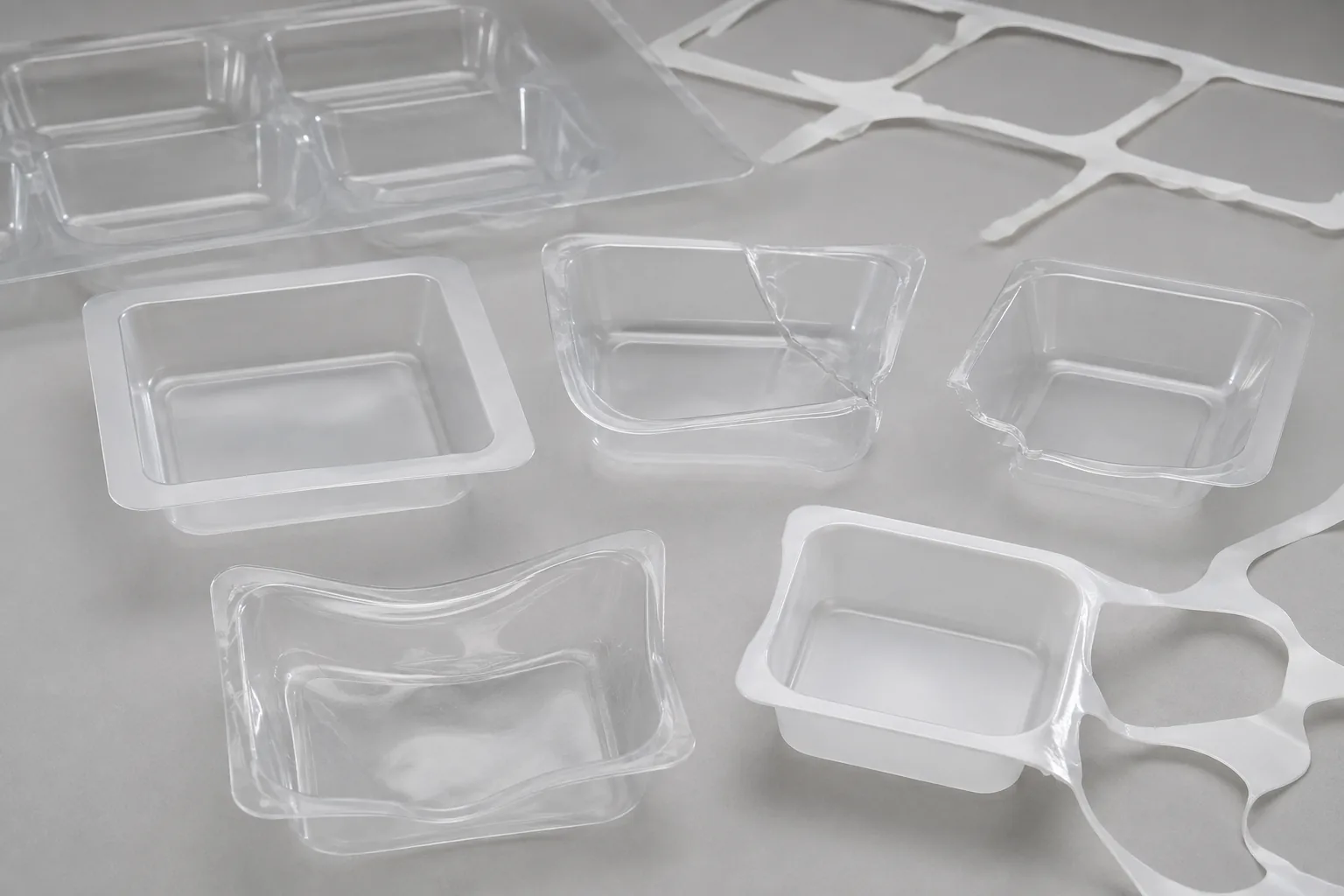
A thermoformed web contains drawn cavities, thin corners and sealing flanges whose thickness differs from the original sheet. Trim tooling must register to the formed geometry, support the flange and release both tray and skeleton without cracking stressed regions.
Updated
Where This Cutting Application Appears
In-line tray separation
Separates formed trays from the indexed web after forming or cooling.
Multi-cavity trim tooling
Cuts repeated cavity arrays while controlling registration across the web.
Prototype and format change
Validates flange support and corner release for a new tray geometry.
Web Trim And Tray Separation process boundary
web trim and tray separation for thermoformed plastic tray webs is a linked sequence: the output condition and datum from each operation become the controlled input for the next. It should not be evaluated as one generic cut or accepted only by the final dimension.
Web Trim And Tray Separation setup checkpoint
For thermoformed plastic tray webs, define the operation order, intermediate dimensions, registration transfer, material support, web or part handling and waste route for every stage of web trim and tray separation.
Web Trim And Tray Separation acceptance checkpoint
Verify both intermediate and final results from web trim and tray separation, including dimensions, registration, edge or feature quality, material damage, waste separation and stable transfer between stages.
Define the Required Cut Result
- Clean sealing flange
- Complete corners
- Undistorted trays
- Reliable skeleton release
Problems to Diagnose Before Changing the Knife
Flange crack
- Check drawn thickness
- Inspect corner stress
- Support the flange
Incomplete corner
- Check registration
- Inspect penetration
- Review local backing
Tray distortion
- Control ejection
- Check clamp load
- Measure cooling state
Skeleton sticking
- Inspect uncut bridges
- Review stripping
- Check nesting layout
Knife Forms That May Be Considered
| Possible knife form | When it may be considered | What must be confirmed |
|---|---|---|
| matched profile knife and die | Supports registered high-volume separation around formed flanges. | Confirm the final geometry and mounting from the thermoform trim press equipment, an unworn sample or an approved drawing before manufacture. |
| profile cutting rule | May suit selected shallow forms or prototypes with engineered backing and ejection. | Confirm the final geometry and mounting from the tray profile cutter equipment, an unworn sample or an approved drawing before manufacture. |
| oscillating knife | May suit low-volume development work when formed stock is fully supported. | Confirm the final geometry and mounting from the thermoformed-web cutting table equipment, an unworn sample or an approved drawing before manufacture. |
Information to Send for Technical Review
You do not need to know the exact blade name. Send the available workpiece, machine, current-knife and cut-result information so the application can be reviewed against a drawing or sample.
- Thermoformer and trim press
- Polymer and sheet gauge
- Tray and flange drawing
- Drawn corner thickness
- Cavity pitch and registration
- Cooling and support
- Defect trays and skeleton
- Tool quantity and schedule
Questions About This Cutting Application
Why do tray flanges crack after trimming?
Residual forming stress, thin corners and poor support can leave notches that open later.
What causes incomplete corners?
Registration error, limited penetration or worn local support commonly contribute.
Can PET and PP use one trim setting?
Do not assume so; stiffness, recovery and fracture differ.
Why does the skeleton remain attached?
Inspect bridges, tool joints, penetration and stripping sequence.
What sample set is needed?
Provide untrimmed web, accepted trays, rejected trays and the matching skeleton.
Related product and service information
- Silver Metal Foil Precision Blanking Blades - silver metal foil · precision blanking
- Cutting Extruded Plastic Profiles - extruded plastic profiles · in-line cutoff
- Corrugated Plastic Sheet Trimming - polypropylene corrugated sheets · sheet edge trimming and sizing
Request a Custom Cutting-Knife Review
Send the workpiece details, machine or holder information, current knife photos or sample, required quantity and examples of the present cut problem. Final dimensions, material, edge geometry and tolerances are confirmed from the approved requirements.