
Blade Application Guides / Application Guide / returnable packaging and sign-sheet production
Corrugated Plastic Sheet Trimming
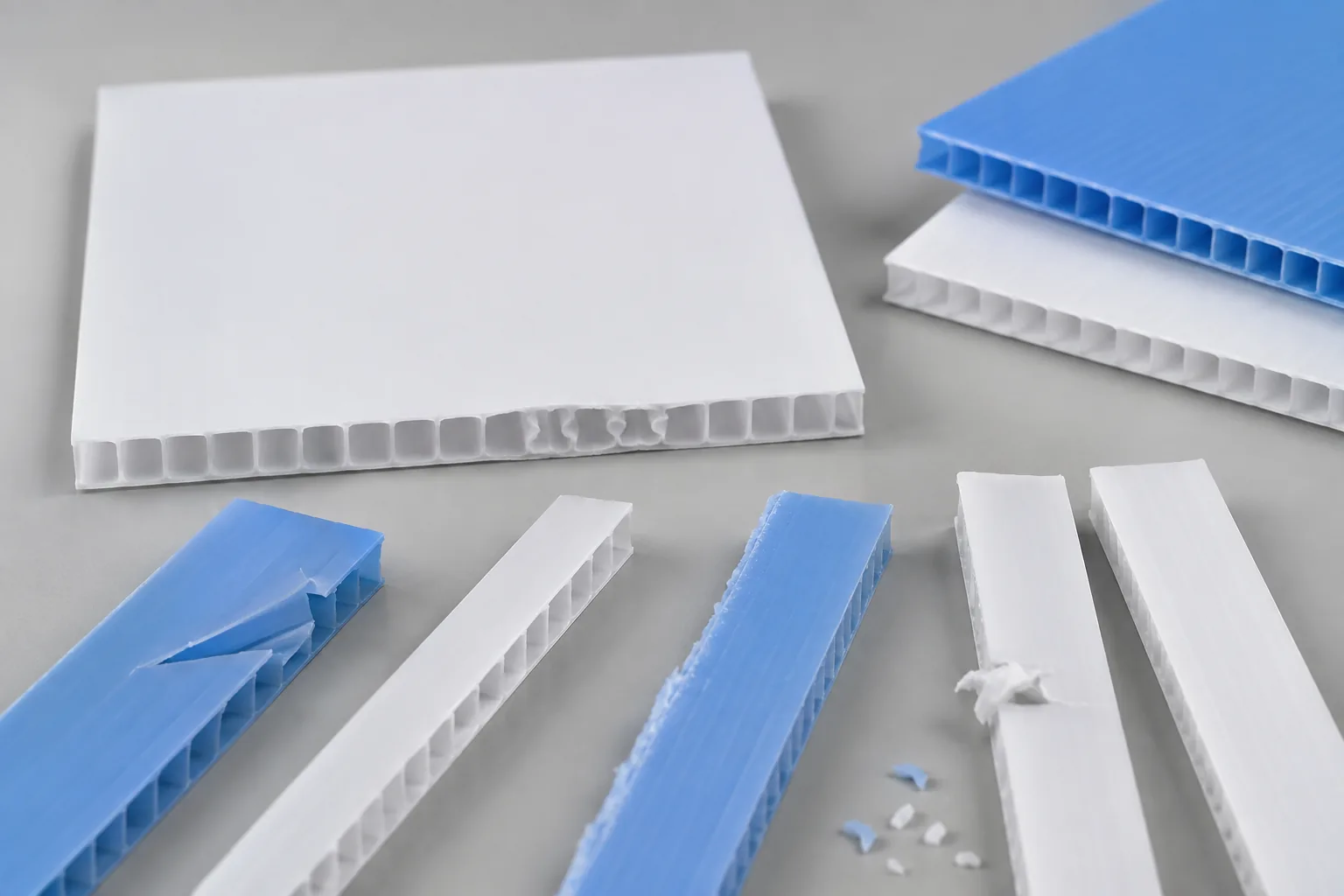
Corrugated polypropylene sheet carries load through thin skins and internal flutes. Trimming must support that hollow section so the outer skin separates cleanly without collapsing ribs or steering along the flute direction.
Updated
Where This Cutting Application Appears
Extruded-sheet edge trim
Removes irregular margins before stacking or printing.
Returnable box blank sizing
Cuts twinwall sheet to blank dimensions before creasing and assembly.
Sign and protective-layer conversion
Produces square panels with clean visible edges.
Sheet Edge Trimming And Sizing process boundary
sheet edge trimming and sizing for polypropylene corrugated sheets is a linked sequence: the output condition and datum from each operation become the controlled input for the next. It should not be evaluated as one generic cut or accepted only by the final dimension.
Sheet Edge Trimming And Sizing setup checkpoint
For polypropylene corrugated sheets, define the operation order, intermediate dimensions, registration transfer, material support, web or part handling and waste route for every stage of sheet edge trimming and sizing.
Sheet Edge Trimming And Sizing acceptance checkpoint
Verify both intermediate and final results from sheet edge trimming and sizing, including dimensions, registration, edge or feature quality, material damage, waste separation and stable transfer between stages.
Define the Required Cut Result
- Square panel dimensions
- Uncrushed flutes
- Clean top and bottom skins
- Low loose plastic debris
Problems to Diagnose Before Changing the Knife
Flute crush
- Support the hollow section
- Check clamp pressure
- Review edge force
Skin tear
- Inspect edge sharpness
- Check exit support
- Compare flute direction
Cut drift
- Align sheet datum
- Check rib steering
- Inspect guide rigidity
Plastic debris
- Inspect edge wear
- Check speed and heat
- Review extraction
Knife Forms That May Be Considered
| Possible knife form | When it may be considered | What must be confirmed |
|---|---|---|
| straight shear knife | May suit supported square sizing where a matched edge separates both skins. | Confirm the final geometry and mounting from the corrugated-sheet shear equipment, an unworn sample or an approved drawing before manufacture. |
| serrated straight knife | May reduce force through thicker twinwall stock if tooth marks remain acceptable. | Confirm the final geometry and mounting from the corrugated-sheet cutter equipment, an unworn sample or an approved drawing before manufacture. |
| powered rotary cutter | May suit guided trimming of large sheets with controlled support. | Confirm the final geometry and mounting from the corrugated-sheet trim station equipment, an unworn sample or an approved drawing before manufacture. |
Information to Send for Technical Review
You do not need to know the exact blade name. Send the available workpiece, machine, current-knife and cut-result information so the application can be reviewed against a drawing or sample.
- Cutter model
- PP grade
- Sheet gauge and flute pitch
- Flute direction
- Panel dimensions and squareness
- Support and clamp
- Crush and tear samples
- Tool quantity and destination
Questions About This Cutting Application
Why do flutes collapse at the edge?
Unsupported ribs or excessive clamp and edge force can crush the section.
Should cuts follow or cross flutes?
Both directions can behave differently; identify every required orientation.
Can paper-corrugator tooling be reused?
Do not assume so; polypropylene skin and flute behavior differ.
How is debris assessed?
Define loose particles and attached burr separately.
What sample is useful?
Provide full-thickness edges cut both with and across flutes.
Related product and service information
- Thermoformed Plastic Tray Web Trimming - thermoformed plastic tray webs · web trim and tray separation
- Cutting Extruded Plastic Profiles - extruded plastic profiles · in-line cutoff
- Coated Paper Sheet Trimming Without Surface Damage - coated paper sheets · sheet trimming
Request a Custom Cutting-Knife Review
Send the workpiece details, machine or holder information, current knife photos or sample, required quantity and examples of the present cut problem. Final dimensions, material, edge geometry and tolerances are confirmed from the approved requirements.