
Blade Application Guides / Application Guide / profile extrusion
Cutting Extruded Plastic Profiles
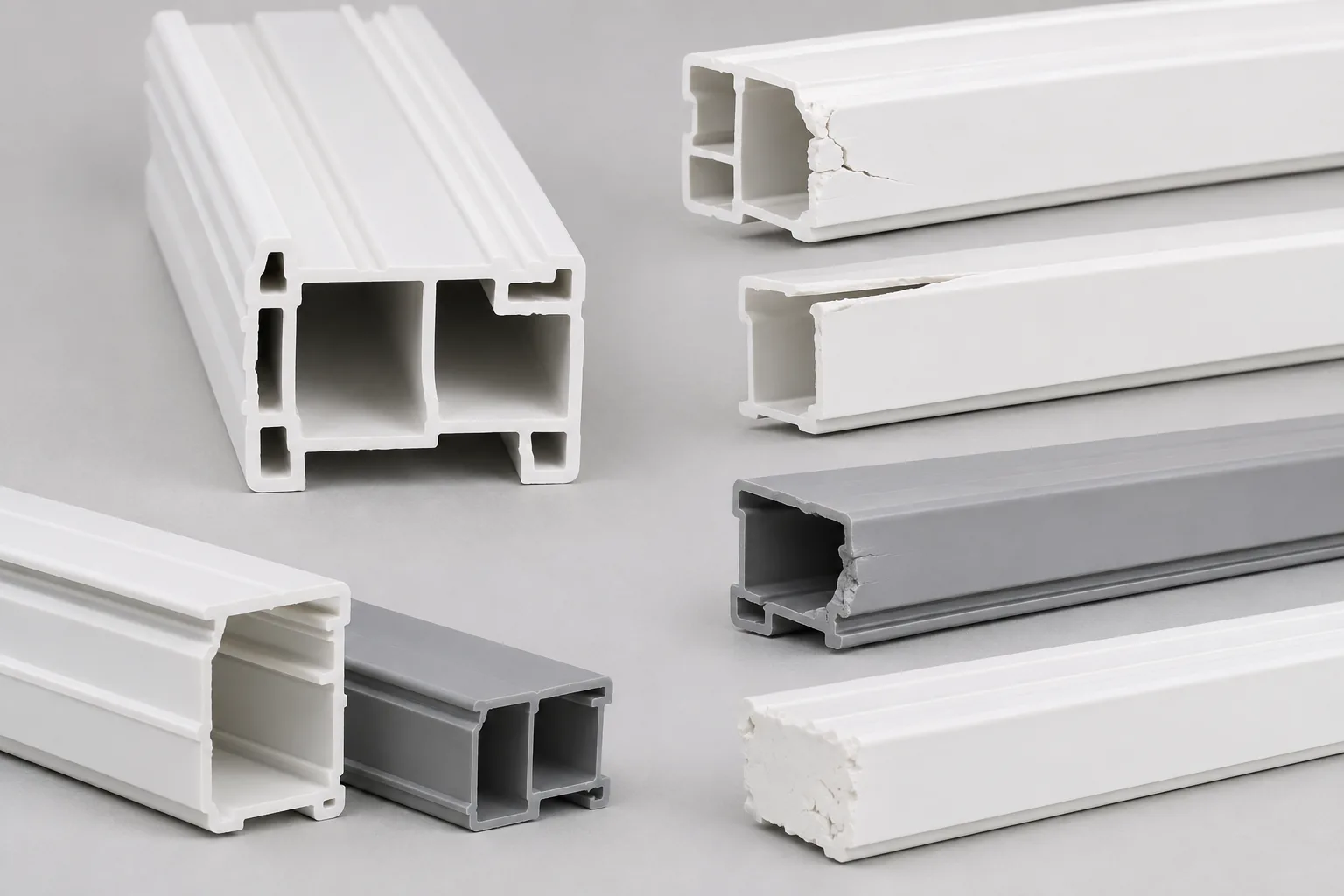
Plastic profiles concentrate stiffness in ribs, thin walls and hollow chambers. Cutoff must support that uneven section and account for extrusion temperature, residual stress and filler content before a knife form is selected.
Updated
Where This Cutting Application Appears
Window and seal profile cutoff
Cuts rigid or semi-rigid profiles into handling lengths after extrusion.
Hollow channel sizing
Separates chambered sections without collapsing webs or lips.
Filled-compound changeover
Rechecks wear and fracture when mineral or fiber loading changes.
In-Line Cutoff process boundary
in-line cutoff for extruded plastic profiles is planned around separation across the material flow or part axis to establish a controlled repeat length or finished end; it is not longitudinal width conversion, shaped contour production or particle-size reduction.
In-Line Cutoff setup checkpoint
For extruded plastic profiles, confirm target length, datum or registration reference, feed indexing, support on both sides, cut timing and post-cut transfer.
In-Line Cutoff acceptance checkpoint
For extruded plastic profiles, evaluate length distribution, squareness or cutoff angle, both cut faces, deformation, registration drift and stacking or discharge consistency.
Define the Required Cut Result
- Square ends through ribs and cavities
- No corner cracks or split lips
- Minimal collapse of hollow sections
- Repeatable cooled length
Problems to Diagnose Before Changing the Knife
Corner cracking
- Check residual stress and temperature
- Inspect edge chipping
- Support projecting lips
Hollow-section collapse
- Match nests to the section
- Reduce clamp load
- Check penetration force
Rough end face
- Identify filler and wall variation
- Inspect cutting speed
- Compare entry and exit surfaces
Length variation
- Verify haul-off and stop
- Define cooling condition
- Check profile slip
Knife Forms That May Be Considered
| Possible knife form | When it may be considered | What must be confirmed |
|---|---|---|
| fine-tooth cutoff blade | May suit rigid profiles where tooth pitch and chip clearance match wall thickness. | Confirm the final geometry and mounting from the profile cutoff equipment, an unworn sample or an approved drawing before manufacture. |
| straight shear knife | May suit supported semi-rigid sections under an indexed stroke. | Confirm the final geometry and mounting from the profile shear equipment, an unworn sample or an approved drawing before manufacture. |
| supported guillotine knife | Can work with a shaped nest that restrains hollow geometry during separation. | Confirm the final geometry and mounting from the profile guillotine equipment, an unworn sample or an approved drawing before manufacture. |
Information to Send for Technical Review
You do not need to know the exact blade name. Send the available workpiece, machine, current-knife and cut-result information so the application can be reviewed against a drawing or sample.
- Extruder and cutoff model
- Polymer, filler and extrusion temperature
- Profile drawing and cavity layout
- Wall and rib thickness range
- Line speed and cycle rate
- Nest and clamp design
- Crack and rough-face samples
- Knife quantity and schedule
Questions About This Cutting Application
Why do only profile corners crack?
Corners can hold residual stress and lack support; inspect temperature and entry direction.
Should length be checked hot or cold?
Specify the condition because thermal contraction can be significant.
Can one nest fit several profiles?
Only if every load-bearing surface remains supported.
How does filler affect the knife?
Mineral or glass filler may raise wear and change fracture behavior.
Is a fine-tooth blade always suitable?
No. Tooth pitch, speed, wall gauge and chip removal must match the profile.
Related product and service information
- Corrugated Plastic Sheet Trimming - polypropylene corrugated sheets · sheet edge trimming and sizing
- Thermoformed Plastic Tray Web Trimming - thermoformed plastic tray webs · web trim and tray separation
- Trimming Sheet-Metal Blanks - sheet-metal blanks · blank trimming
Request a Custom Cutting-Knife Review
Send the workpiece details, machine or holder information, current knife photos or sample, required quantity and examples of the present cut problem. Final dimensions, material, edge geometry and tolerances are confirmed from the approved requirements.