
Blade Application Guides / Application Guide / cable recycling
Scrap Copper Cable Chopping
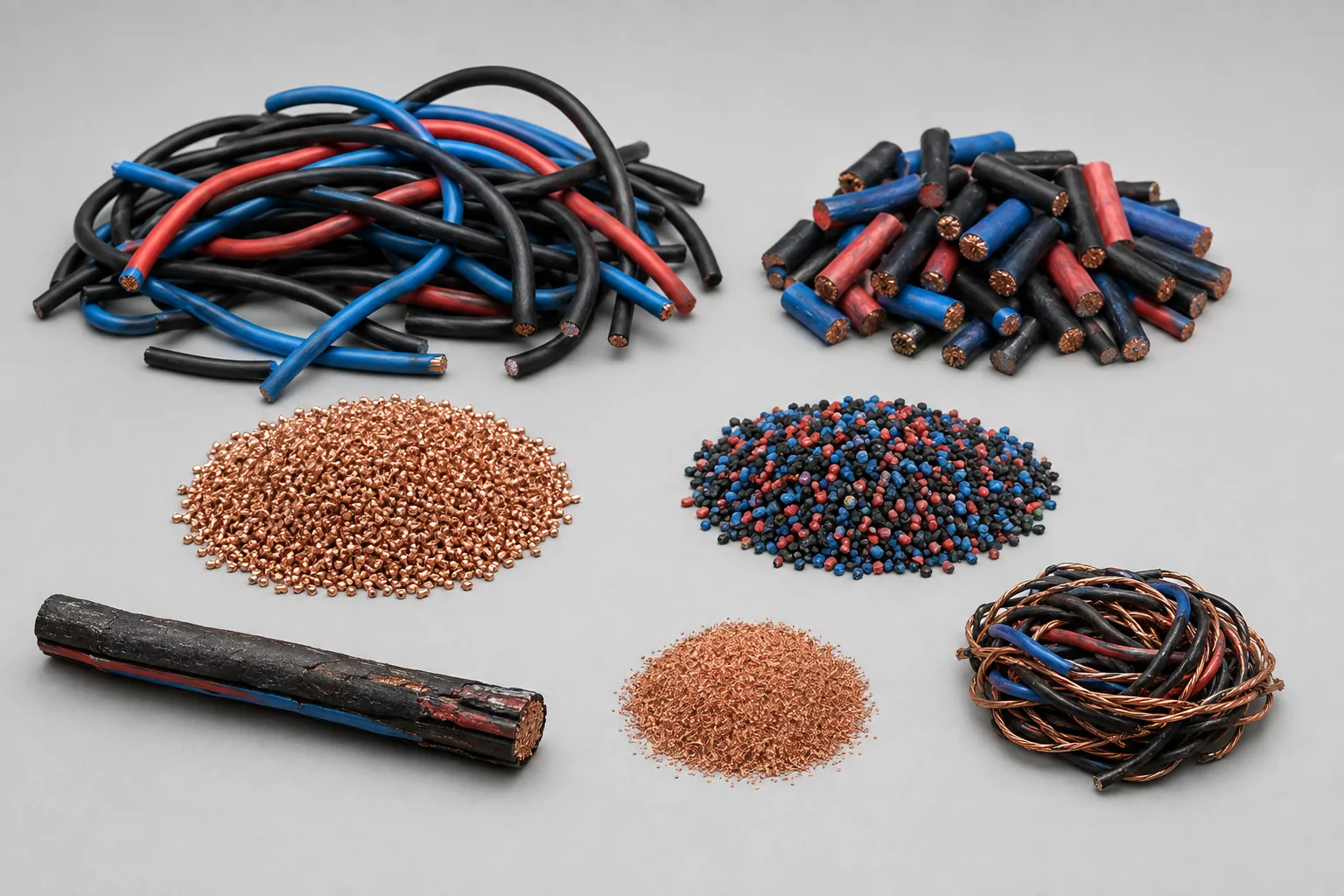
Scrap cable may combine fine flexible wire, power cable, shielding, armor, plugs and different insulation systems. The useful cut result is not simply a short piece: the downstream separator needs an agreed liberation condition without avoidable conductor loss or long wire carryover. Define the representative cable mix and separation target before reviewing the chopping knife.
Updated
Where This Cutting Application Appears
Chopping mixed insulated copper wire
Prepare sorted cable fractions for downstream copper and polymer separation.
Reducing pre-cut cable segments
Process feed that has already passed through a primary cutter but remains too long for effective liberation.
Granulating flexible harness wire
Cut fine multi-strand conductors and insulation into a distribution suited to the customer's separation stage.
Cable Chopping process boundary
cable chopping for scrap copper cable is planned around preparation of fiber, strand, cable or compacted feed into a controlled form and length for the next processing stage; it is not finished sheet sizing, profile cutting or uncontrolled bulk shredding.
Cable Chopping setup checkpoint
For scrap copper cable, confirm incoming bundle or bale condition, alignment, restraint, feed rate, target length or opening degree and downstream discharge.
Cable Chopping acceptance checkpoint
For scrap copper cable, evaluate length or opening distribution, long strands or clumps, fines, incomplete separation, fiber damage and stable downstream feeding.
Define the Required Cut Result
- Adequate copper-polymer liberation for downstream sorting
- Controlled particle distribution with limited ultrafine copper loss
- Complete cutting of flexible conductor bundles
- Stable knife life under declared contaminants and feed mix
Problems to Diagnose Before Changing the Knife
Copper remains trapped in long insulation pieces
Review input length, working clearance, edge condition, screen, recirculation and feed density.
Too many fine copper particles are produced
Check rotor speed, repeated passes, screen restriction, knife overlap and brittle or very fine conductor feed.
Flexible wire wraps around the rotor
Inspect feed preparation, rotor engagement, stator clearance and whether long loops enter the chamber.
Knife edges chip unexpectedly
Identify steel armor, plugs, terminals, stones or other contaminants and correlate damage with sorting records.
Scrap copper cable chopping: follow the rejected fraction back to its cause
Separate feed-mix, cutter-interface and separator effects before changing the blade.
Long wire strands or intact cable sections remain
Sort rejects by cable construction and diameter, then inspect feed presentation, knife engagement, clearance, screen condition and bypass.
Connectors, armor or shielding cause isolated edge damage
Record the hard attachment and its frequency, locate damage by knife position and review upstream sorting or pre-cutting before changing material.
Copper remains with insulation or enters the wrong fraction
Compare chopping output with separator settings and required liberation. Confirm whether the defect begins in cutting or separation using paired samples.
Acceptance Criteria for a Controlled Trial
Agree how the trial will be judged before changing the knife or machine setting.
- Run the agreed representative cable mix and record plugs, terminals, armor and shielding in the sample.
- Measure long strands, intact cable pieces and the target chopped fraction using fixed sampling.
- Record unliberated conductor/insulation and misplaced copper in the named downstream separator sample.
- Inspect labeled cutting positions for local chipping, scoring and seating marks after the controlled interval.
Knife Forms That May Be Considered
| Possible knife form | When it may be considered | What must be confirmed |
|---|---|---|
| rotor chopping knife | A rotating knife can repeatedly shear cable against a fixed counter-edge to promote liberation. Select the cutter and stationary mating edge from the actual chopper or granulator interface, cable mix and liberation target; do not infer geometry from conductor diameter alone. | Confirm rotor drawing, seat, bolt pattern, cutting circle, rotation, screen and maximum feed construction. |
| fixed bed knife | A stationary bed knife establishes the counter-edge and clearance used to cut conductor and insulation together. | Confirm length, section, datum, adjustment direction and measured clearance across the rotor. |
Information to Send for Technical Review
You do not need to know the exact blade name. Send the available workpiece, machine, current-knife and cut-result information so the application can be reviewed against a drawing or sample.
- Cable mix by type, conductor range, insulation system and allowable lot variation
- Presence of plugs, terminals, steel armor, shielding, jelly or other attachments
- Feed length and bundle condition plus upstream sorting and pre-cutting
- Required chopped-size and downstream copper/insulation separation criteria
- Chopper or granulator make or model, rotor layout and adjustment method
- Rotor knife, bed knife, holder, clamp and screen drawings with used samples
- Feed rate, speed, recirculation, wrap locations and load observations
- Paired input, rejected chop and downstream separation samples
Related Recycling Knife and Service Pages
Questions About This Cutting Application
How is cable chopping different from jacket stripping?
Chopping destroys cable into sortable particles; stripping opens the jacket while preserving a recoverable conductor length.
What does poor liberation look like?
Copper remains enclosed in polymer or long composite pieces. Provide separator rejects as well as granulator output.
Can a smaller screen improve copper recovery?
Not by itself. It may create more fines and recirculation; evaluate liberation and separator performance together.
Why does fine flexible wire wrap?
Long loops and low stiffness can follow the rotor instead of entering the shear gap. Feed preparation and capture geometry matter.
What should a cable-recycling RFQ include?
Describe feed mix, contamination, input and target sizes, sorting equipment, rotor/bed geometry, screen and worn knives.
Public references and scope
These public sources provide material, cutting-method or safety context for this guide. Supplier pages describe their own materials or equipment; they do not establish a MEIRENTE blade specification or performance claim. Confirm the actual grade, machine setup and required cut with a drawing or sample.
Related product and service information
- Cutting Agricultural Mulch Film for Recycling - used agricultural mulch film · contaminated film size reduction
- Granulating Plastic Scrap and Regrind - plastic scrap and regrind feed · granulation and size reduction
- Cutting Post-Consumer Plastic Film for Recycling - post-consumer plastic film · film shredding and granulation
Request a Custom Cutting-Knife Review
Send the workpiece details, machine or holder information, current knife photos or sample, required quantity and examples of the present cut problem. Final dimensions, material, edge geometry and tolerances are confirmed from the approved requirements.