
Blade Application Guides / Application Guide / agricultural plastics recycling
Cutting Agricultural Mulch Film for Recycling
Used mulch film may reach the reducer with soil, moisture, plant residue, folds and rigid-plastic or metal contamination. Those conditions affect feeding, wrapping, abrasion and downstream washing. Define whether the machine is opening contaminated film or producing screened feed for a later process, then evaluate the knife and acceptance method for that stage.
Updated
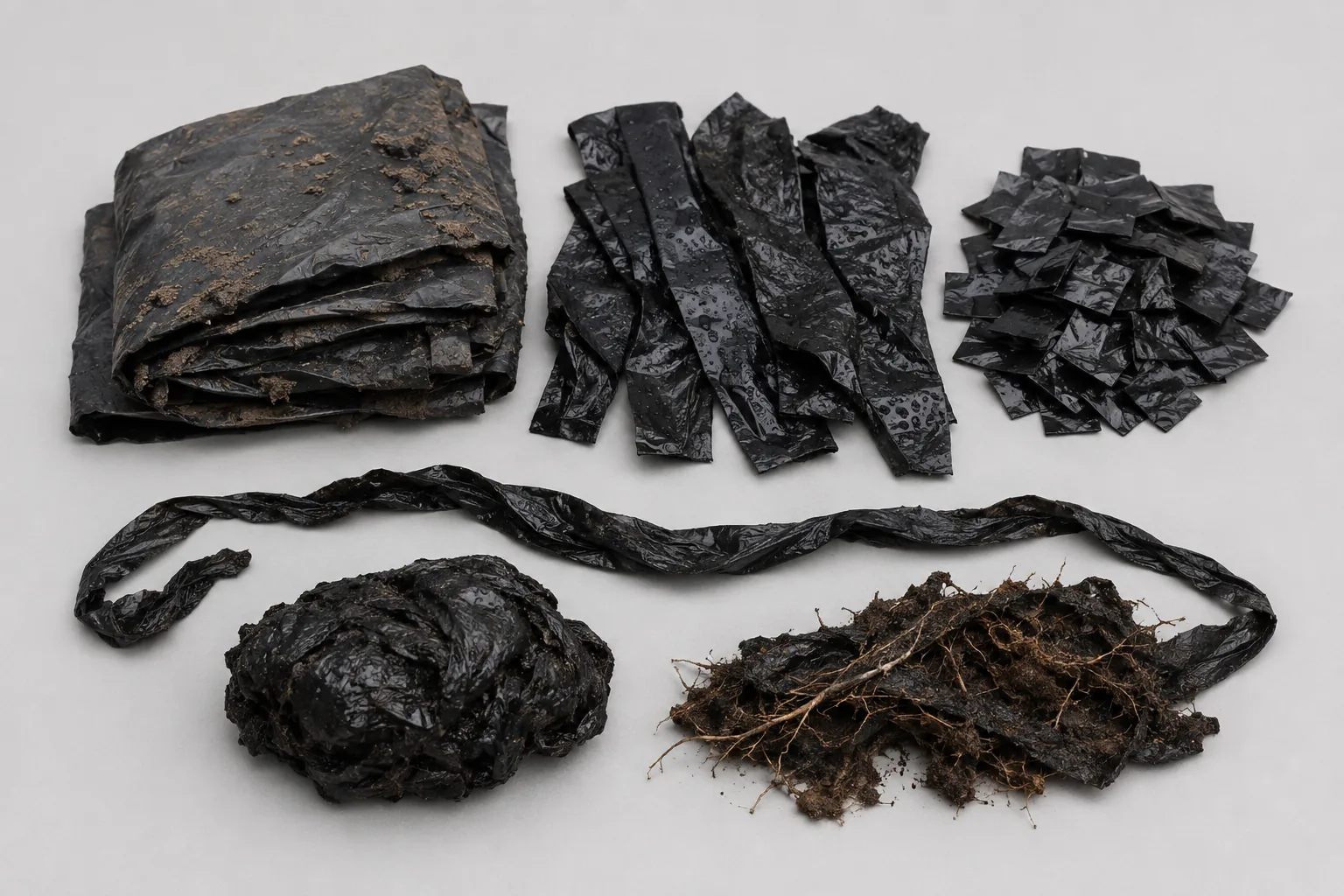
Where This Cutting Application Appears
Opening collected mulch-film bundles
Reduce compacted field film before washing or gross-contaminant separation.
Cutting wet film after washing
Shorten slippery folded material before drying or downstream reprocessing.
Granulating cleaned mulch-film strips
Produce controlled pieces after soil and crop residue have been substantially removed.
Contaminated Film Size Reduction process boundary
contaminated film size reduction for used agricultural mulch film is planned around controlled feed-size reduction, with the required output range and downstream separation step defined before equipment selection; it is not a finished-dimension cut or an unspecified one-stage crushing operation.
Contaminated Film Size Reduction setup checkpoint
For used agricultural mulch film, confirm incoming form and maximum size, contamination, target particle range, throughput, heat control and the screen or classification route.
Contaminated Film Size Reduction acceptance checkpoint
For used agricultural mulch film, evaluate output-size distribution, oversize return, fines, contamination release, temperature, throughput stability and suitability for the next recovery stage.
Define the Required Cut Result
- Reliable capture of low-density folded film
- Reduced shaft wrapping and long ribbon output
- Wear behavior matched to declared soil contamination
- Controlled pieces for the next washing or drying stage
Problems to Diagnose Before Changing the Knife
Film wraps at rotor or shaft ends
Check input length, feed compaction, rotor engagement, counter-edge clearance and shaft protection.
Soil rounds the edge rapidly
Quantify residual dirt by process stage and inspect wear concentration, washing and feed distribution.
Wet bundles compact without separating
Review drainage, fold thickness, feed rate, chamber buildup and whether the rotor opens the bundle.
Long ribbons leave the cutter
Inspect edge overlap, screen condition, film folding and whether flexible layers evade the shear gap.
Agricultural mulch film: diagnose contamination, wrapping and stage mismatch
Keep the incoming contamination state with every trial record so cleaning or feed changes are not credited to the knife.
Bales bridge or dense folds pass without stable engagement
Record bale opening, fold and sheet dimensions, soil/moisture load and metering. Compare a controlled loosened sample before altering cutter projection.
Film wraps while soil accelerates uneven edge damage
Map wrap and wear by knife position, inspect anti-wrap clearance and seats, and document abrasive contamination rather than assuming uniform blade wear.
Reduced film is the right nominal size but washing or densifying rejects it
Measure long strips, dirt carryover and discharge condition using the downstream step’s acceptance method; cutting does not replace washing or sorting.
Acceptance Criteria for a Controlled Trial
Agree how the trial will be judged before changing the knife or machine setting.
- Define film construction, bale condition, moisture, soil and foreign-object state for the trial batch.
- Count bridging, reversal and wrapping events over a fixed mass or interval.
- Measure long strips, target fraction and fines plus dirt carryover using the agreed downstream sample.
- Record temperature, discharge stability and position-specific edge or seat marks.
Knife Forms That May Be Considered
| Possible knife form | When it may be considered | What must be confirmed |
|---|---|---|
| rotor knife | A rotating edge can capture and shear prepared film when the chamber and counter-tool control wrapping. Choose an opening-shredder cutter or granulator rotor/bed pair only after confirming the stage, contamination controls, mounting interface and downstream handoff. | Confirm rotor drawing, seat, rotation, cutting circle, feed form and abrasive contamination. |
| stator knife | The fixed counter-edge sets the working clearance and influences whether folded film shears or pulls through. | Confirm length, section, datum, adjustment, support and measured clearance across the rotor. |
Information to Send for Technical Review
You do not need to know the exact blade name. Send the available workpiece, machine, current-knife and cut-result information so the application can be reviewed against a drawing or sample.
- Mulch-film construction, thickness range, crop/use source and allowable lot variation
- Loose or baled presentation, maximum sheet/fold/bale dimensions and feed preparation
- Moisture, soil, plant residue, rigid plastic, wire and stone contamination controls
- Required output for washing, drying, densifying, agglomerating or extrusion
- Machine sequence, make or model, shaft/rotor arrangement and adjustment method
- Cutter, counterknife, holder, anti-wrap component and screen drawings or used samples
- Feed rate, speed, reversals, wrap locations, load and temperature records
- Accepted and rejected output plus downstream cleaning samples from one batch
Related Recycling Knife and Service Pages
Questions About This Cutting Application
Why is mulch film more abrasive than clean packaging film?
Field soil and mineral particles travel with the film and can dominate edge wear even when the polymer is thin.
Should film be cut before or after washing?
That is a process-design decision. State the actual stage because wetness, contamination and feed form differ.
Can a sharper edge stop wrapping?
Not alone. Capture, counter-edge clearance, input length and shaft-end geometry also control wrapping.
What causes wet film to form dense lumps?
Water, folds and pressure can compact layers that slide together instead of entering the shear.
What should be photographed for an RFQ?
Show unopened feed, contaminants, the state at the cutter, output ribbons or pieces and worn-tool surfaces.
Public references and scope
These public sources provide material, cutting-method or safety context for this guide. Supplier pages describe their own materials or equipment; they do not establish a MEIRENTE blade specification or performance claim. Confirm the actual grade, machine setup and required cut with a drawing or sample.
Related product and service information
- Washed PET Bottle Flake Cutting - washed PET bottle flakes · flake size reduction
- Granulating Plastic Scrap and Regrind - plastic scrap and regrind feed · granulation and size reduction
- Cutting Post-Consumer Plastic Film for Recycling - post-consumer plastic film · film shredding and granulation
Request a Custom Cutting-Knife Review
Send the workpiece details, machine or holder information, current knife photos or sample, required quantity and examples of the present cut problem. Final dimensions, material, edge geometry and tolerances are confirmed from the approved requirements.