
Blade Application Guides / Application Guide / hygiene products
Sanitary Pad Absorbent Core Cutting
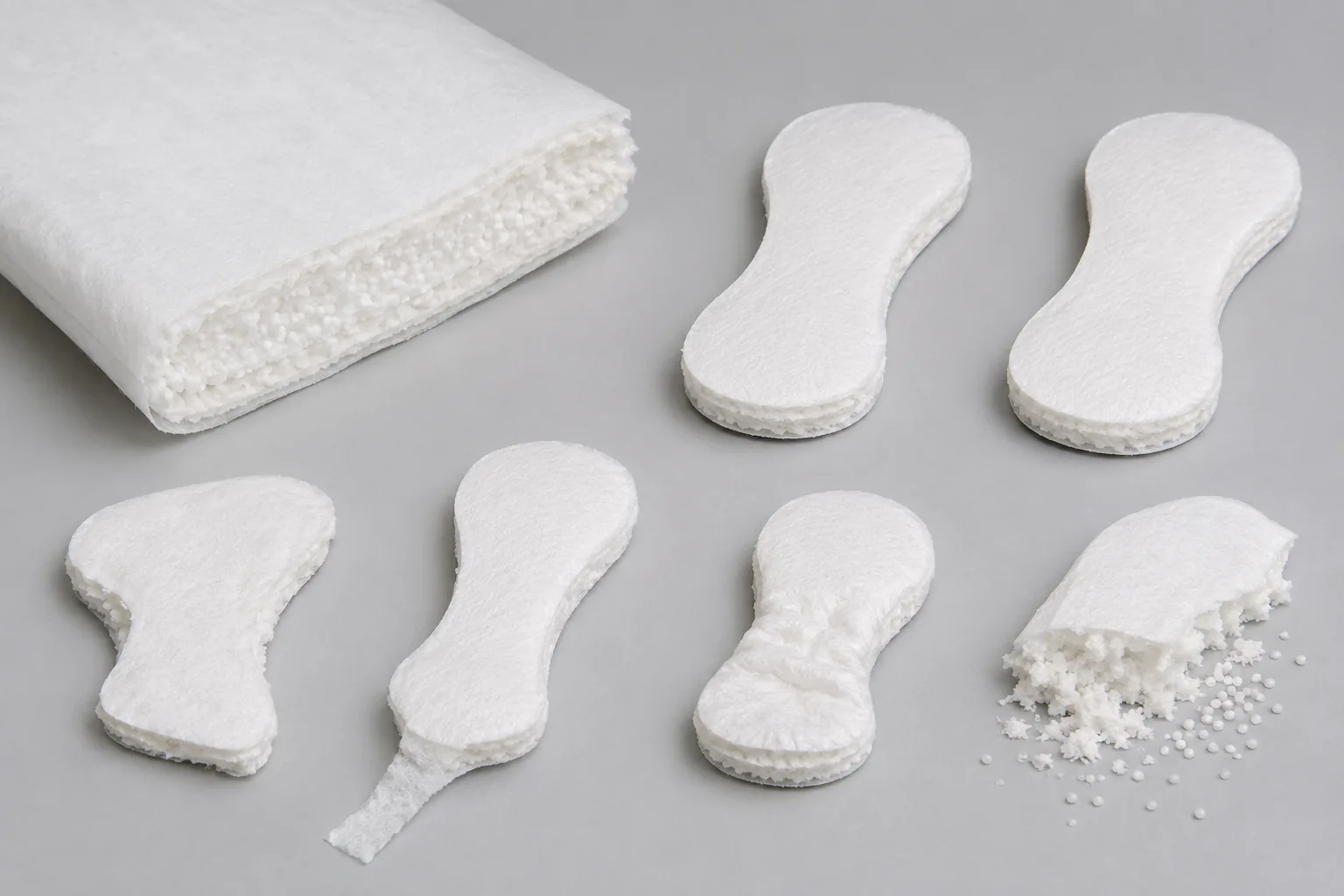
An absorbent core is a low-density composite rather than a uniform sheet: loose pulp, absorbent particles and carrier tissue can shift or escape when compressed. Contour cutting must preserve the intended profile while controlling dust, particle loss and layer movement around the perimeter.
Updated
Where This Cutting Application Appears
Shaping hourglass absorbent cores
Cut side contours that fit the product design while retaining pulp and absorbent material inside the carrier layers.
Cutting straight core lengths
Separate a continuous absorbent structure into indexed lengths before wrapping or assembly.
Trimming laminated core margins
Remove irregular tissue or nonwoven edges after the core components have been combined.
Core Contour Cutting process boundary
core contour cutting for sanitary pad absorbent cores is planned around following a specified shaped boundary or cross-section rather than making only a straight sizing cut; it is not simple rectangular sizing, longitudinal slitting or narrow edge trimming.
Core Contour Cutting setup checkpoint
For sanitary pad absorbent cores, confirm drawing geometry, minimum radii, entry and exit points, support near direction changes, registration and shaped-waste removal.
Core Contour Cutting acceptance checkpoint
For sanitary pad absorbent cores, evaluate complete profile dimensions, radius and tangent fidelity, corner condition, local distortion, edge quality and fit in the next assembly.
Define the Required Cut Result
- A repeatable perimeter profile without core collapse
- Limited fluff dust and absorbent-particle escape
- Carrier layers cut cleanly without peeling away
- Stable core position through cutting and transfer
Problems to Diagnose Before Changing the Knife
Fluff pulp and particles spill from the edge
Review core compression, carrier closure, edge path, cutting speed and the time between forming and cutting.
The contour is distorted or asymmetric
Check registration, core position, differential web tension, profile runout and compression across the width.
Carrier tissue remains connected
Inspect penetration, backing or anvil condition, layer wrinkles, edge continuity and local core thickness.
Dust rises sharply as the tool wears
Compare edge condition, pulp moisture, compression and vacuum extraction; record the point in the run when dust increases.
Knife Forms That May Be Considered
| Possible knife form | When it may be considered | What must be confirmed |
|---|---|---|
| profiled rotary knife | A rotary profile can suit repeated high-cycle contours when registration and the mating anvil are controlled. | Confirm profile drawing, repeat length, mounting, runout, penetration, anvil construction and allowed core compression. |
| straight cutoff knife | A straight knife may suit core length cutting or end trimming on a supported indexed web. | Confirm cutting width, stroke, bevel, holder, backing surface and maximum core build-up at the cut. |
Information to Send for Technical Review
You do not need to know the exact blade name. Send the available workpiece, machine, current-knife and cut-result information so the application can be reviewed against a drawing or sample.
- Core recipe category and layer sequence
- Fluff pulp basis weight and absorbent-particle distribution
- Carrier tissue or nonwoven construction and bond method
- Core thickness, density and compression at cutting
- Profile drawing, repeat length and registration marks
- Line speed, web tension, transfer and vacuum arrangement
- Rotary holder or straight-knife interface with anvil details
- Samples showing particle loss, dust, profile error or uncut tissue
Questions About This Cutting Application
Why does absorbent material fall from a clean-looking edge?
The carrier may open after compression is released. Inspect the edge immediately and after normal transfer, and describe how the core is contained.
Can contour accuracy be judged from the knife drawing alone?
No. Registration, core movement, anvil condition and compression can shift the finished shape even when the tool profile is correct.
What causes tissue tails around the core?
Thin carrier layers can wrinkle or deflect into clearance. Check backing contact and penetration across thick and thin core regions.
Will a sharper edge always reduce dust?
It may help, but pulp condition, compression, extraction and product transfer also contribute. Compare dust timing with edge wear.
What should a contour sample show?
Supply several consecutive cores with feed direction and registration position identified, including the surrounding trim if available.
Related product and service information
- Wound Dressing Laminate Die Cutting - wound dressing laminates · laminate die cutting
- Cotton Pad and Cosmetic Round Cutting - cotton pads and cosmetic rounds · stack cutting and shaping
- Elastic Ear-Loop Cord Cutting - elastic ear-loop cord · high-cycle length cutting
Request a Custom Cutting-Knife Review
Send the workpiece details, machine or holder information, current knife photos or sample, required quantity and examples of the present cut problem. Final dimensions, material, edge geometry and tolerances are confirmed from the approved requirements.