
Blade Application Guides / Application Guide / personal care products
Cotton Pad and Cosmetic Round Cutting
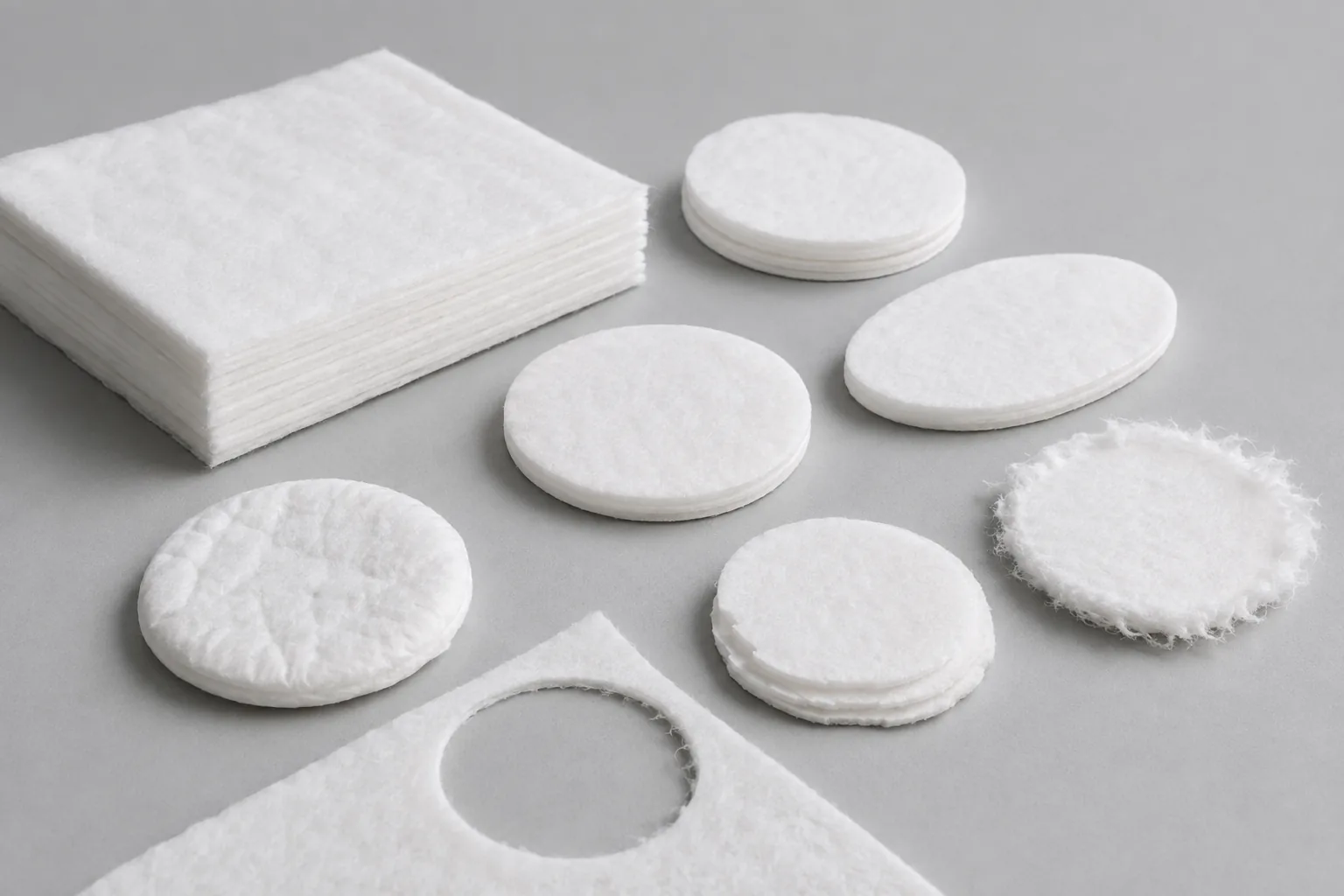
Cotton pads are soft, lofty fiber assemblies that can flatten under load and recover after the cut. Whether the material is loose cotton, hydroentangled web or a laminated pad, profile accuracy depends on stack restraint, penetration through every ply and clean release from the cutting outline.
Updated
Where This Cutting Application Appears
Punching round cosmetic pads
Cut repeated discs from layered web while keeping the circumference smooth and the plies aligned.
Shaping oval or contoured pads
Produce non-round care-product shapes whose corners and narrow features must release without tearing.
Cutting stacked cotton sheets
Separate multiple plies in one cycle without leaving uncut fibers in the lower layers.
Stack Cutting And Shaping process boundary
stack cutting and shaping for cotton pads and cosmetic rounds is a linked sequence: the output condition and datum from each operation become the controlled input for the next. It should not be evaluated as one generic cut or accepted only by the final dimension.
Stack Cutting And Shaping setup checkpoint
For cotton pads and cosmetic rounds, define the operation order, intermediate dimensions, registration transfer, material support, web or part handling and waste route for every stage of stack cutting and shaping.
Stack Cutting And Shaping acceptance checkpoint
Verify both intermediate and final results from stack cutting and shaping, including dimensions, registration, edge or feature quality, material damage, waste separation and stable transfer between stages.
Define the Required Cut Result
- A complete perimeter with limited loose fiber
- Repeatable shape after the pad recovers from compression
- Aligned layers without edge steps or ply displacement
- Reliable part and matrix release after cutting
Problems to Diagnose Before Changing the Knife
Fibers pull from the cut perimeter
Check fiber orientation, edge continuity, penetration, backing support and stripping direction.
Lower plies remain connected
Review stack height, compression, stroke parallelism, backing wear and local thickness variation.
Pads measure undersize immediately after cutting
Distinguish temporary compression from permanent distortion by recording measurement time and stack pressure.
Parts remain lodged in the cutting profile
Inspect taper, internal surface, pad loft, static, ejector or stripping method and compacted lint.
Knife Forms That May Be Considered
| Possible knife form | When it may be considered | What must be confirmed |
|---|---|---|
| profiled punch knife | A closed punch can suit discrete pad shapes when the press controls alignment, penetration and ejection. | Confirm profile, corner radii, section, mounting, backing material, stack height and release method from an approved drawing. |
| straight stack knife | A straight knife may suit strips, squares or preliminary stack sizing before final shaping. | Confirm cutting length, bevel, stroke, hold-down, bed and maximum compressed stack thickness. |
Information to Send for Technical Review
You do not need to know the exact blade name. Send the available workpiece, machine, current-knife and cut-result information so the application can be reviewed against a drawing or sample.
- Fiber type and web-forming method
- Single-ply thickness, basis weight and pad layer count
- Dry, premoistened, coated or laminated condition
- Finished shape drawing and tolerance after recovery
- Maximum stack height and applied compression
- Press stroke, holder, backing and ejection arrangement
- Current knife profile and locations of lint buildup
- Consecutive samples showing fiber pullout, uncut plies or distortion
Questions About This Cutting Application
Why does the finished pad change size after cutting?
Lofty fibers recover after pressure is released. State the conditioning and measurement time used for acceptance.
Can more stack compression improve the edge?
It may stabilize plies, but excessive pressure can densify or distort the pad. Evaluate finished samples after recovery.
What causes only the bottom layers to remain attached?
Penetration may vary with backing wear, stack height or press alignment. Map the defect across the cutting area.
Can a finished pad be used to reproduce the knife profile?
It helps define the outcome, but recovery and edge fuzz can obscure the intended geometry. Supply a controlled profile drawing.
Which details matter for part release?
Provide pad loft, profile depth, internal taper, ejection or stripping method and the point where parts begin to stick.
Related product and service information
- Elastic Ear-Loop Cord Cutting - elastic ear-loop cord · high-cycle length cutting
- Sanitary Pad Absorbent Core Cutting - sanitary pad absorbent cores · core contour cutting
- Wound Dressing Laminate Die Cutting - wound dressing laminates · laminate die cutting
Request a Custom Cutting-Knife Review
Send the workpiece details, machine or holder information, current knife photos or sample, required quantity and examples of the present cut problem. Final dimensions, material, edge geometry and tolerances are confirmed from the approved requirements.