
Blade Application Guides / Application Guide / wound care products
Wound Dressing Laminate Die Cutting
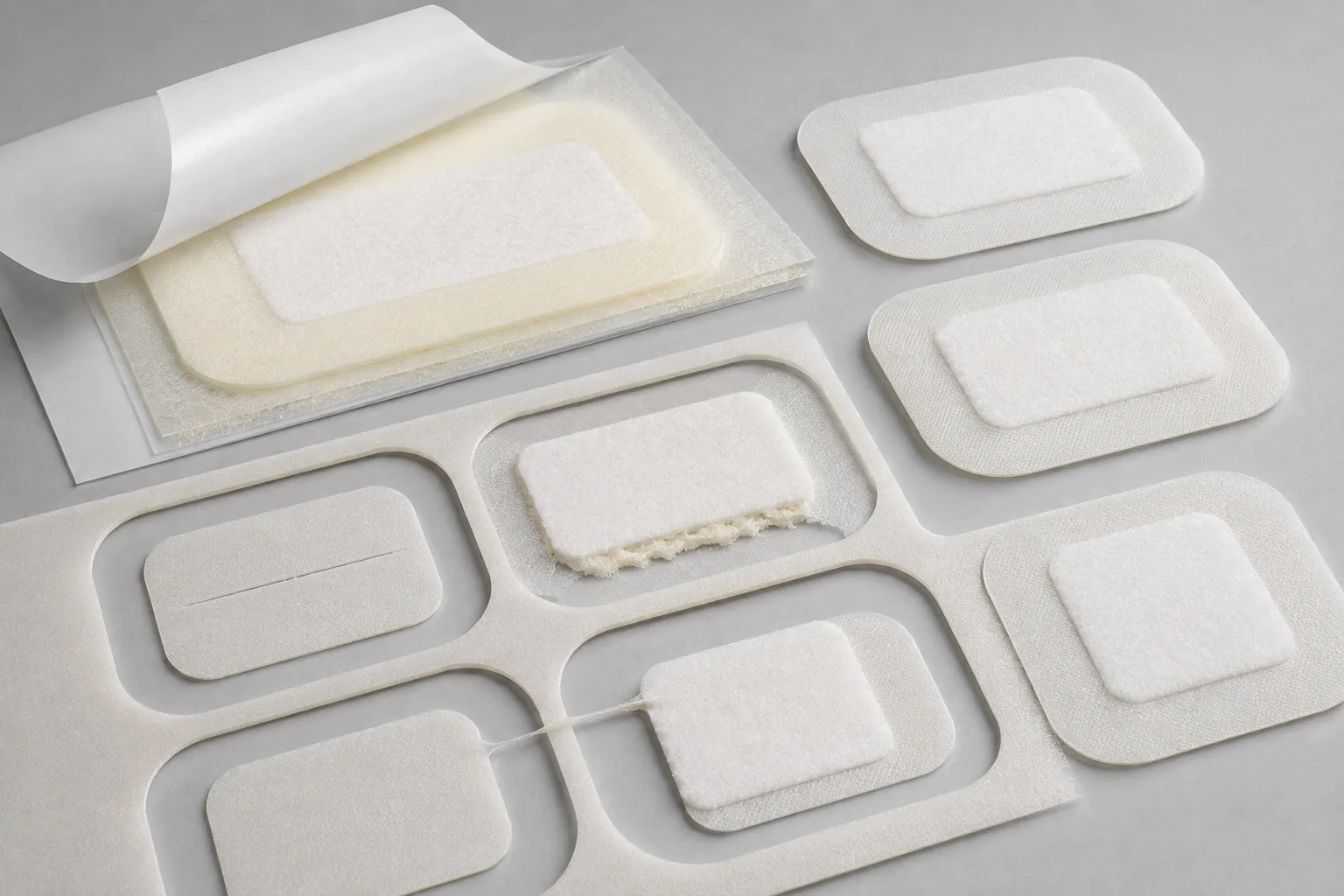
Wound dressing stock may contain films, foams, nonwovens, absorbent pads, pressure-sensitive adhesive and release liners in one construction. Kiss cutting must separate selected layers without marking the liner, while full-profile cutting must control compression and release around soft or adhesive components.
Updated
Where This Cutting Application Appears
Kiss cutting adhesive dressing shapes
Cut the face construction to profile while leaving the release liner continuous for handling and dispensing.
Full-cutting foam dressing blanks
Separate soft multilayer pieces through all layers before individual packing or further assembly.
Cutting windowed or island-pad constructions
Form an outer adhesive border around a central absorbent or non-adherent area without shifting the inner component.
Laminate Die Cutting process boundary
laminate die cutting for wound dressing laminates is planned around repeatable full or controlled-depth formation of a defined shape using registered tooling and a managed waste path; it is not straight slitting, simple length separation or narrow edge cleanup.
Laminate Die Cutting setup checkpoint
For wound dressing laminates, confirm finished geometry, clearance or cutting depth, tool-to-anvil support, registration, feed orientation and waste or part release.
Laminate Die Cutting acceptance checkpoint
For wound dressing laminates, evaluate complete geometry, dimensions, registration, burr or fiber pull, corner integrity, waste separation and part flatness.
Define the Required Cut Result
- Accurate profile and corner radii across the web
- Controlled kiss-cut depth with an intact release liner
- Clean foam and film edges with limited compression recovery
- Reliable part release without adhesive strings or lifted layers
Problems to Diagnose Before Changing the Knife
The release liner is scored or cut through
Check penetration setting, liner thickness, backing hardness, web flatness and local laminate build-up.
Foam edges remain compressed after cutting
Review edge wedge, dwell, hold-down, foam density and when dimensions are measured after recovery.
Adhesive strings connect parts to the matrix
Inspect adhesive flow, temperature, edge finish, stripping direction and the distance between cutting and waste removal.
An inner pad shifts relative to the outer profile
Check component registration, laminate bond, web tension, compression and timing between placement and cutting.
Knife Forms That May Be Considered
| Possible knife form | When it may be considered | What must be confirmed |
|---|---|---|
| profiled die-cutting knife | A closed profile suits repeated dressing shapes when the equipment controls registration, penetration and backing support. | Confirm the approved profile, corner radii, total build, cut depth, mounting, repeat and backing system. |
| straight cutoff knife | A straight edge may suit final sheeting or strip separation after profile features have been cut. | Confirm whether the duty is full-depth or kiss cut, plus web width, stroke, holder and counter-surface. |
Information to Send for Technical Review
You do not need to know the exact blade name. Send the available workpiece, machine, current-knife and cut-result information so the application can be reviewed against a drawing or sample.
- Complete layer stack with material and thickness for every layer
- Adhesive zones, uncoated areas and release-liner orientation
- Kiss-cut or full-cut requirement for each profile segment
- Drawing with radii, tolerances, repeat pitch and registration datum
- Foam or absorbent-component density and recovery behavior
- Web speed, tension, backing and waste-stripping arrangement
- Current die or knife, observed wear and penetration settings
- Consecutive samples showing liner marks, strings, compression or registration error
Questions About This Cutting Application
What is the difference between kiss cutting and full cutting?
Kiss cutting separates selected upper layers while preserving a carrier or liner; full cutting separates the entire construction. The drawing must state each boundary.
Why does the liner cut through only in certain areas?
Local thickness, backing wear, web wrinkles or tool runout can alter penetration. Map defects to profile and machine position.
When should foam dimensions be checked?
Use the customer's agreed time after cutting because compressed foam may recover. Record both the method and conditioning state.
Can a dressing profile be reproduced from a finished sample?
A sample helps define shape, but layer boundaries and intended kiss depth may be hidden. Confirm them in a controlled drawing.
Who approves medical suitability of the finished part?
The product manufacturer owns material and device validation. Knife review addresses geometry, process interface and stated cut quality only.
Related product and service information
- Microfluidic Diagnostic Adhesive Tape Die-Cutting Blades - Liner-backed microfluidic diagnostic adhesive tape · Registered die-cutting and kiss-cutting
- Sanitary Pad Absorbent Core Cutting - sanitary pad absorbent cores · core contour cutting
- Cotton Pad and Cosmetic Round Cutting - cotton pads and cosmetic rounds · stack cutting and shaping
Request a Custom Cutting-Knife Review
Send the workpiece details, machine or holder information, current knife photos or sample, required quantity and examples of the present cut problem. Final dimensions, material, edge geometry and tolerances are confirmed from the approved requirements.