
Blade Application Guides / Application Guide / mask production
Elastic Ear-Loop Cord Cutting
Ear-loop cord is presented under tension but measured after it relaxes, so a mechanically accurate cutoff can still produce the wrong free length. Braided, knitted and covered elastic constructions also separate differently, making restraint and cut timing central to both length control and end quality.
Updated
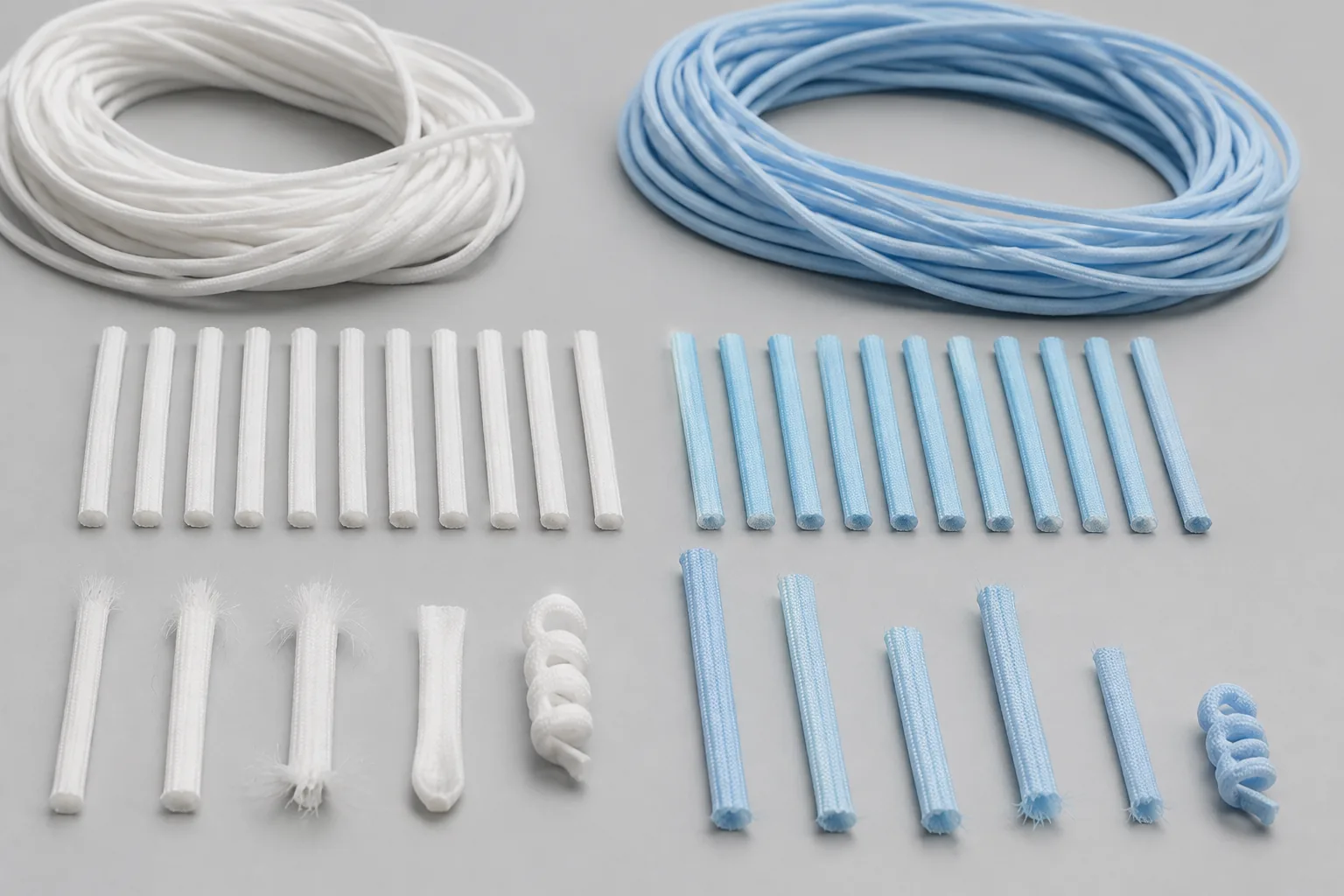
Where This Cutting Application Appears
Cutting individual mask ear loops
Produce paired lengths before welding or attachment while controlling relaxed length.
Cutting covered elastic cord
Separate elastic cores surrounded by textile yarns without leaving long frayed filaments.
Timed cutoff after cord feeding
Synchronize cut position with measured feed when cord stretch changes during acceleration or clamping.
High-Cycle Length Cutting process boundary
high-cycle length cutting for elastic ear-loop cord is planned around separation across the material flow or part axis to establish a controlled repeat length or finished end; it is not longitudinal width conversion, shaped contour production or particle-size reduction.
High-Cycle Length Cutting setup checkpoint
For elastic ear-loop cord, confirm target length, datum or registration reference, feed indexing, support on both sides, cut timing and post-cut transfer.
High-Cycle Length Cutting acceptance checkpoint
For elastic ear-loop cord, evaluate length distribution, squareness or cutoff angle, both cut faces, deformation, registration drift and stacking or discharge consistency.
Define the Required Cut Result
- Consistent relaxed length, not feed length alone
- Complete separation of elastic core and cover yarns
- Low fraying at ends intended for attachment
- Stable high-cycle release without cord wrap or carryover
Problems to Diagnose Before Changing the Knife
Cut pieces relax to different lengths
Check incoming tension, clamp sequence, feed acceleration, dwell before measurement and elastic lot variation.
Cover yarns remain connected
Review edge continuity, cord orientation, backing contact and whether the cord rolls away from the knife.
Cord snaps back out of position
Inspect restraint on both sides of the cut, clamp timing and distance from clamp to cutting line.
Ends flatten or fuse into an unacceptable shape
Compare compression, edge thickness, speed, frictional heating and the attachment method that follows.
Knife Forms That May Be Considered
| Possible knife form | When it may be considered | What must be confirmed |
|---|---|---|
| straight cutoff knife | A straight edge can suit a timed clamp-and-cut station where the cord is restrained close to the cut. | Confirm knife width, bevel, mounting, stroke, backing, clamp sequence and permitted cord tension. |
| serrated cutoff knife | Progressive tooth engagement may help certain covered cords, but it can increase fraying or visible tooth marks. | Confirm tooth profile and direction with actual cord, holder geometry and attachment trials before approval. |
Information to Send for Technical Review
You do not need to know the exact blade name. Send the available workpiece, machine, current-knife and cut-result information so the application can be reviewed against a drawing or sample.
- Cord construction: braided, knitted, covered or monofilament
- Fiber and elastic-core materials
- Cord diameter or width under a stated tension
- Target free length and measurement time after release
- Feed tension, clamp positions and cycle sequence
- Required cut frequency and changes during acceleration
- Holder, knife and backing-surface drawings
- Samples showing fray, incomplete separation, flattening or length variation
Questions About This Cutting Application
Why does cord length differ even when feed travel is constant?
Elastic extension can vary with tension, speed and clamping. Compare feed length with relaxed length after a defined dwell.
Should ear-loop cord be cut under tension?
The machine may require tension for feeding, but the value and release sequence must be documented because they affect final length.
Can serrations prevent incomplete cuts?
They may engage a textile cover progressively, but unsuitable teeth can pull yarns. Test the declared cord construction.
What causes fraying on only one side?
Bevel orientation, cord roll, backing wear or asymmetric restraint can load the two ends differently.
What should a replacement knife RFQ include?
Provide cord samples, free-length criteria, tension and clamp sequence, backing details, current knife and labelled rejected ends.
Related product and service information
- Sanitary Pad Absorbent Core Cutting - sanitary pad absorbent cores · core contour cutting
- Wound Dressing Laminate Die Cutting - wound dressing laminates · laminate die cutting
- Cotton Pad and Cosmetic Round Cutting - cotton pads and cosmetic rounds · stack cutting and shaping
Request a Custom Cutting-Knife Review
Send the workpiece details, machine or holder information, current knife photos or sample, required quantity and examples of the present cut problem. Final dimensions, material, edge geometry and tolerances are confirmed from the approved requirements.