
Blade Application Guides / Application Guide / disposable products converting
Sheeting Nonwoven Wipe Material
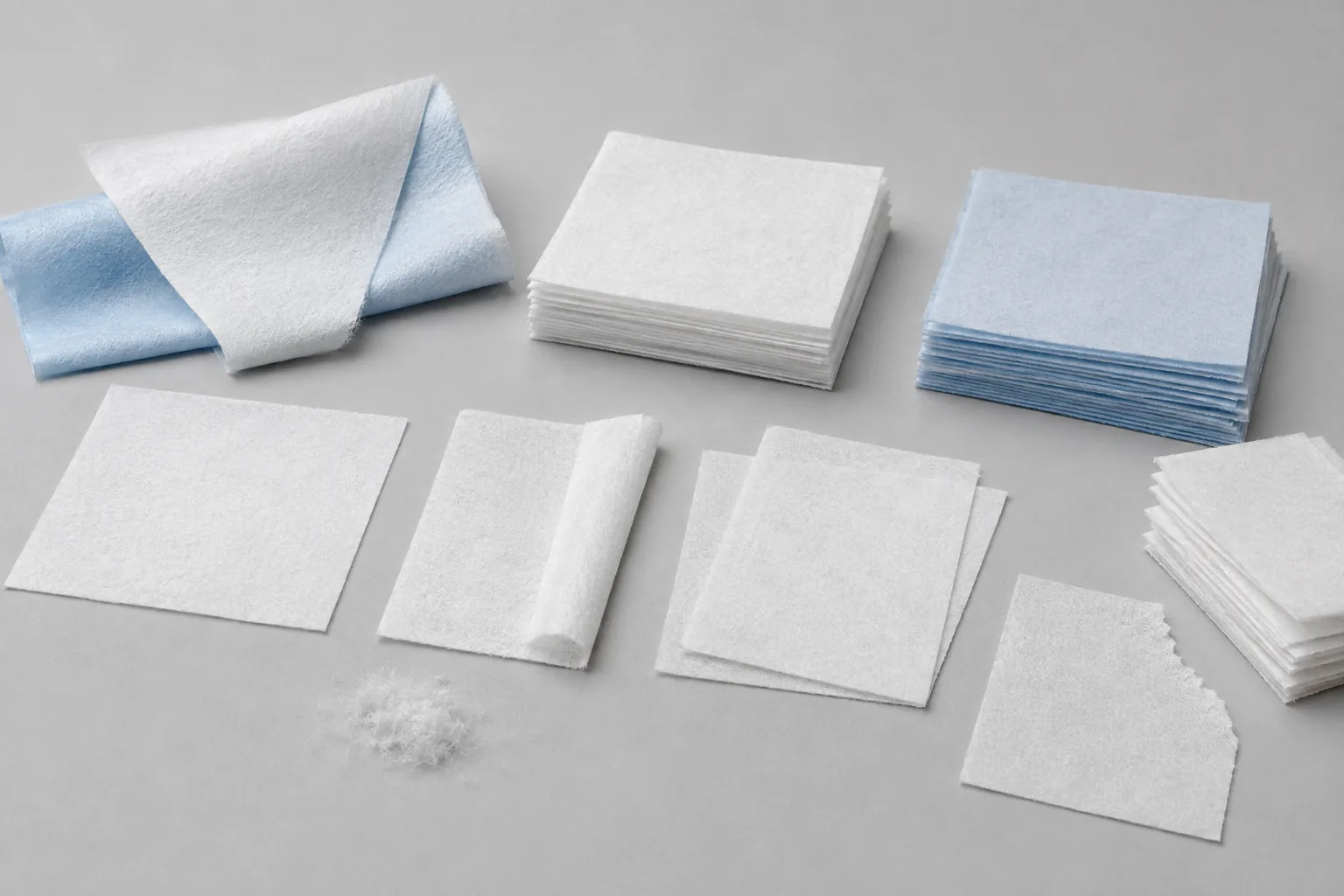
Wipe stock is often cut as a light single web, a wet-laid sheet or a multi-fold stack. The cross-cutter must manage low stiffness, lotion or moisture and changing layer count without pushing the web ahead of the cut.
Updated
Where This Cutting Application Appears
Dry-wipe roll sheeting
Cuts a continuous nonwoven web into individual sheets before stacking or packaging.
Folded wet-wipe cutoff
Separates folded, moistened layers where slip and incomplete bottom-ply cutting are key risks.
Perforation-to-cut format change
Adjusts the cutting cycle for a new sheet length, fold count or dispensing format.
Sheeting And Cross-Cutting process boundary
sheeting and cross-cutting for nonwoven wipe material is a linked sequence: the output condition and datum from each operation become the controlled input for the next. It should not be evaluated as one generic cut or accepted only by the final dimension.
Sheeting And Cross-Cutting setup checkpoint
For nonwoven wipe material, define the operation order, intermediate dimensions, registration transfer, material support, web or part handling and waste route for every stage of sheeting and cross-cutting.
Sheeting And Cross-Cutting acceptance checkpoint
Verify both intermediate and final results from sheeting and cross-cutting, including dimensions, registration, edge or feature quality, material damage, waste separation and stable transfer between stages.
Define the Required Cut Result
- Repeatable sheet length at production speed
- Complete separation of every folded layer
- Low lint and no torn corners
- Stacks that remain registered after cutoff
Problems to Diagnose Before Changing the Knife
Folded web at the cut
- Check air and hold-down near the edge
- Review lotion-related slip
- Inspect timing between folding and cutting
Fiber lint
- Identify web construction and bond
- Inspect edge damage
- Check extraction and deposit points
Uneven sheet length
- Verify feed roll slip
- Check encoder and cutoff timing
- Measure wet and dry material separately
Edge tearing
- Inspect bottom-layer support
- Check blade parallelism
- Compare tear at folds and open spans
Knife Forms That May Be Considered
| Possible knife form | When it may be considered | What must be confirmed |
|---|---|---|
| rotary cross-cutter | Suitable for continuous high-cycle sheeting when surface speed and phase are synchronized with the web. | Confirm dimensions and edge details from the wipe cross-cutter equipment, an unworn sample or an approved drawing before manufacture. |
| straight shear knife | May suit indexed stacks where clamping and a matched bed provide complete full-width separation. | Confirm dimensions and edge details from the wipe sheeter equipment, an unworn sample or an approved drawing before manufacture. |
| serrated knife | May cut bulky folded stacks progressively, provided lint and tooth marks are acceptable. | Confirm dimensions and edge details from the folded-wipe cutter equipment, an unworn sample or an approved drawing before manufacture. |
Information to Send for Technical Review
You do not need to know the exact blade name. Send the available workpiece, machine, current-knife and cut-result information so the application can be reviewed against a drawing or sample.
- Sheeter, folder and feed-unit model
- Fiber blend, basis weight and bonding method
- Dry, lotion-treated or saturated condition
- Open width, fold pattern and layer count
- Sheet length, tolerance and cycle rate
- Clamp, vacuum, backing and extraction
- Defect samples from top and bottom layers
- Knife dimensions, quantity and schedule
Questions About This Cutting Application
Why is only the bottom wipe layer uncut?
Penetration, backing wear or stack compression may prevent full separation at the bottom.
Does lotion change knife selection?
It can change friction, swelling, deposits and layer slip; provide the production formulation or a representative wet sample.
What causes short and long sheets in the same run?
Check feed-roll slip, web stretch, encoder signal and phase between feed and cutter.
Can a rotary cutter process folded stacks?
Only if the machine supports the stack and supplies enough controlled engagement across all layers.
How should lint be documented?
Photograph the edge and collection points, then record web grade, blade hours and extraction condition.
Related product and service information
- Slitting Spunbond Nonwoven Rolls - spunbond nonwoven rolls · longitudinal roll slitting
- Slitting Meltblown Nonwoven Web - meltblown nonwoven web · precision web slitting
- Cutting Needle-Punched Felt - needle-punched felt · sheet and roll cutting
Request a Custom Cutting-Knife Review
Send the workpiece details, machine or holder information, current knife photos or sample, required quantity and examples of the present cut problem. Final dimensions, material, edge geometry and tolerances are confirmed from the approved requirements.