
Blade Application Guides / Application Guide / Label converting
Label Kiss Cutting Without Damaging the Release Liner
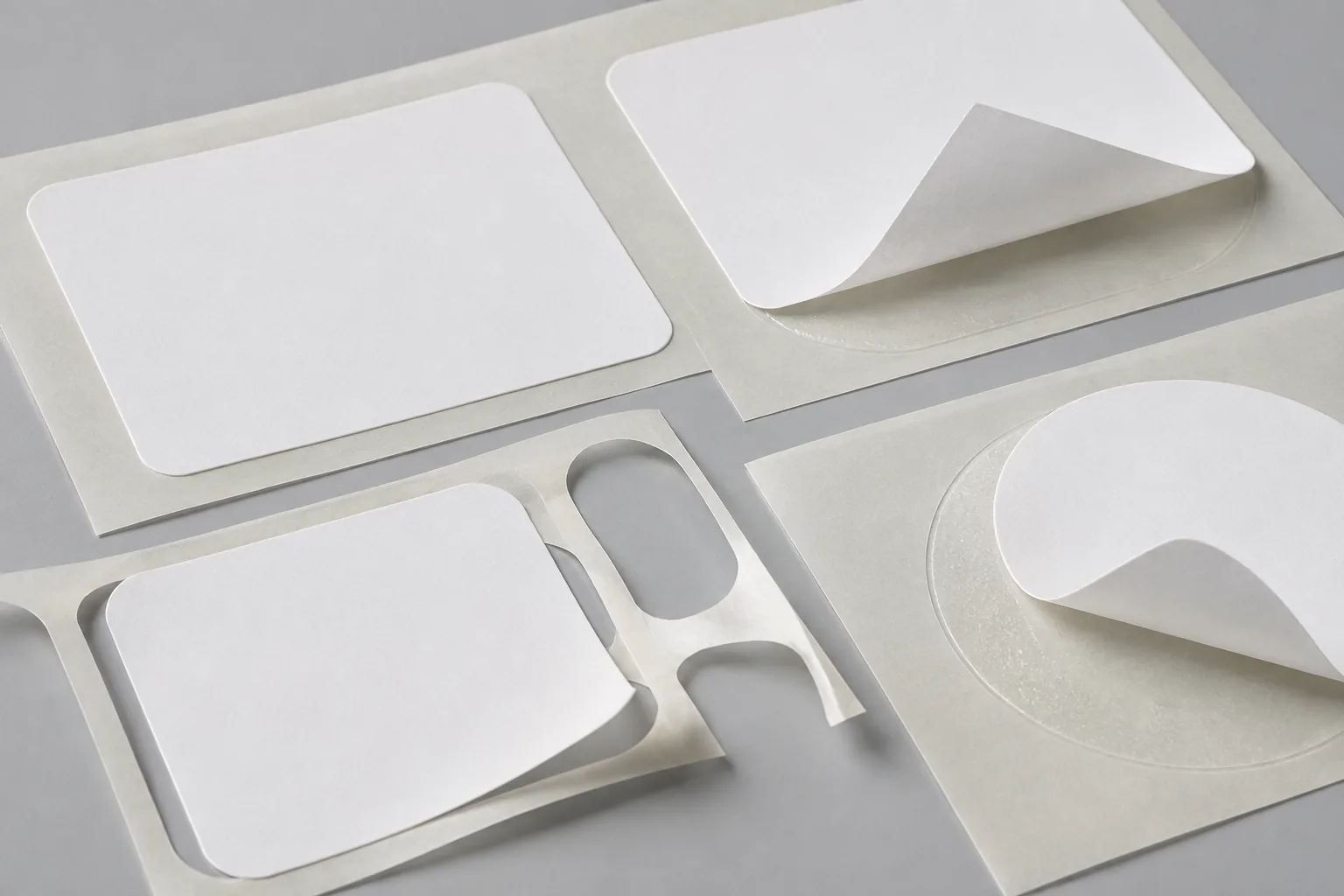
Kiss cutting must separate the label face stock and adhesive while leaving the release liner functional. Small changes in material stack, liner caliper, support, pressure, or web tension can shift the result from incomplete labels to liner penetration.
Updated
Where This Cutting Application Appears
Pressure-sensitive roll-label finishing
Printed label webs are kiss cut into individual shapes while remaining on the liner for dispensing, rewinding, and later application.
Industrial identification label production
Durable film or coated-paper labels are profiled around holes, radii, and tabs without weakening the carrier liner.
Promotional sticker and decal conversion
Nested shapes and small corners are kiss cut before matrix removal, where clean release and visible edge quality are essential.
Kiss Cutting process boundary
Kiss cutting penetrates the face material to a controlled depth while leaving the release liner or carrier substantially intact; it is not full-through die cutting or simple surface scoring.
Kiss Cutting setup checkpoint
Confirm face-layer thickness, liner construction, target residual liner thickness, cutting-depth uniformity, web tension and anvil or support condition across the working width.
Kiss Cutting acceptance checkpoint
Peel representative parts and inspect complete face separation, liner marks or breakthrough, edge lifting, adhesive ooze, registration and release performance.
Define the Required Cut Result
- Separate the full face-stock perimeter without cutting through the liner
- Maintain small corners, radii, and internal features without lifting
- Keep adhesive inside the intended label profile
- Allow the waste matrix to strip continuously while labels remain seated
Problems to Diagnose Before Changing the Knife
Incomplete cut through face stock or adhesive
Map uncut positions against profile geometry, material caliper, coating, pressure distribution, support, wear, and web direction.
Release liner penetration or fracture
Inspect liner caliper and variation, die pressure, support, local high points, splice zones, and whether damage appears after bending or rewind.
Label corners lift during matrix stripping
Review corner radius, matrix direction, stripping angle, speed, adhesive, face-stock stiffness, and the location where lift begins.
Adhesive strings or residue at the profile
Confirm adhesive chemistry, coat weight, temperature, dwell, profile spacing, waste tension, and deposit growth during the run.
Knife Forms That May Be Considered
| Possible knife form | When it may be considered | What must be confirmed |
|---|---|---|
| Profiled kiss-cutting form | Consider for closed label outlines, internal openings, radii, and repeated lanes. | Confirm CAD geometry, face stock, adhesive, liner, support, pressure method, web direction, and approved tooling drawing. |
| Perforating or combination form | Consider where the label construction also requires tear lines or full-cut sections. | Separate kiss-cut, perforation, and through-cut requirements in the drawing and approve each cut depth on production material. |
Information to Send for Technical Review
You do not need to know the exact blade name. Send the available workpiece, machine, current-knife and cut-result information so the application can be reviewed against a drawing or sample.
- Label face-stock material, thickness, coating, and print process
- Adhesive type, coat weight, temperature range, and laminate age
- Release-liner material, caliper, release level, and orientation
- Finished label CAD profile, minimum radii, gaps, and internal features
- Kiss-cut, perforation, and through-cut lines identified separately
- Web direction, speed, tension, support, and matrix-stripping angle
- Accepted samples plus maps of incomplete cuts, liner marks, and lifted labels
- Press interface, pressure or impression method, lane count, and inspection plan
Questions About This Cutting Application
How can liner penetration be checked without removing every label?
Use a defined sampling plan with backlighting, bending, peel inspection, or another agreed method. Inspect high-risk corners, splices, and positions across the web.
Why do small label corners lift during matrix removal?
A sharp corner, stiff face stock, aggressive adhesive, unfavorable stripping direction, or incomplete cut can raise the label. Record the first lift point and stripping geometry.
Should kiss-cut depth be expressed as one fixed dimension?
Material and liner caliper vary, so a nominal depth alone may not describe acceptance. Define the required face-stock separation and allowable liner witness with sample evidence.
What changes when moving from paper labels to film labels?
Film stretch, static, corner recovery, adhesive interaction, and liner pairing can differ. Trial the actual laminate at production direction, speed, and tension.
Can a successful sample guarantee performance on every label lane?
No. Pressure distribution, web variation, lane position, profile density, and support must be checked across the working width before the drawing and acceptance plan are approved.
Related product and service information
- Solid Board Guillotine Cutting for Square Stacks - solid paperboard sheets · guillotine cutting
- Foam Tape Profile Cutting Without Cell Deformation - foam adhesive tape · profile cutting
- Folding Carton Die Cutting and Crease-Area Integrity - folding carton blanks · die cutting
Request a Custom Cutting-Knife Review
Send the workpiece details, machine or holder information, current knife photos or sample, required quantity and examples of the present cut problem. Final dimensions, material, edge geometry and tolerances are confirmed from the approved requirements.