
Blade Application Guides / Application Guide / Foam tape converting
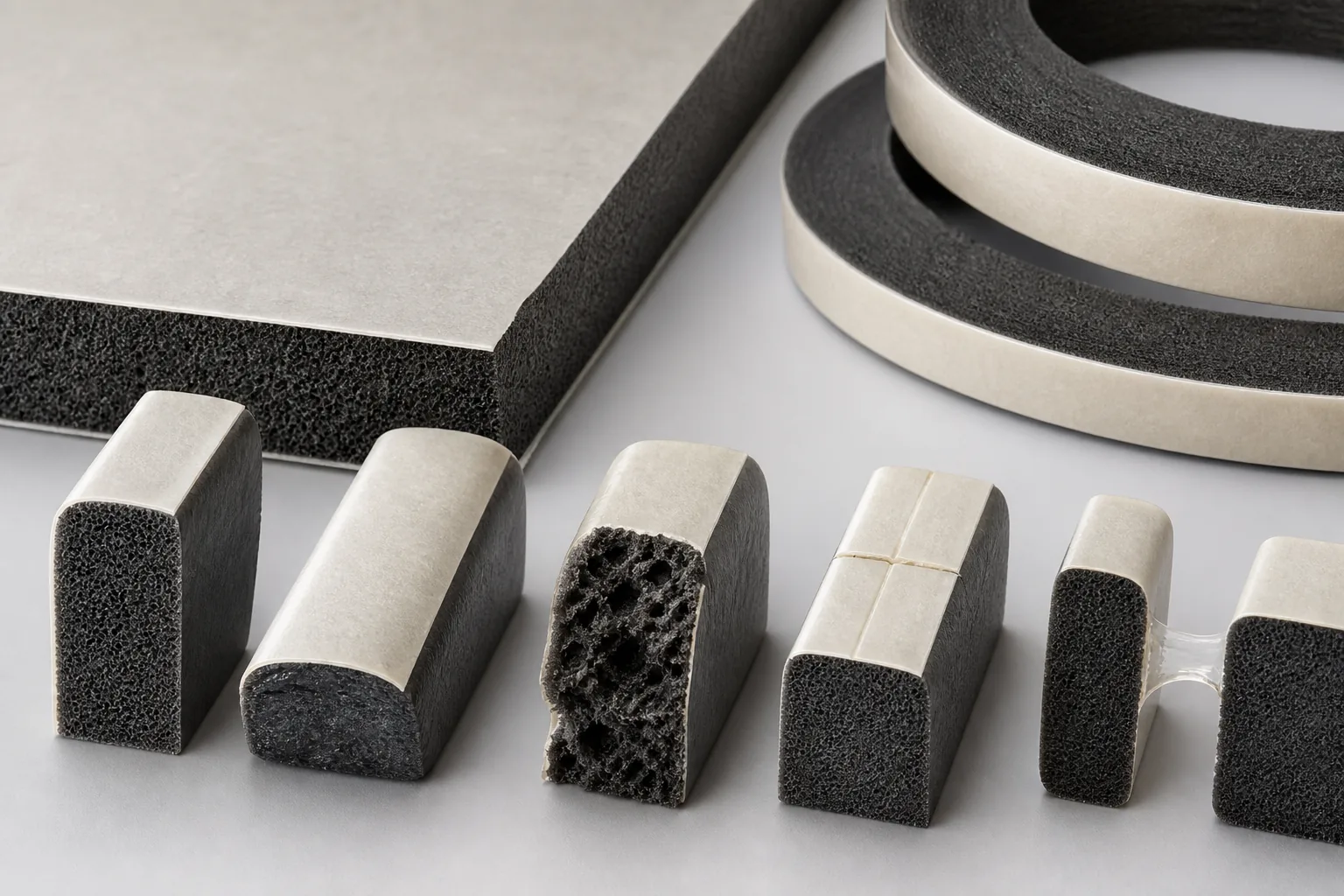
Foam Tape Profile Cutting Without Cell Deformation
Foam tape compresses under cutting pressure and then recovers, so a part can change size or edge shape after it leaves the support. Foam chemistry, density, thickness, adhesive, liner, profile geometry, and dwell all belong in the review.
Updated
Where This Cutting Application Appears
Mounting pad conversion
Double-sided foam tape is profiled into pads for signs, trim, electronics, or assemblies while liners remain usable for placement.
Foam gasket and seal preparation
Closed-cell or open-cell adhesive foam is cut into sealing profiles where edge recovery and internal openings affect contact.
Cushioning spacer production
Thicker foam tape is converted into strips or shaped spacers that must release from the matrix without tearing or permanent compression.
Profile Cutting process boundary
Profile cutting follows the specified finished outline, including shaped or non-rectangular boundaries; it is distinct from straight sizing and narrow edge cleanup.
Profile Cutting setup checkpoint
Review the finished outline, inside and outside radii, start and stop points, material support near corners and the method used to remove shaped waste.
Profile Cutting acceptance checkpoint
Compare the complete profile to the drawing or template, including corners, holes, narrow features, edge condition and fit in the downstream assembly.
Define the Required Cut Result
- Allow the foam edge to recover to the approved profile
- Keep release liners intact until part application
- Prevent adhesive smear from closing small openings
- Release pads, gaskets, and spacers without tearing the cell structure
Problems to Diagnose Before Changing the Knife
Compressed edge remains undersize after cutting
Compare foam type, density, thickness, compression force, dwell, support, recovery time, and when the dimension is measured.
Open cells tear or drag along the profile
Review cell size, skin layer, cutting direction, support, profile radius, feed motion, and whether tearing begins on entry or exit.
Release liner is scored or cut through
Inspect liner material and caliper, impression variation, local high points, foam compression, splice zones, and the agreed witness limit.
Adhesive bridges small holes or corners
Check adhesive coat, temperature, profile spacing, ejection, matrix direction, dwell, and residue growth during the run.
Knife Forms That May Be Considered
| Possible knife form | When it may be considered | What must be confirmed |
|---|---|---|
| Profiled kiss-cutting form | Consider when foam parts must remain on one release liner after the profile is cut. | Confirm foam compression, liner witness criteria, CAD profile, support, pressure method, and approved tooling drawing. |
| Through-cut profile form | Consider when individual foam parts and all liner layers must be separated completely. | Confirm total stack, ejection, minimum radii, waste gaps, backing support, and final part acceptance samples. |
Information to Send for Technical Review
You do not need to know the exact blade name. Send the available workpiece, machine, current-knife and cut-result information so the application can be reviewed against a drawing or sample.
- Foam polymer, open- or closed-cell structure, density, and skin
- Foam thickness range and compression-recovery data if available
- Single- or double-sided adhesive, coat, carrier, and laminate age
- Release-liner material, caliper, release level, and which liner remains
- Finished CAD profile, internal openings, radii, gaps, and tolerances
- Kiss-cut or through-cut requirement plus acceptable liner witness
- Support, pressure or impression method, dwell, speed, and ejection
- Conditioning time before measurement, accepted samples, and matrix behavior
Questions About This Cutting Application
When should a foam-tape part be measured after cutting?
Measure at an agreed interval after pressure is removed because recovery may continue. Record immediate and conditioned dimensions for the actual foam grade.
Why can an internal hole close after the profile looks separated?
Compressed cells and mobile adhesive may recover or bridge inward after release. Hole size, foam density, dwell, ejection, and conditioning should be compared.
How is a kiss cut distinguished from a through cut on foam tape?
Define which liner or carrier must remain continuous and the allowable witness on it. Cross-section samples and peel checks are clearer than a nominal depth alone.
Do open-cell and closed-cell foams require separate reviews?
Yes. Cell size, tear behavior, compression recovery, skin, and adhesive support differ. Use representative laminates for each construction.
Can a CAD profile alone confirm a foam cutting setup?
No. Material stack, compression, liner, support, ejection, equipment interface, and conditioned dimensions must also be approved.
Related product and service information
- Folding Carton Die Cutting and Crease-Area Integrity - folding carton blanks · die cutting
- Label Kiss Cutting Without Damaging the Release Liner - self-adhesive labels · kiss cutting
- Industrial Filter Paper Cutting Without Fiber Pullout - industrial filter paper · profile cutting
Request a Custom Cutting-Knife Review
Send the workpiece details, machine or holder information, current knife photos or sample, required quantity and examples of the present cut problem. Final dimensions, material, edge geometry and tolerances are confirmed from the approved requirements.